TL;DR:
- Writing a UK-legal will online takes about 15 minutes for data entry, provided thorough preparation beforehand. The process requires signing the document in ink in front of two independent witnesses to ensure legality. Proper preparation, clear asset descriptions, and correct signing procedures are essential to create a valid and enforceable will.
You can write a legally valid will in 15 minutes using a guided online platform built for UK law. The process covers three core tasks: entering your personal details, naming your beneficiaries, and appointing an executor. Under the Wills Act 1837, section 9, the document then requires a physical signature from you in the presence of two independent adult witnesses who sign simultaneously. Platforms like Clearlegacy combine AI-assisted document preparation with review by qualified estate planners, meaning the drafting itself is genuinely quick. The 15 minutes refers to the data entry stage. Preparation and signing are separate steps, and both matter just as much.
What preparation do you need before writing a will in 15 minutes?
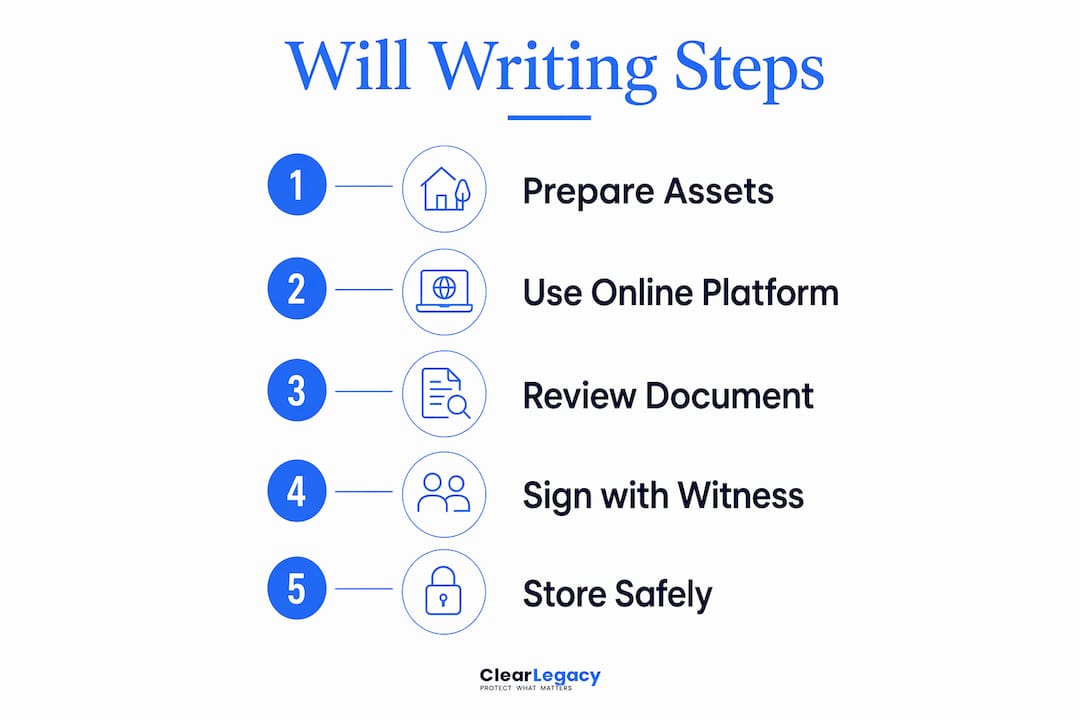
The 15-minute drafting window covers data entry only. Users should expect 30–60 minutes of preparatory work before sitting down at the platform. That preparation is what makes the drafting session fast, accurate, and complete in one go.
Gather the following before you start:
- Full legal names and addresses of every beneficiary you intend to name. A nickname or partial address creates ambiguity that can complicate probate.
- Full legal name and address of your chosen executor. This is the person who will administer your estate after you die. Choose someone organised, trustworthy, and willing to take on the role.
- A clear list of your assets. Include property (and whether you hold it as joint tenants or tenants in common), bank accounts, investments, pension details, vehicles, and digital assets such as cryptocurrency or online accounts with monetary value.
- Arrangements for dependents. If you have children under 18, you need to name a guardian. This is one of the most important decisions in the entire document, so think it through before you open the platform.
- Contingency beneficiaries. Decide what happens to a gift if a beneficiary dies before you do. Without a contingency, that gift may fall into your residuary estate or cause a partial intestacy.
Clarity at this stage prevents delays during drafting. A vague asset description such as "my savings" is far less useful to an executor than "my Barclays current account, sort code 20-00-00, account number 12345678."
Pro Tip: Write your asset list on paper first. Cross off each item as you enter it into the platform. This simple check prevents omissions and keeps the session moving at pace.
How do online will writing platforms work step by step?
Structured digital platforms guide users through every required clause in plain English, which prevents the most common omissions, including missing residuary clauses. A residuary clause is the part of the will that catches everything not specifically gifted elsewhere. Without one, anything not explicitly named passes under the intestacy rules of the Administration of Estates Act 1925, which may not reflect your wishes at all.
Here is how a typical session on a platform like Clearlegacy unfolds:
- Personal details. You enter your full legal name, date of birth, and address. The platform uses this to identify you as the testator, the legal term for the person making the will.
- Executor appointment. You name your executor and provide their contact details. You can name a substitute executor in case your first choice is unable or unwilling to act.
- Beneficiary details. You name each beneficiary and specify what they receive. Specific gifts (a named item or sum) come first, followed by the residuary estate, which is everything left over after debts, taxes, and specific gifts are settled.
- Guardian appointment. If you have children under 18, you name a guardian here.
- Review and confirm. The platform presents a summary of your will before generating the document. Read this carefully. Errors are far easier to correct at this stage than after signing.
- Document generation. The platform produces a formatted will document, typically as a PDF, ready for printing and signing.
Clearlegacy adds a further layer: every document is reviewed by a qualified estate planner before delivery, which arrives by email within 24 hours. That review catches errors a purely automated system might miss.
Pro Tip: Do not rush the review screen. Spend two minutes reading the summary in full before confirming. A mistyped name or wrong percentage split is invisible in the data entry fields but obvious when you read the finished document.
What are the legal steps to finalise a valid UK will?
Generating a document online does not, by itself, create a legally binding will. The physical signing ceremony is mandatory. Digital signatures are not sufficient under UK law for wills. The document must be printed and signed in ink.
Under section 9 of the Wills Act 1837, the following formalities apply:
- You must sign the will yourself, or direct someone to sign it in your presence if you are physically unable to do so.
- Two independent adult witnesses must be present simultaneously when you sign. They then sign the will themselves, in your presence and in each other's presence.
- Witnesses must be independent. Witnesses who are beneficiaries risk losing their gift entirely. The will itself remains valid, but the gift to that witness is revoked. Using a beneficiary's spouse or civil partner as a witness carries the same risk.
- No witness should be under 18, and no witness should be someone who lacks mental capacity to understand what they are signing.
"A will must be signed by the testator in the presence of two independent witnesses who sign it simultaneously to be valid under UK law. Improper witnessing invalidates the will." — Age UK
Good choices for witnesses include a neighbour, a colleague, or a friend who is not named anywhere in the will. Once signed correctly, store the original signed will in a secure but accessible location and tell your executor exactly where it is. A will that cannot be found is almost as problematic as no will at all.
For a detailed walkthrough of the signing process, the Clearlegacy guide on signing a will correctly covers every formality in plain English.
What mistakes should you avoid when writing a will quickly?
Speed is an advantage of online will writing, but it creates specific risks if you let pace override care. The most common errors are avoidable with a short checklist.
- Naming a beneficiary as a witness. This is the single most frequent mistake in DIY will writing. The will remains valid, but that person loses their gift. Use two people who receive nothing under the will.
- Skipping the residuary clause. Every will needs one. If you leave specific gifts but forget the residuary clause, anything not explicitly named passes under intestacy rules. The platform should prompt you, but confirm it is present in the review screen.
- Vague asset descriptions. "My car" is insufficient if you own two vehicles. "My blue 2022 Volkswagen Golf, registration AB22 XYZ" leaves no room for dispute.
- Forgetting contingency beneficiaries. If a beneficiary dies before you and there is no contingency named, that gift may lapse. Name a substitute for each significant gift.
- Starting without preparation. Stopping mid-session to look up account numbers or beneficiary addresses breaks your focus and increases the chance of errors. Complete your asset list before you open the platform.
For complex estates, including blended families, business interests, or significant inheritance tax considerations above the £325,000 nil-rate band, professional oversight from a solicitor or qualified estate planner is the prudent choice. Online platforms suit straightforward estates well. They are not a substitute for specialist advice when the circumstances require it.
Pro Tip: After signing, make a note of your will's location and give a copy of that note to your executor. Probate registries and solicitors regularly encounter estates where the original will cannot be found, which causes significant delays and distress for families.
Key takeaways
Writing a legally valid will quickly is achievable for most UK adults, provided the drafting session is preceded by thorough preparation and followed by a correctly executed signing ceremony.
| Point | Details |
|---|---|
| Preparation is non-negotiable | Gather beneficiary names, asset lists, and executor details before starting the platform. |
| The 15 minutes covers drafting only | Allow 30–60 minutes for preparation and additional time for the signing ceremony. |
| Physical signing is mandatory | Print the document and sign it in ink with two independent adult witnesses present simultaneously. |
| Witnesses must not be beneficiaries | A beneficiary who witnesses the will loses their gift, even though the will itself remains valid. |
| Store the original securely | Tell your executor where the signed original is kept to prevent probate delays. |
Why i think the 15-minute will is one of the most underrated tools in UK estate planning
The most common reason people die without a will is not ignorance. It is procrastination. People know they should have one. They intend to get around to it. Then life intervenes, and the conversation never happens. The 15-minute online will does not solve every estate planning problem, but it solves the most important one: it gets something legally valid in place today rather than theoretically in place at some unspecified point in the future.
What I find genuinely underappreciated is how much the online format reduces the emotional friction of the process. Sitting across from a solicitor and discussing your own death is uncomfortable for many people. Completing a guided form at home, at your own pace, removes that barrier entirely. The primary benefit is not speed for its own sake. It is that any valid will is vastly preferable to dying intestate, where the Administration of Estates Act 1925 distributes your estate according to rules that may bear no resemblance to your actual wishes.
That said, I would caution against treating the 15-minute figure as a complete picture. The drafting is quick. The preparation and the signing ceremony are not included in that number. And for anyone with a blended family, a business, or an estate that approaches or exceeds the inheritance tax threshold, the online process is a starting point, not a finishing line. Use it to get a valid will in place, then revisit with professional support as your circumstances change.
The misconception I encounter most often is the belief that an online will is somehow less legally valid than one drafted by a solicitor. It is not. Validity under the Wills Act 1837 depends entirely on the signing formalities, not on who drafted the document. A correctly signed online will carries exactly the same legal weight as one produced by a high street firm.
— Sat
Start your will today with Clearlegacy
Clearlegacy offers a UK-tailored online will writing service built specifically for individuals and families who want a legally valid document without the cost or delay of a traditional solicitor appointment. Prices start at £69, with no hidden fees and a fixed price from the outset.

Every will is reviewed by a qualified estate planner before delivery, and you receive your completed document by email within 24 hours. Clear signing instructions are included so the witnessing ceremony is straightforward. Over 100 UK families have already used Clearlegacy to protect their estates. If you are ready to write a will online and get it done today, Clearlegacy is built for exactly that.
FAQ
Can i legally write a will myself in the UK?
Yes. A will you draft yourself is legally valid in England and Wales provided it is signed by you in the presence of two independent adult witnesses who also sign it, as required by section 9 of the Wills Act 1837.
Does an online will have the same legal standing as a solicitor-drafted will?
Yes. Legal validity depends on the signing formalities, not on who drafted the document. An online-generated will signed and witnessed correctly carries the same legal weight as one prepared by a solicitor.
Can my spouse or partner witness my will?
No. A witness who is also a beneficiary, or the spouse or civil partner of a beneficiary, risks losing their gift under the will. Choose two independent adults who receive nothing under the document.
What happens if i die without a will in the UK?
Your estate is distributed under the intestacy rules set out in the Administration of Estates Act 1925. Unmarried partners receive nothing under these rules regardless of the length of the relationship, since common law marriage does not exist in UK law.
How do i know my online will is complete and legally sound?
Use a platform that includes a review stage before document generation and offers oversight by a qualified estate planner. Clearlegacy reviews every will before delivery, which provides a practical check against common omissions such as missing residuary clauses.