TL;DR:
- Writing a valid online will in the UK requires signing and witnessing the document correctly under the Wills Act 1837. Online services provide guided templates, but the original must be printed, signed, and stored securely by the individual. Proper execution and storage are crucial to ensure the will's legality and effectiveness.
You can write a legally valid will online by completing a guided questionnaire, generating a compliant document, then printing, signing, and witnessing it correctly under the Wills Act 1837. The medium of preparation does not affect validity. An online will is fully legal in the UK provided it meets the same formalities as a solicitor-drafted document. Services such as Clearlegacy make this process accessible from £69, with documents ready within 24 hours. For most straightforward estates, you do not need a solicitor at all.
What are the legal requirements for a valid will in the UK?
A legally valid will in the UK must satisfy the formalities set out in section 9 of the Wills Act 1837. These rules apply whether your will is drafted by a solicitor, written by hand, or produced through an online will drafting service. The signing and witnessing rules are non-negotiable.
The core requirements are:
- Written document. The will must be in writing. A typed, printed document satisfies this.
- Signed by the testator. You must sign the will yourself, or direct someone to sign it in your presence if you are physically unable to do so.
- Two independent witnesses. You must sign in the presence of two independent witnesses, who must both be present at the same time.
- Witnesses sign in your presence. Both witnesses must then sign the will while you watch.
- Mental capacity. You must be of sound mind, understanding what a will is, what you own, and who your natural beneficiaries are.
- Voluntary intent. The will must be made freely, without pressure or coercion from anyone.
One rule catches many people out: a beneficiary named in your will must not act as a witness. If they do, the gift to that person fails, even though the rest of the will remains valid. The same applies to the spouse or civil partner of a beneficiary.
Pro Tip: A common misconception is that online wills are automatically stored or registered by the service. In reality, you must print, sign, and store the original yourself. The online platform produces the document. Execution is entirely your responsibility.

Complex estates involving blended families, foreign assets, business interests, or likely legal challenges under the Inheritance (Provision for Family and Dependants) Act 1975 warrant professional solicitor advice. For most single or married adults with a straightforward estate, an online service is entirely appropriate.
How do online will-writing services work?
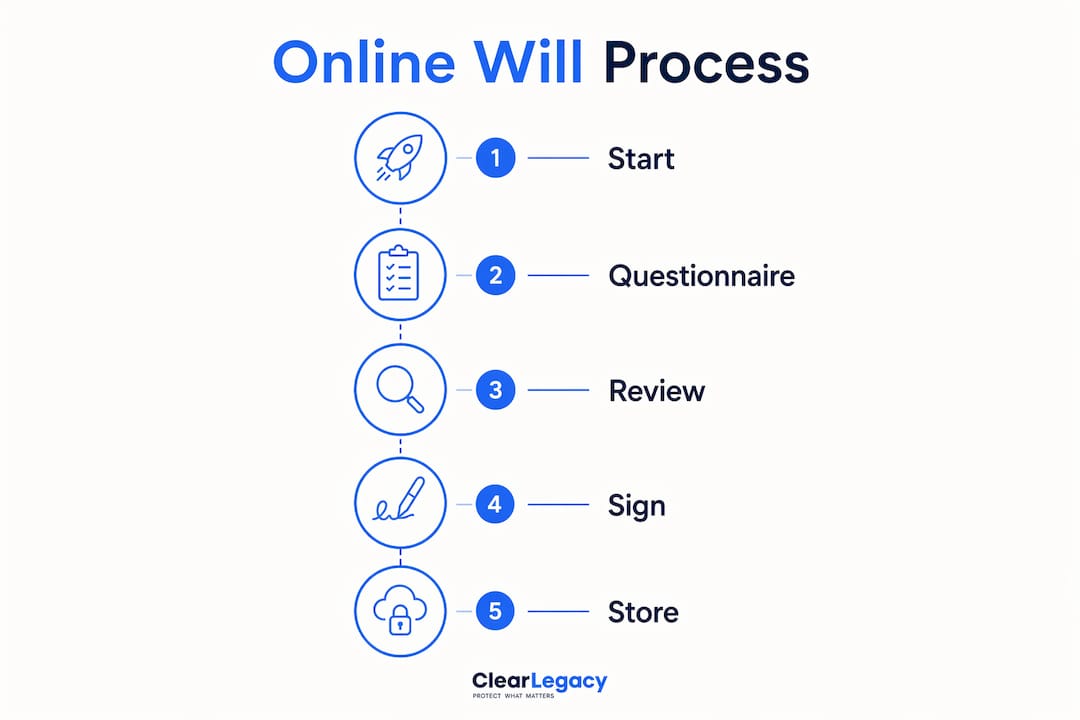
Online will services provide guided templates and step-by-step questionnaires that tailor documents to your jurisdiction and personal situation. You answer questions about your assets, beneficiaries, executors, and any specific wishes. The platform then generates a legally binding will template for you to review, print, and execute.
Before you start, gather the following:
- Full legal names and addresses of all beneficiaries
- Full legal name and address of your chosen executor (and a substitute executor)
- A clear picture of your assets: property, savings, investments, personal possessions
- Details of any specific gifts you wish to leave
- Names of guardians if you have children under 18
Pricing for UK online will services typically ranges from £50 for a basic document to £200 for packages that include additional estate planning documents. Clearlegacy charges a fixed price from £69, with no hidden fees, and includes review by a qualified estate planner.
| Feature | Basic online template | Reviewed online service (e.g. Clearlegacy) | Solicitor |
|---|---|---|---|
| Price range | Free to £30 | £69 to £200 | £300 to £700+ |
| Solicitor or specialist review | No | Yes | Yes |
| Turnaround time | Immediate | Within 24 hours | Days to weeks |
| Guided questionnaire | Sometimes | Yes | Yes |
| Suitable for complex estates | No | Straightforward to moderate | Yes |
| Document storage | User only | User only | Often offered |
Pro Tip: Free will creation tools and basic templates carry a higher risk of errors because they offer no review. A reviewed online service strikes a balance between full solicitor drafting and a DIY document, improving both compliance and your confidence in the result.
Step-by-step guide to writing and executing your will online
The key risk in online wills is not the drafting. It is improper execution. A perfectly written will becomes worthless if it is signed incorrectly. Follow these steps precisely.
-
Gather your information. Collect full names, addresses, and relationships of all beneficiaries and your executor. List your assets and their approximate values. Decide on guardians for any minor children.
-
Complete the online questionnaire carefully. Read each question before answering. Do not rush. Errors at this stage create ambiguity in the final document, which can cause disputes during probate.
-
Review the generated document thoroughly. Check every name, every gift, and every clause. Confirm your residuary clause (the part that deals with everything not specifically mentioned) covers your intentions. If anything is unclear, contact the service before printing.
-
Print the will. Print every page. Do not alter the document after printing. Any handwritten changes made after signing can invalidate the affected clause or the entire will.
-
Sign in the presence of two independent witnesses. All three of you must be in the same room at the same time. You sign first. Both witnesses then sign immediately after, while you are still present. Neither witness may be a beneficiary or married to a beneficiary.
-
Consider a self-proving affidavit. This is an affidavit signed by you and your witnesses before a notary, confirming the signing was valid. It is not mandatory in England and Wales, but it simplifies probate by removing the need for witness testimony years later.
-
Store the will safely and inform your executor. Place the original in a fireproof safe, a solicitor's strongroom, or with a professional will storage service. Tell your executor exactly where it is.
Pro Tip: Date the will clearly on the day of signing. If you have an earlier will, include a revocation clause in the new one. Clearlegacy's documents include this as standard, but always verify it is present before you sign.
Common mistakes that can invalidate your online will
Incorrect signing or absent witnesses are the most frequent reasons a will fails at probate. These errors are more common with DIY documents but can occur with any online template if the execution steps are ignored. Knowing what to avoid is as important as knowing what to do.
Watch out for these errors:
- Witnesses who are also beneficiaries. The gift to that person fails automatically. Choose neighbours, colleagues, or friends with no financial interest in your estate.
- Signing without both witnesses present simultaneously. Each witness must see you sign. Signing separately, even on the same day, is not valid.
- Failing to print and physically sign the document. An unsigned digital file has no legal standing whatsoever.
- Not storing the original securely. If the original cannot be located after your death, the court may presume you destroyed it intentionally. A copy alone is rarely sufficient.
- Not telling your executor where the will is kept. Executors need to locate the original to apply for probate. If they cannot find it, the estate is administered as if no will exists.
- Failing to update after major life changes. Marriage revokes a previous will in England and Wales. Divorce does not revoke the will but removes gifts to the former spouse. The birth of a child, a house purchase, or a significant inheritance all warrant a review.
"A will only becomes legally valid when signed and witnessed correctly. The drafting is the easy part. Execution is where most people go wrong."
Pro Tip: Review your will every three to five years, or immediately after any major life event. Many online services, including Clearlegacy, make updating straightforward because your original answers are already on record.
What to do after creating your will online
Safe storage is not optional. Many online platforms do not file or store wills. The physical document must be signed, printed, and stored by you. Failure to locate the original after death can invalidate the will entirely.
Recommended storage options:
- A fireproof, waterproof safe at home
- A solicitor's strongroom (a small annual fee usually applies)
- A professional will storage service
- The National Will Register (optional in the UK, but useful for helping executors locate the document)
Inform your executor of the exact location in writing. Do not rely on them remembering a verbal conversation. Leave a letter with your personal papers confirming where the will is held and who to contact.
Digital assets require specific attention. Cryptocurrency, online accounts, and digital businesses do not pass automatically under a standard residuary clause without proper access information. Consider a separate letter of wishes alongside your will to address these. Clearlegacy's guidance on digital assets after death covers this in detail.
Update your will after marriage, divorce, the birth of a child, a significant change in assets, or the death of a named beneficiary or executor. Most online services allow you to create a new will quickly. Always revoke the previous version explicitly in the new document.
Key takeaways
Writing a legally valid will online requires correct execution under the Wills Act 1837, not just a well-drafted document.
| Point | Details |
|---|---|
| Legal validity depends on execution | A will is only valid when signed by the testator in front of two independent witnesses who also sign. |
| Online wills are fully legal in the UK | The method of preparation does not affect validity, provided all formalities are met. |
| Never use a beneficiary as a witness | Any gift to a witness or their spouse automatically fails, even if the rest of the will stands. |
| You must store the original yourself | Online services do not file or register your will; you must print, sign, and store it securely. |
| Update after every major life event | Marriage revokes a will in England and Wales; review after divorce, births, or significant asset changes. |
Why I think most people wait too long to write their will
Most adults in the UK know they should have a will. Very few have one. The reason is not cost or complexity. It is the assumption that it can wait until things are more settled, until the house is paid off, until the children are older. That moment rarely arrives on its own.
What I have seen, working in this space, is that the people who benefit most from online will writing are not the wealthy or the elderly. They are people in their thirties and forties with a mortgage, a partner, and children who have simply not got round to it yet. For them, a straightforward online service is not a compromise. It is the right tool for the job.
The limitation is real, though. If your estate involves a business, foreign property, a blended family with competing claims, or any likelihood of a challenge under the Inheritance (Provision for Family and Dependants) Act 1975, an online template is not enough. Spend the money on a solicitor. The cost of getting it wrong is far higher.
For everyone else, the barrier is now genuinely low. A reviewed online service from a reputable provider costs less than a family dinner out and takes about 15 minutes. The only thing stopping most people is inertia. Write the will. Store it properly. Tell your executor where it is. That is the whole job.
— Sat
Start your will with Clearlegacy today

Clearlegacy offers a fast online will service with a fixed price from £69 and no hidden fees. You complete a guided questionnaire in around 15 minutes. A qualified estate planner reviews the document, and you receive your completed will by email within 24 hours. Every will is drafted in compliance with the Wills Act 1837, covering England and Wales. Over 100 UK families have already used Clearlegacy to protect their estates. If you want a 24-hour turnaround with specialist review and fixed pricing, Clearlegacy is the place to start.
FAQ
Is an online will legally valid in the UK?
Yes. An online will is fully valid in the UK provided it is signed by the testator in the presence of two independent witnesses, who also sign in the testator's presence, in compliance with section 9 of the Wills Act 1837.
Can a beneficiary witness my will?
No. A beneficiary must not act as a witness. If they do, the gift to that person fails automatically, though the rest of the will remains valid.
Do I need a solicitor to write a will online?
Not for a straightforward estate. Online will drafting services are suitable for most adults with standard assets and family arrangements. Solicitor advice is recommended for complex estates involving blended families, foreign assets, or business interests.
How do I store my will after creating it online?
Store the original signed document in a fireproof safe, with a solicitor, or through a professional will storage service. Tell your executor the exact location. Online platforms do not store or register your will on your behalf.
How much does it cost to write a will online in the UK?
Prices range from free for basic templates to around £200 for reviewed packages. Clearlegacy charges from £69 for a fixed-price, solicitor-reviewed will with a 24-hour turnaround.