TL;DR:
- Online wills are cheaper because they replace costly solicitor consultations with automated templates and fixed prices. They carry the same legal validity under the Wills Act 1837 for straightforward estates, offering significant savings of up to 80 percent compared to solicitor drafts.
Online wills cost less because they replace expensive solicitor consultations with automated document platforms, standardised legal templates, and fixed pricing. Where a solicitor-drafted will in England and Wales typically costs £375–£800, an online will costs as little as £69–£249. That gap exists because the drafting process is commoditised. The document itself carries the same legal weight under the Wills Act 1837 whether a solicitor typed it or a platform generated it. For most families with straightforward estates, understanding why online wills cost less is the first step toward protecting your legacy without overpaying.
Why online wills cost less: the key factors
The true cost difference between online and solicitor-drafted wills lies in legal labour. Solicitors charge for their consulting time, office overheads, and bespoke advice. Online platforms remove most of those costs entirely. The drafting process is commoditised, meaning the document production itself carries no premium value. What you pay for with a solicitor is largely the conversation, not the paperwork.
Here is a breakdown of the specific factors that reduce the cost of online wills:
- No face-to-face appointments. Solicitors charge for every hour of your time in their office. Online platforms ask you to complete a guided questionnaire at home, at no hourly rate.
- Standardised legal templates. Platforms use pre-approved legal frameworks that meet the requirements of the Wills Act 1837. There is no bespoke drafting from scratch, which cuts preparation time dramatically.
- Automated document production. AI-driven tools generate the will document from your answers. Clearlegacy, for example, uses automation reviewed by qualified estate planners to produce legally compliant wills in around 15 minutes.
- Lower overheads. Online services carry no high-street office costs, no receptionist, and no filing rooms. Those savings pass directly to you.
- Fixed pricing, not hourly billing. Solicitors often bill by the hour, meaning a complicated conversation adds to your invoice. Online platforms charge a flat fee. You know the total cost before you begin.
Pro Tip: Before choosing any online will service, confirm whether the price shown is the total price. Some platforms charge separately for edits, storage, or document downloads. A genuinely flat-fee service shows you the full cost upfront.
Online will services take about 20 minutes to complete. That speed is not a shortcut. It reflects how efficiently a well-designed platform can guide you through the same legal questions a solicitor would ask, without the scheduling delays or hourly charges.

How do online wills compare to solicitor wills on cost?
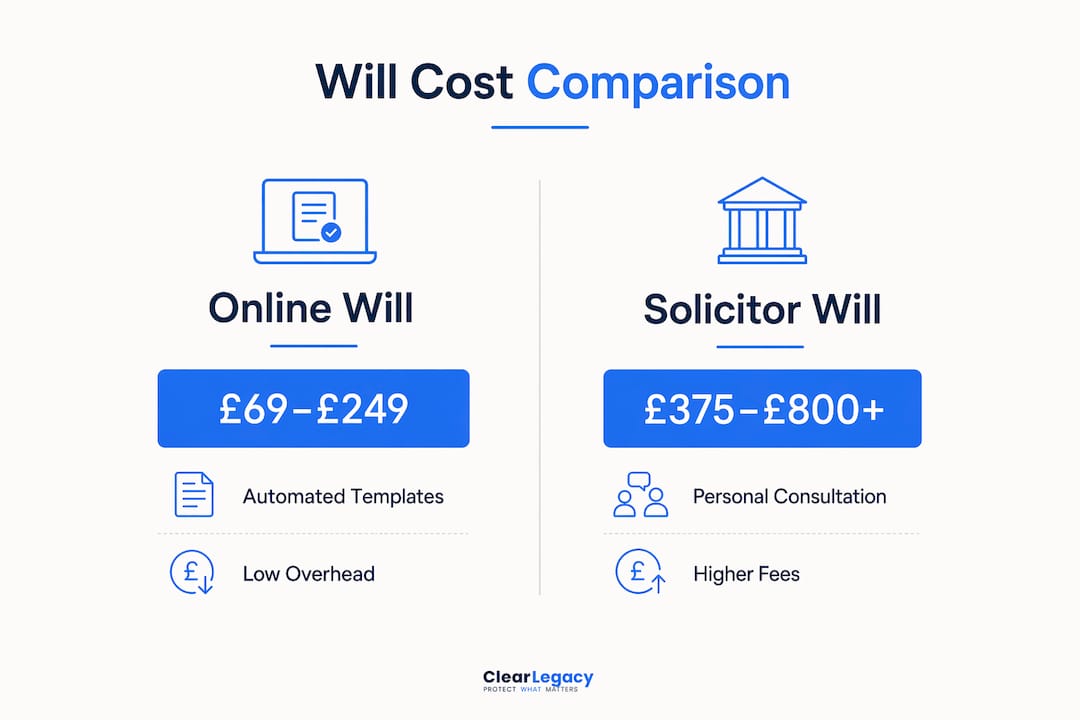
The cost of online wills sits firmly below solicitor fees for the vast majority of straightforward estates. The table below shows a direct comparison for 2026.
| Factor | Online Will | Solicitor-Drafted Will |
|---|---|---|
| Typical price range | £69–£249 | £375–£800+ |
| Complex estate cost | £150–£350 | £1,500–£5,000+ |
| Time to complete | 15–30 minutes | Days to weeks |
| Fixed pricing | Yes | Rarely |
| Legal validity | Yes (Wills Act 1837) | Yes (Wills Act 1837) |
| Bespoke legal advice | Limited | Full |
| Document delivery | Email within 24 hours | Post or collection |
Simple online wills save families 50–80% compared to solicitor-drafted equivalents. That saving is not trivial. For a couple each writing a will, the difference between paying £138 online versus £750 with a solicitor is over £600 in your pocket.
The comparison shifts for complex estates. If your estate involves business assets, trusts, foreign property, or significant inheritance tax planning under the Inheritance Tax Act 1984, a solicitor's expertise justifies the higher fee. The £325,000 nil-rate band and the £175,000 residence nil-rate band involve planning decisions that go beyond what any template can handle. For everyone else, the affordability of digital wills is a genuine advantage, not a compromise.
Pro Tip: If you and your partner both need wills, look for services offering a mirror will option. Two wills written together typically cost less than two separate documents, and they ensure your wishes align.
The probate process is another cost consideration that rarely gets mentioned. Probate fees can represent 3–8% of an estate's value, causing delays of 18–24 months. A clear, valid will reduces the risk of disputes and complications that push probate costs higher. The small upfront cost of an online will is modest compared to the potential cost of dying without one.
What are the risks of choosing an online will based on price alone?
Affordability is a genuine benefit of online wills, but price alone is a poor selection criterion. Several risks are worth understanding before you commit.
- Limited personalised legal advice. Online wills are legally equivalent to solicitor-drafted wills in terms of document validity, but they do not replicate the strategic advice a solicitor provides. If your estate involves a residuary clause with multiple conditions, or you have dependants with complex needs under the Inheritance (Provision for Family and Dependants) Act 1975, a template may not capture your intentions accurately.
- Hidden fees on some platforms. Some online platforms charge extra for ongoing access, edits, or notarisation. Most users focus on the headline price and overlook these charges. Your total lifetime cost on a subscription-based platform can exceed the base price significantly.
- DIY will kits carry greater risk. DIY kits are usually less flexible and harder to customise than proper online services. They lack guided legal frameworks and offer no review process. They are the cheapest option, but they carry the highest risk of errors that could invalidate the document.
- Execution errors invalidate wills. The Wills Act 1837, section 9, requires a will to be signed by the testator in the presence of two independent witnesses who also sign. No online platform can supervise this step. An error here renders the will void, regardless of how well the document was drafted.
- Complex estates need solicitor input. For complex estates or tax planning, solicitor expertise is valuable despite higher costs. Online wills lack the bespoke advice needed for inheritance tax mitigation, business succession, or trusts.
The hybrid approach addresses most of these concerns. You draft your will online at low cost, then pay a solicitor a fixed fee to review it. This gives you the affordability of digital wills with the reassurance of professional oversight. It is increasingly recommended for anyone whose estate sits in a grey area between simple and complex.
How to choose a reliable online will service in the UK
Choosing the right service is not complicated, but it requires asking the right questions. Follow these steps to find an online will service that is both affordable and legally sound.
-
Confirm legal validity. The service must produce a will that complies with the Wills Act 1837. Look for explicit statements about legal compliance and check whether the documents are reviewed by qualified estate planners, not just generated by software alone.
-
Check the full pricing structure. Compare the upfront fee against any charges for edits, updates, storage, or downloads. A service charging £49 with a £9.99 monthly subscription may cost more over two years than a service charging £99 with unlimited edits included.
-
Look for unlimited edits within a reasonable period. Life changes. You may need to update your will after a marriage, the birth of a child, or a change in assets. A service that charges for every amendment adds friction and cost over time.
-
Consider a hybrid option for added confidence. If your estate is more complex, look for services that offer an optional solicitor review. Hybrid legal review services typically charge a fixed fee for a professional check after online drafting. This keeps costs manageable while adding a layer of legal certainty.
-
Evaluate customer support and reputation. Read verified reviews. Check whether the service offers support if you have questions during the process. A reputable service will be transparent about its process, its qualifications, and its limitations.
-
Choose a UK-focused service. Estate planning law differs significantly between jurisdictions. A service built for England and Wales will use the correct legal framework, reference the right legislation, and produce documents appropriate for probate in the UK. Clearlegacy is built specifically for UK families, with online will writing starting from £69 and documents delivered within 24 hours.
Pro Tip: Check whether the service you choose references the Wills Act 1837 explicitly in its compliance documentation. If it does not, ask directly. Any reputable UK will-writing service should be able to confirm how its documents meet the statutory requirements for validity.
The pros and cons of online wills ultimately come down to your personal circumstances. For straightforward estates, the case for an online service is strong. For complex situations, a hybrid model gives you the best of both worlds.
Key takeaways
Online wills cost 50–80% less than solicitor-drafted wills because automated platforms remove legal labour costs, office overheads, and hourly billing from the equation.
| Point | Details |
|---|---|
| Cost saving is structural | Online platforms remove solicitor labour and overheads, not legal quality. |
| Legal validity is equal | Both online and solicitor wills are valid under the Wills Act 1837 if correctly executed. |
| Hidden fees matter | Always check for edit, storage, and subscription charges beyond the headline price. |
| Complex estates need more | Solicitor input or a hybrid review is advisable for tax planning or trust arrangements. |
| Execution rules are fixed | Two independent witnesses must sign in your presence regardless of how the will was drafted. |
The honest case for online wills (and when to think twice)
My view is straightforward. For the majority of UK adults with a home, a partner, children, and modest savings, an online will is not a compromise. It is the sensible choice. The document you receive carries the same legal authority as one drafted by a solicitor at five times the price. The difference is in the advice that surrounds it, not the paper it is printed on.
What I have seen repeatedly is that people delay writing a will because they assume it will be expensive, time-consuming, or complicated. That assumption costs families dearly. Dying intestate in England and Wales means the Administration of Estates Act 1925 decides who inherits your estate. For unmarried partners in particular, that outcome can be devastating. There is no common law marriage in UK law. An unmarried partner has no automatic right to inherit, regardless of how long you have been together.
The one area where I would urge caution is complexity. If your estate involves business interests, foreign assets, a blended family with competing claims, or significant inheritance tax exposure above the £325,000 nil-rate band, please do not rely solely on a template. Use an online service to draft the document, then invest in a fixed-fee solicitor review. The hybrid model costs a fraction of full solicitor drafting and gives you genuine peace of mind.
The worst outcome is no will at all. The second worst is a will that does not reflect your actual wishes because you chose a platform that did not ask the right questions. Choose carefully, act promptly, and do not let the perfect be the enemy of the good.
— Sat
Write your will online with Clearlegacy from £69
If you are ready to protect your family without paying solicitor rates, Clearlegacy makes the process straightforward. Prices start at £69, the process takes around 15 minutes, and your completed will arrives by email within 24 hours.

Clearlegacy uses AI-assisted document preparation reviewed by qualified estate planners, so your will meets the requirements of the Wills Act 1837. There are no hidden fees and no subscription traps. Over 100 UK families have already used Clearlegacy to put their wishes in writing. You can write a will online today, or explore the 24-hour turnaround service if you need your documents quickly. Your legacy deserves a plan.
FAQ
Why are online wills cheaper than solicitor wills?
Online wills cost less because they use standardised templates and automated document generation, removing the solicitor's hourly consulting fees and office overheads. The drafting process is commoditised, so you pay for the document, not the conversation.
Are online wills legally valid in england and wales?
Yes. An online will is legally valid in England and Wales provided it is signed by the testator in the presence of two independent witnesses who also sign, as required by section 9 of the Wills Act 1837. The method of drafting does not affect validity.
How much does an online will cost in the UK in 2026?
Online wills in the UK typically cost between £69 and £249 for a straightforward document. Solicitor-drafted wills for simple estates average £375–£800, making online services 50–80% cheaper for most families.
What hidden fees should i watch out for with online will services?
Some platforms charge separately for edits, document updates, ongoing storage, or notarisation. Always check the full pricing structure before committing, and look for services that include unlimited edits within a set period at no extra cost.
When should i use a solicitor instead of an online will service?
Use a solicitor when your estate involves business assets, foreign property, trusts, or significant inheritance tax planning above the £325,000 nil-rate band. For complex situations, a hybrid approach combining online drafting with a fixed-fee solicitor review offers both affordability and legal confidence.