TL;DR:
- Nearly 63% of UK adults lack valid wills, leaving estate distribution to rigid intestacy laws that ignore personal wishes. Making a will allows you to choose beneficiaries, appoint executors and guardians, reduce family disputes, and create tax-saving opportunities, ensuring better protection for loved ones. Updating or creating a will is straightforward and essential immediately after life changes, and professional online services make the process accessible and affordable.
Nearly 63% of UK adults currently have no valid will, which means the majority of families in England and Wales are leaving their most important decisions to a set of rigid legal rules they have never read. If you have been putting off estate planning, the question of why make a will now has a straightforward answer: because the people you love deserve better than the alternative. This guide covers the legal risks of dying intestate, the real benefits of making a will, common pitfalls to avoid, and the practical steps you can take today to protect your family's future.
Table of Contents
- Key takeaways
- Why make a will now: the legal cost of waiting
- The real benefits of making a will
- Common misconceptions about will-making
- How to make a will: practical steps
- Wills within a broader estate plan
- My honest view on why people keep waiting
- Write your will with Clearlegacy today
- FAQ
Key takeaways
| Point | Details |
|---|---|
| Intestacy leaves you no say | Without a will, the law decides who inherits, often ignoring partners, stepchildren, and close friends. |
| A will protects non-standard families | Cohabiting partners, blended families, and unmarried couples gain no automatic inheritance rights without one. |
| Timing affects legal validity | Life changes such as marriage or divorce can revoke or alter an existing will and require prompt updating. |
| DIY wills carry real risk | Missing a witness or using ambiguous language can void a will and trigger costly probate delays. |
| Starting is simpler than you think | A legally valid will can be written in around 15 minutes using a professional online service from £69. |
Why make a will now: the legal cost of waiting
When someone dies without a valid will in England and Wales, their estate passes under the rules of intestacy set out in the Administration of Estates Act 1925. Those rules follow a fixed hierarchy of relatives. They do not account for your wishes, your relationships, or what you would actually want to happen.
Here is what intestacy means in practice:
- Cohabiting partners receive nothing. There is no such thing as common law marriage in the UK. A partner you have lived with for 20 years has no automatic entitlement to your estate, regardless of shared finances or children.
- Stepchildren are excluded. Only biological or legally adopted children inherit under intestacy rules.
- Friends, carers, and charities are ignored. No matter how meaningful those relationships are, they carry no legal weight without a will.
- Blended families face serious conflict. When intestacy rules distribute assets in ways nobody expected, disagreements between family members can turn into costly legal disputes.
Under the current rules, if you are married with children, your spouse receives the first £322,000 of your estate (the statutory legacy, updated July 2023) plus half of anything above that. Your children inherit the other half. That may sound fair on paper, but it takes no account of your specific circumstances. What if your adult child is financially independent and your spouse needs the full estate to remain in the family home?
Without a will, the estate is distributed by rigid intestacy rules that often cause disputes, and avoidable court battles become far more likely when families are left to interpret the law rather than following your expressed wishes.
The probate process itself also becomes more complicated and time-consuming without a will. Your family may need to apply for letters of administration before they can access any assets, adding months to an already difficult period.
The real benefits of making a will

The benefits of making a will go well beyond simply deciding who gets what. A properly drafted will is one of the most considerate things you can do for the people you leave behind. It can turn the worst day in a family's life from a legal disaster into a paperwork exercise.
Here are the core protections a will puts in place:
- You choose your beneficiaries. You decide who inherits your estate, in what proportions, and under what conditions. You can include friends, stepchildren, unmarried partners, and charities, none of whom would receive a penny under intestacy.
- You appoint an executor. Your executor organises the administration of your estate and guides the probate process. Choosing someone you trust, and naming an alternate in case they cannot act, avoids uncertainty at a critical time.
- You appoint guardians for minor children. This is perhaps the most urgent reason to create a will if you have children under 18. Without your appointment, a court decides who cares for them.
- You reduce family conflict. Clear instructions in a will remove ambiguity and give your loved ones something definitive to follow rather than grieving while also arguing.
- You create tax planning opportunities. A will can be structured to make use of the nil-rate band (£325,000) and the residence nil-rate band (£175,000) under the Inheritance Tax Act 1984, potentially saving your estate a significant sum.
Pro Tip: If you and your partner own property as tenants in common rather than joint tenants, your share does not automatically pass to your partner on your death. A will is the only document that controls where that share goes.
The importance of a will now is not just about wealth. It is about reducing uncertainty for people who are already grieving.
Common misconceptions about will-making
One of the most persistent myths is that wills are only for older people or those with significant assets. In reality, if you have a partner, children, a property, a pension, or strong wishes about your funeral, you need a will. Age and wealth are irrelevant.
Another common misconception is that a will you wrote years ago still reflects your wishes. Life changes quickly.
- Marriage automatically revokes an existing will in England and Wales unless that will was made in contemplation of the marriage. If you married after writing your will and have not updated it, your old will is very likely void.
- Divorce does not automatically revoke a will, but it does treat your former spouse as having predeceased you for the purposes of gifts and executor appointments. This can produce unintended outcomes if you have not reviewed the document since your divorce.
- The birth of a child is not reflected in a will written before that child was born, unless you included a residuary clause covering future children.
DIY wills carry their own risks. Incorrect formatting or absent witnesses can void a will entirely, and unclear language is frequently challenged during probate. Under section 9 of the Wills Act 1837, a will must be signed by the testator in the presence of two independent witnesses who also sign the document. A witness who is also a beneficiary, or the spouse of a beneficiary, forfeits their gift under the will. These are not obscure technicalities. They catch people out regularly.
When to write a will is ideally as soon as you have any dependants, assets, or wishes you want recorded. Updating it whenever your circumstances change is equally important.
How to make a will: practical steps
Knowing you need a will and actually making one are two different things. The process is more straightforward than most people expect.
Gathering the information you need
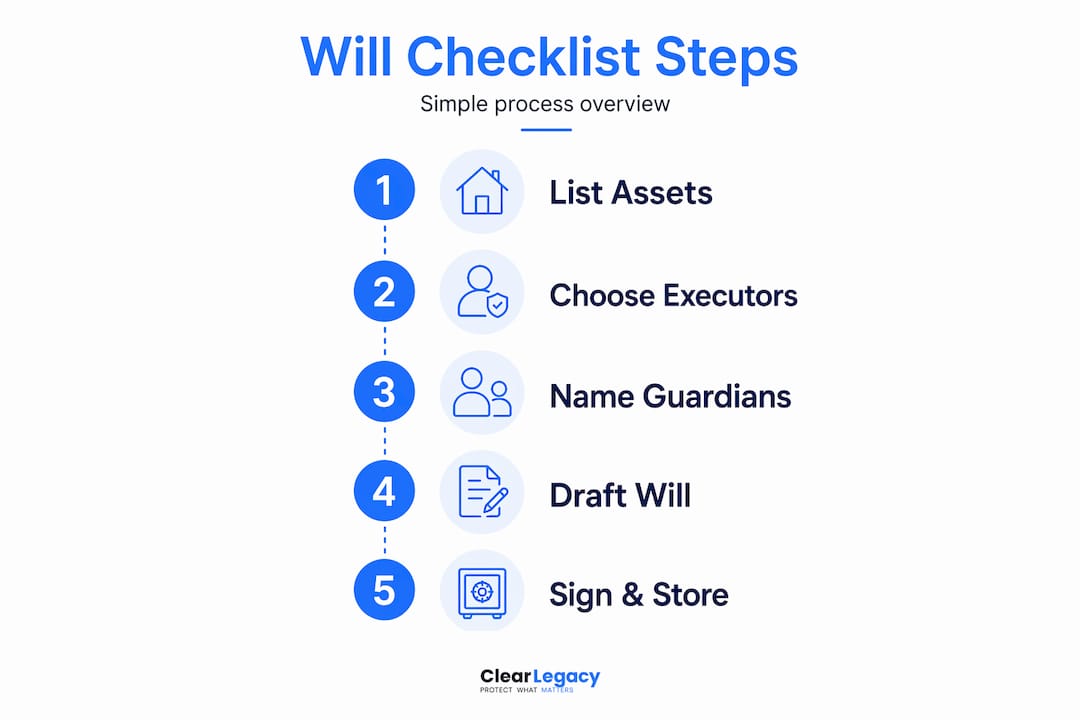
Before you start, list your assets and liabilities. This includes property, savings, investments, pension death benefits, business interests, and personal possessions of value. Note any outstanding mortgages or debts. This does not need to be an exhaustive legal inventory; it simply helps you think through who should receive what.
Choosing your executors and guardians
Your executor should be someone organised, trustworthy, and willing to take on the role. A spouse or adult child is common, but a solicitor or professional executor is worth considering for larger or more complex estates. Name at least one alternate in case your first choice is unable to act.
Online service or solicitor: a comparison
| Situation | Recommended approach |
|---|---|
| Straightforward estate, clear wishes | Online will service reviewed by qualified estate planners |
| Complex estate, business interests, trusts | Solicitor with estate planning expertise |
| Blended family with multiple beneficiaries | Professional review strongly advisable |
| First will, single or married, no complications | Online service is cost-effective and legally valid |
Online will services versus solicitors each have their place. For straightforward needs, a quality online service reviewed by qualified estate planners offers legal validity at a fraction of the cost. For complex estates involving trusts, business assets, or contested family dynamics, professional legal advice from an estate planning solicitor adds important protection.
Signing and storing your will correctly
Once drafted, your will must be signed in the presence of two independent, adult witnesses who are not beneficiaries and who also sign the document. Store the signed original in a safe place and tell your executor where it is. Remarkably, 29% of people with a will have not told anyone where it is stored, which creates unnecessary difficulty at the worst possible time.
Pro Tip: Register your will with the National Will Register or use a professional will storage service. This costs very little and means your executor can locate the document quickly when it is needed.
Wills within a broader estate plan
A will is the cornerstone of estate planning, but it is not the whole structure. Understanding what it does and does not do helps you plan more completely.
A will guides the probate process but does not bypass it. During probate, your will becomes a public document. If privacy matters to you, a discretionary trust written into your will, or a living trust established separately, can manage certain assets outside the probate process. Trusts offer continuity and privacy that wills alone cannot provide.
A will also has no authority while you are alive. Estate planning tools that complement your will include:
- Lasting Power of Attorney (property and financial affairs), which allows someone you trust to manage your finances if you lose mental capacity.
- Lasting Power of Attorney (health and welfare), which covers medical decisions and care preferences.
- Expression of wishes for pension death benefits, as pensions generally fall outside the estate and are not governed by your will.
Powers of attorney cover incapacity in ways a will simply cannot. Treating them as a package, rather than alternatives, gives you and your family complete legal protection.
My honest view on why people keep waiting
I have worked with families navigating the aftermath of intestacy, and the pattern is always the same. Nobody thought it would happen to them this soon. The estate gets tied up, the partner has no access to funds, and siblings who got along perfectly well suddenly find themselves on opposite sides of a dispute none of them wanted.
The hesitation I see most often is not really about time or cost. It is about discomfort. Writing a will means thinking about your death, and most of us prefer not to. But that avoidance does not protect your family. It leaves them exposed.
What I have found is that people feel genuinely relieved once it is done. Not morbid. Relieved. There is a real sense of having taken care of something that matters. I also believe in being honest with your loved ones about where your will is and what it contains. A conversation now prevents confusion later. Making a will is not a concession to mortality. It is one of the clearest acts of care you can offer the people who depend on you.
— Sat
Write your will with Clearlegacy today
If you have been looking for a reason to act, this is it. Clearlegacy's online will writing service lets you create a legally valid will in around 15 minutes, with your documents delivered by email within 24 hours. Prices start at £69 with no hidden fees, and every will is reviewed by a qualified estate planner to meet the requirements of the Wills Act 1837.

Whether you are writing your first will or updating one that no longer reflects your life, Clearlegacy makes it straightforward. Over 100 UK families have already used the service to protect what matters most. You can start your will today and have it completed before the end of the day.
FAQ
What happens if I die without a will in the UK?
Your estate is distributed under the intestacy rules of the Administration of Estates Act 1925, which follow a fixed hierarchy of relatives. Unmarried partners, stepchildren, and friends receive nothing, regardless of your relationship with them.
When is the right time to write a will?
The right time is as soon as you have dependants, assets, or wishes you want to be legally recorded. You should also review and update your will after any major life change, including marriage, divorce, the birth of a child, or acquiring significant property.
Are online wills legally valid in the UK?
Yes, provided they meet the formalities set out in section 9 of the Wills Act 1837, including signature and two independent witnesses. A quality online will service reviewed by qualified estate planners produces a legally binding document.
Does marriage cancel my existing will?
Yes. In England and Wales, marriage automatically revokes a will unless it was made in express contemplation of that specific marriage. If you married after writing your will, you should treat your estate as currently unprotected and write a new one.
Can I make a will without a solicitor?
Yes. Many straightforward wills are written without a solicitor, particularly through professional online services. For complex estates involving trusts, business assets, or disputed family arrangements, legal advice adds important protection, but it is not a legal requirement.