TL;DR:
- Most adults in England and Wales need a will to ensure their estate is distributed according to their wishes and avoid intestacy laws. Without a will, the state decides asset distribution, guardianship, and inheritance, often leading to delays, costs, and disputes. Creating a valid will provides control, reduces family conflicts, and legally appoints guardians for minors and executors, making it a practical essential for everyone.
A will is a legally binding document that specifies how your estate should be distributed after your death, and every adult in England and Wales needs one. Without a will, the state decides who inherits your assets under the Administration of Estates Act 1925, regardless of your wishes or your family's circumstances. Between 50% and 60% of adults currently have no will in place, leaving their estates vulnerable to intestacy rules, probate delays, and family disputes. Whether you own a home, have children, or simply want a trusted person to receive your belongings, the importance of having a will cannot be overstated. A will is not a document reserved for the elderly or the wealthy. It is a practical necessity for any adult who cares about what happens after they are gone.
Why everyone needs a will: the core case
A will, known formally as a last will and testament, is the only legal mechanism through which you can direct the distribution of your estate, appoint guardians for your children, and name the executors responsible for carrying out your wishes. Without one, you have no voice in any of those decisions. The Wills Act 1837, specifically section 9, sets out the formalities required for a valid will in England and Wales, including signing in the presence of two independent witnesses.

Many people assume a will is only necessary once they reach a certain age or accumulate significant wealth. That assumption is wrong. A cohabiting partner has no automatic right to inherit under English law. There is no such thing as common law marriage in the UK, and without a will, an unmarried partner receives nothing from your estate regardless of how long you have lived together. For new parents, blended families, and homeowners, the stakes are equally high.
The benefits of a will extend beyond asset distribution. A well-drafted will reduces the risk of family conflict, speeds up the administration of your estate, and can support inheritance tax planning under the Inheritance Tax Act 1984, where the nil-rate band stands at £325,000 and the residence nil-rate band at £175,000.
What happens if you die without a will?
Dying without a will is known legally as dying intestate. The consequences are governed by the Administration of Estates Act 1925, which applies a rigid formula to determine who inherits, with no regard for your personal relationships or intentions.
The intestacy rules prioritise married or civil partners, then children, then wider family. Cohabiting partners, stepchildren, close friends, and charities you care about receive nothing. If you are married with children, your spouse receives the first £322,000 (the statutory legacy as updated in July 2023) plus personal possessions, with the remainder split between your spouse and children. That division can force the sale of a family home.
The practical consequences compound quickly:
- Guardianship uncertainty. If you have minor children and die intestate, a court decides who raises them. Courts prioritise their own choice of guardian without any input from you, creating family uncertainty and potential legal delays.
- Probate delays. Uncontested probate can exceed 12 months, freezing your assets and leaving dependants without access to funds during that period.
- Significant costs. Probate fees can consume up to 5% of the estate's total value, a figure that rises sharply without strategic planning.
- Family disputes. Intestacy creates ambiguity. Relatives who feel overlooked by the formula may challenge the outcome, adding legal costs and emotional strain.
To understand the full picture of what intestacy means for your family, the consequences of dying without a will are worth reading in detail before making any decisions.
What are the key benefits of having a will?
A properly drafted will gives you control over outcomes that would otherwise be decided by legislation or a court. The benefits are both legal and deeply personal.
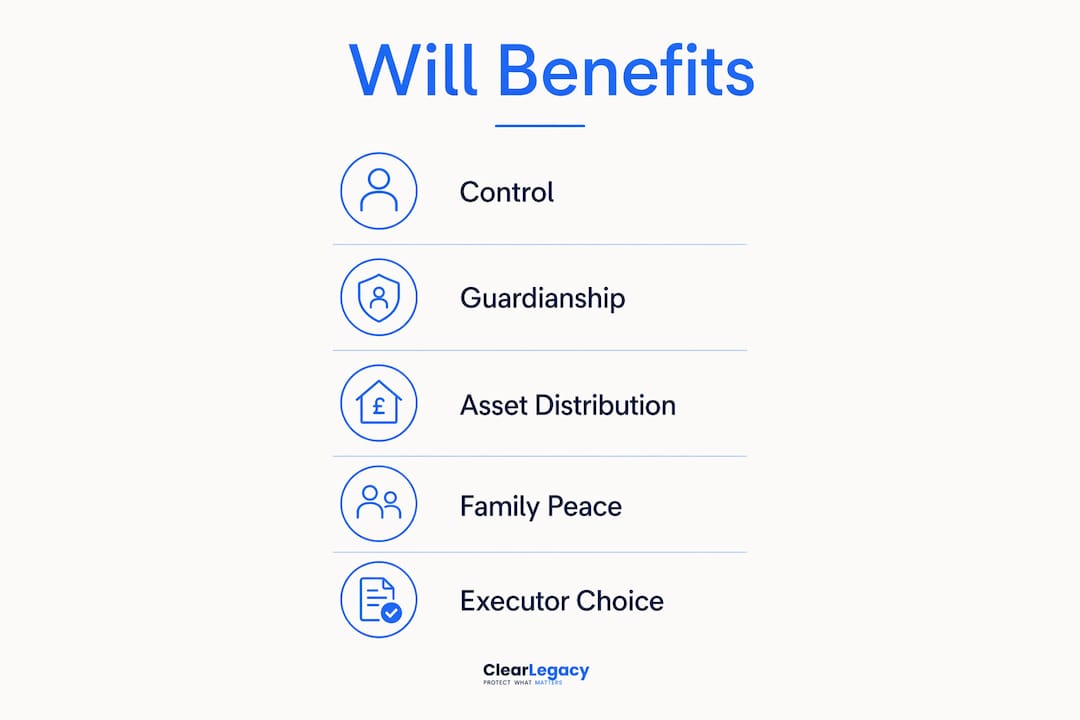
Appointing guardians for minor children is one of the most compelling reasons to create a will. Guardianship can only be designated through a will, meaning it is the single document that allows you to name the person you trust to raise your children if you die while they are young.
Specifying asset distribution removes ambiguity entirely. You can leave specific legacies, such as a piece of jewellery to a sibling or a sum of money to a godchild, and use a residuary clause to capture everything not specifically mentioned. This prevents assets from falling into intestacy even if you forget to list them individually.
Reducing family disputes is a direct result of clarity. A clearly drafted will lowers the likelihood of inheritance conflicts by documenting beneficiaries and executors in unambiguous terms, leaving less room for competing interpretations.
Additional benefits include:
- Leaving charitable gifts to organisations you support
- Including funeral directives so your family knows your preferences
- Incorporating digital estate clauses, which give your executor access to online accounts and digital assets, an increasingly important consideration in modern estates
- Supporting inheritance tax planning by structuring gifts and legacies to make use of available exemptions
Pro Tip: Name a substitute executor in your will in case your first choice is unable or unwilling to act. Choosing the right executor is one of the most consequential decisions in the entire document, as they bear significant responsibility for handling your estate efficiently and fairly.
Will vs trust: which estate planning tools do you need?
Wills and trusts are complementary rather than interchangeable. Understanding the distinction helps you build a complete estate plan rather than relying on one document to do everything.
| Tool | Primary purpose | When it applies |
|---|---|---|
| Will | Distributes assets after death; appoints guardians and executors | Required by every adult; takes effect on death |
| Trust | Manages assets during lifetime and after death; can bypass probate | Useful for complex estates, vulnerable beneficiaries, or tax planning |
| Lasting Power of Attorney | Authorises someone to make financial or healthcare decisions if you lose capacity | Operates before death; does not affect inheritance |
Wills and trusts serve different purposes: a will distributes assets after death, while a trust can manage assets during your lifetime and continue after it. A trust can be particularly useful if you have a vulnerable beneficiary, such as a child with a disability, or if you want to reduce the estate passing through probate. For a detailed overview of how trust planning fits alongside a will, the trust planning guide from Blackbook Protocol provides a useful UK-focused perspective.
A Lasting Power of Attorney (LPA) is a separate but equally important document. It allows a trusted person to manage your finances or make healthcare decisions if you lose mental capacity. An LPA operates during your lifetime and has no bearing on what happens to your estate after death. A will, an LPA, and where appropriate a trust, together form a complete estate planning framework. No single document substitutes for the others.
A common misconception is that placing assets in joint names removes the need for a will. It does not. Joint tenancy means assets pass automatically to the surviving owner, but this applies only to jointly held property and does not cover the rest of your estate.
How to write a valid will in the UK
Creating a legally valid will in England and Wales requires meeting the formalities set out in section 9 of the Wills Act 1837. Follow these steps to get it right.
- Decide what to include. List your assets: property, savings, investments, personal possessions, and digital accounts. Identify who you want to benefit and in what proportions. Include a residuary clause to cover anything not specifically mentioned.
- Choose your executor. Your executor administers your estate, pays debts, and distributes assets. Choose someone trustworthy, organised, and willing to take on the role. Name a substitute in case your first choice cannot act.
- Appoint guardians if you have minor children. This is the only document through which you can make this designation legally binding.
- Sign the will correctly. You must sign in the presence of two independent witnesses, both present at the same time. Witnesses must be adults who are not beneficiaries and not married to beneficiaries. Failure to follow this process renders the will invalid under the Wills Act 1837.
- Store it safely. Keep the original in a secure location and tell your executor where it is. You can register it with the National Will Register for a small fee.
- Review it regularly. Marriage automatically revokes a will in England and Wales. Divorce, the birth of a child, or a significant change in assets are all triggers to update your document.
Pro Tip: Avoid DIY kits unless you are confident in the legal requirements. Errors in witnessing or ambiguous wording can make a will invalid or open to challenge, which is precisely the outcome a will is designed to prevent. Online services that combine a guided process with review by a qualified estate planner offer a practical middle ground between a solicitor and a blank template.
Many people believe that making a will is expensive or time-consuming. In practice, a straightforward will can be completed in an afternoon at modest cost, and services like Clearlegacy make the process accessible to anyone with a computer and 15 minutes to spare. You can find a step-by-step breakdown of the process in this guide on how to write a will in the UK.
Key takeaways
A will is the single most important legal document an adult in England and Wales can have, because without one, the state distributes your estate and a court appoints your children's guardian.
| Point | Details |
|---|---|
| Intestacy removes your voice | Without a will, the Administration of Estates Act 1925 decides who inherits, not you. |
| Guardianship requires a will | The only way to legally designate a guardian for minor children is through a valid will. |
| Probate costs are avoidable | Fees can reach 5% of estate value; a well-drafted will reduces delays and expense significantly. |
| Wills and trusts are complementary | A trust manages assets during life; a will distributes them after death. Both may be needed. |
| Legal formalities are non-negotiable | Section 9 of the Wills Act 1837 requires signing before two independent witnesses simultaneously. |
Why I think most people underestimate what a will actually does
Most people frame a will as a document about money. After working in estate planning, I have come to see it differently. A will is primarily a document about relationships. It is the mechanism through which you tell the people you love, and the law, exactly how you want to be remembered and what you want to happen when you are no longer there to say it yourself.
The delay most people experience is not financial or logistical. Adults postpone making a will because confronting mortality is uncomfortable, not because the process is difficult or expensive. That discomfort is understandable. But the cost of delay falls entirely on the people you leave behind, not on you.
I have seen families spend months in dispute over estates where the deceased's wishes were perfectly clear to everyone in the room but legally unenforceable because nothing was written down. A will does not just protect assets. It provides emotional support for grieving families by removing uncertainty at the worst possible moment. That is worth more than any legal fee.
If you have been putting this off, the honest truth is that there is no good reason to wait any longer.
— Sat
Write your will today with Clearlegacy
If you have been considering making a will but felt uncertain about where to start, Clearlegacy makes the process straightforward and affordable.

Clearlegacy's online will writing service starts at £69, with no hidden fees and a fixed price from the outset. You complete your will in around 15 minutes through a guided digital process, and receive a legally valid document by email within 24 hours. Every will is reviewed by a qualified estate planner and prepared in compliance with the Wills Act 1837, so you can be confident it will hold up when it matters most. Over 100 UK families have already used Clearlegacy to protect their legacies. To find out what to look for when choosing a service, read the guide on selecting an online will writing service before you decide.
FAQ
Who needs a will in the UK?
Every adult in England and Wales benefits from having a will, regardless of age or wealth. Cohabiting partners, parents of minor children, homeowners, and anyone with specific wishes about their estate all have particular reason to act.
What happens if I die without a will?
Your estate is distributed according to the intestacy rules under the Administration of Estates Act 1925. Unmarried partners receive nothing, and a court appoints guardians for any minor children without your input.
Is a will legally valid if I write it myself?
A handwritten will can be valid in England and Wales if it meets the formalities in section 9 of the Wills Act 1837, including signing before two independent witnesses simultaneously. Errors in this process render the will void, which is why professional review is strongly recommended.
How often should I update my will?
Review your will after any major life event: marriage (which automatically revokes an existing will in England and Wales), divorce, the birth of a child, or a significant change in your assets. A general review every three to five years is good practice.
What is the difference between a will and a trust?
A will takes effect after death and distributes your estate to named beneficiaries. A trust can manage assets both during your lifetime and after death, and may help reduce probate costs or protect vulnerable beneficiaries. For complex estates, trust and will planning together provide the most complete protection.