TL;DR:
- Estate planning is a cost-effective way to avoid expensive probate fees, legal disputes, and family conflicts after death. Properly prepared plans, including trusts and wills, provide faster asset transfer, privacy, and clarity on guardianship and power of attorney. Early, regular estate planning protects families from unnecessary financial and emotional burdens, ensuring assets are handled according to your wishes.
Estate planning is the legal process of arranging how your assets, property, and personal affairs will be managed during your lifetime and distributed after your death. It is unequivocally worth the cost because the upfront investment in a will, lasting power of attorney, or trust is modest compared to the probate fees, legal disputes, and tax leakage that arise without one. For a typical UK estate, probate fees alone can run into thousands of pounds, and that figure does not account for delays, family conflict, or lost assets. Understanding why estate planning is worth cost means looking honestly at what happens when families are left without a plan.
Why estate planning is worth the cost: the numbers
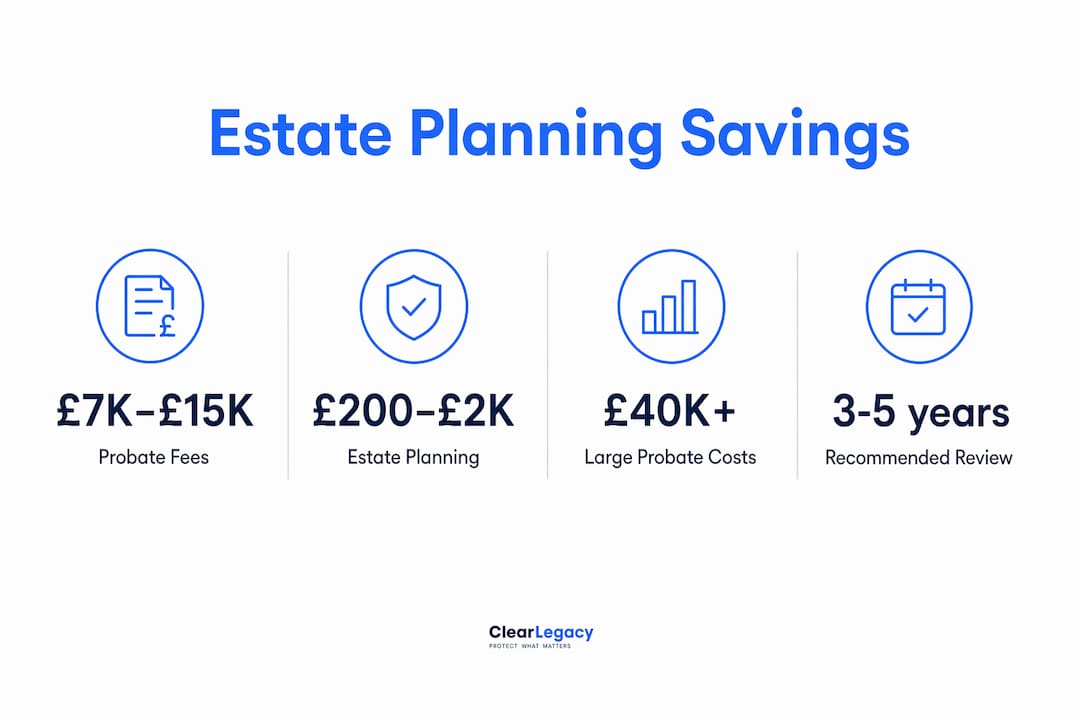
The financial case for estate planning is clear when you compare upfront costs against the alternative. A basic estate plan comprising a will and a lasting power of attorney typically costs a few hundred to around £2,000. A comprehensive arrangement including a revocable living trust generally ranges from £2,000 to £5,000. Those figures sound significant until you consider what probate costs without a plan.

Probate fees for a £250,000 estate typically range from £7,000 to £15,000, with total costs including legal fees, administrative expenses, and lost time potentially reaching £50,000 to £80,000. That is not a worst-case scenario. It is a realistic outcome for a family with a modest home, some savings, and no formal plan in place.
| Estate size | Typical estate planning cost | Estimated probate cost without a plan |
|---|---|---|
| £150,000 | £500–£1,500 | £5,000–£12,000 |
| £250,000 | £1,000–£2,500 | £7,000–£15,000 |
| £500,000 | £2,000–£5,000 | £15,000–£40,000 |
| £1,000,000 | £3,000–£6,000 | £40,000 or more |
For estates valued around £1 million, probate fees can exceed £40,000. That is money that would otherwise pass directly to your family. The ratio is stark: spend a few thousand now, or risk losing tens of thousands later.
Pro Tip: Use Clearlegacy's probate fees calculator to estimate what probate could cost your specific estate. The result is often the most persuasive argument for acting now.
Beyond the headline figures, fixed probate fees and statutory court costs impose a disproportionate burden on moderate estates. A family with a £200,000 home and £30,000 in savings feels probate costs far more acutely than a family with £5 million in diversified assets. This is the detail that surprises most people: estate planning is not just for the wealthy. It is most valuable for ordinary families who cannot afford to lose a significant portion of their estate to court fees and legal administration.
How does estate planning protect your family beyond saving money?
The financial advantages of estate planning are well documented, but the non-financial benefits are equally compelling. A properly drafted estate plan functions as a governance framework for your family. It answers the questions that would otherwise be left to courts, solicitors, and grieving relatives to resolve under pressure.
Here is what a complete estate plan provides beyond cost savings:
- Faster asset distribution. A well-funded trust bypasses probate entirely, giving your family access to assets within days rather than months. Without a plan, probate in England and Wales can take six months to over a year.
- Privacy. Wills that pass through probate become public documents. A trust keeps your affairs private. Your family's financial situation does not become a matter of public record.
- Guardianship clarity. If you have children under 18, your will is the only legal mechanism for nominating a guardian. Without one, the courts decide. That decision may not reflect your wishes.
- Lasting power of attorney. A lasting power of attorney (LPA) under the Mental Capacity Act 2005 allows a trusted person to manage your finances or health decisions if you lose capacity. Without an LPA, your family must apply to the Court of Protection, a process that costs more and takes considerably longer.
- Reduced family conflict. Ambiguity is the primary cause of contested estates. A clear, legally valid will removes the conditions that allow disputes to take root.
Estate planning benefits families at all wealth levels by preventing delays, clarifying authority, and reducing tax leakage that disproportionately affects smaller estates. The importance of estate planning is not about the size of your assets. It is about protecting whatever you have built from unnecessary erosion.
Under the Administration of Estates Act 1925, if you die intestate (without a will), your estate is distributed according to a fixed legal formula. Cohabiting partners receive nothing under intestacy rules, regardless of how long they have lived together. The Inheritance (Provision for Family and Dependants) Act 1975 allows certain dependants to make a claim, but that process is costly and uncertain. A will removes all of that uncertainty at a fraction of the cost.
What mistakes increase estate planning costs or reduce its effectiveness?
A plan that is poorly executed can be as costly as no plan at all. Several common errors undermine the value of estate planning and, in some cases, produce the very probate costs the plan was designed to avoid.
-
Leaving a trust unfunded. A revocable living trust only avoids probate if assets are formally retitled into the trust. DIY trust templates frequently fail because the trust is drafted but never funded. The result is a document that provides false reassurance while the estate still passes through probate.
-
Failing to update beneficiary designations. Beneficiary designations on pension schemes, life insurance policies, and ISAs override your will entirely. Outdated designations after major life events such as divorce, remarriage, or the birth of a child can cause assets to pass to the wrong person, triggering costly disputes that a will cannot resolve.
-
Not reviewing your plan regularly. Estate plans should be reviewed every 3–5 years or after significant life changes. A will written before you bought your home, had children, or remarried may no longer reflect your intentions or comply with current law.
-
Waiting for a health crisis. Waiting until a crisis to initiate estate planning results in higher emergency legal fees and, critically, the potential loss of mental capacity before an LPA can be signed. Once capacity is lost, an LPA cannot be created. The Court of Protection becomes the only route, and it is expensive and slow.
-
Using a will alone when a trust is warranted. A basic will takes effect after death and does not avoid probate. A revocable living trust, if properly funded, takes effect during your lifetime and can bypass probate entirely. For estates with property or complex assets, the difference in outcome is substantial.
Pro Tip: After any major life event, such as marriage, divorce, or the birth of a child, review your will and all beneficiary designations together. Clearlegacy's guide on key life events sets out exactly what to check and when.
How do you choose the right estate planning approach?
The right estate planning approach depends on your personal circumstances, family structure, and the nature of your assets. Not every situation requires a comprehensive trust arrangement. Equally, a basic will alone is insufficient for many families.
| Situation | Recommended approach | Approximate cost |
|---|---|---|
| Single adult, no property, no dependants | Basic will and LPA | £200–£600 |
| Married couple, joint property, young children | Mirror wills, LPAs, guardian nomination | £500–£1,500 |
| Blended family, property, step-children | Discretionary trust will, LPAs | £1,500–£3,500 |
| High-value estate, inheritance tax planning | Comprehensive trust and tax planning | £3,000–£6,000+ |
For most families in England and Wales, a properly drafted will and a lasting power of attorney provide the core protection needed. The current HMRC nil-rate band stands at £325,000, with an additional residence nil-rate band of £175,000 available when a family home passes to direct descendants. Estates that approach or exceed these thresholds benefit significantly from structured planning to reduce inheritance tax liability under the Inheritance Tax Act 1984.
Proactive estate planning is financially smarter than waiting for a health crisis because emergency legal proceedings cost more and reduce your personal control over outcomes. Starting early, even with a straightforward will, establishes the foundation that can be built upon as your circumstances change. Clearlegacy's estate planning decision tools can help you identify which approach suits your situation before you commit to any cost.
Estate planning is the most cost-efficient form of asset protection available to ordinary families. It is not a luxury. It is the mechanism that turns the worst day in a family's life from a legal and financial crisis into a manageable process.
Key takeaways
Estate planning is worth its cost because the upfront investment is consistently and significantly lower than the probate fees, delays, and disputes that arise without a plan.
| Point | Details |
|---|---|
| Probate costs far exceed planning costs | A £250,000 estate can incur £7,000–£15,000 in probate fees without a plan. |
| Trusts bypass probate entirely | A properly funded trust gives families access to assets in days, not months. |
| Beneficiary designations override wills | Review all pension and insurance nominations after every major life event. |
| Plans must be updated regularly | Review your estate plan every 3–5 years or after significant life changes. |
| Early planning reduces total cost | Waiting for a crisis increases legal fees and risks losing the ability to create an LPA. |
Why I believe estate planning is the most undervalued financial decision most families make
I have seen what happens when families are left without a plan. The grief does not wait for the legal process to resolve. Relatives spend months chasing solicitors, paying court fees, and, in some cases, arguing over assets that a clear will would have distributed in weeks. The financial loss is real. The emotional cost is worse.
What strikes me most is how consistently people overestimate the complexity and cost of getting a plan in place. A basic will and LPA can be completed in an afternoon and cost less than a single solicitor's hourly rate. Yet the majority of UK adults still do not have a will. The Wills Act 1837 has required the same basic formalities for nearly two centuries: a written document, signed in the presence of two independent witnesses. The barrier is not legal. It is psychological.
The families who act early almost never regret it. The families who wait frequently do. Estate planning is not about anticipating death. It is about protecting the people you care about from unnecessary cost and confusion at the worst possible time. That is worth every penny.
— Sat
Start protecting your family with Clearlegacy
If this article has clarified why estate planning is worth the investment, the next step is straightforward. Clearlegacy provides legally valid wills for UK residents starting from £69, completed in around 15 minutes and delivered by email within 24 hours. Every document is reviewed by a qualified estate planner and complies fully with the Wills Act 1837. There are no hidden fees and no solicitor appointments required.

Whether you need a simple will or a more comprehensive arrangement, Clearlegacy's online will writing service gives you a clear, fixed-price route to protecting your assets and your family. Over 100 UK families have already used Clearlegacy to put their affairs in order. You can do the same today at clearlegacy.co.uk.
FAQ
What is estate planning and who needs it?
Estate planning is the legal process of arranging how your assets and personal affairs will be managed and distributed. It benefits everyone with assets, dependants, or property, not only the wealthy.
How much does estate planning cost in the UK?
A basic will and lasting power of attorney typically costs £200–£2,000 in the UK. Comprehensive trust arrangements range from £2,000 to £5,000, which is still far less than typical probate costs.
Does a will avoid probate in England and Wales?
A basic will does not avoid probate. A properly funded revocable living trust can bypass probate entirely, giving beneficiaries faster access to assets without court involvement.
How often should I update my estate plan?
Estate plans should be reviewed every 3–5 years or after major life events such as marriage, divorce, the birth of a child, or a significant change in assets.
What happens if I die without a will in the UK?
Without a will, your estate is distributed under the intestacy rules set out in the Administration of Estates Act 1925. Cohabiting partners receive nothing, and the distribution may not reflect your wishes at all.