TL;DR:
- A simple will is a legal document specifying estate inheritance and naming an executor, effective only after death. It must meet strict formalities, clearly identify beneficiaries, and include guardianship and asset distribution instructions while not covering incapacity or tax planning. For most UK families, a well-drafted simple will, combined with a Lasting Power of Attorney, provides comprehensive estate planning.
A simple will is a legal document that specifies who inherits your estate and appoints an executor to carry out your wishes after you die. Known formally as a last will and testament, it is the most widely used estate planning document in England and Wales, and for most people with straightforward assets and clear family arrangements, it is exactly what they need. Under the Wills Act 1837, a will only takes effect on death, meaning it has no power over your affairs during your lifetime. If you own property, have children, or simply want to decide who receives your possessions, a simple will is the logical starting point.
What is a simple will and what must it include?
A simple will is defined as a written declaration of your wishes regarding the distribution of your estate, executed with the formalities required by law. The document must meet specific content and execution standards to be legally valid in England and Wales.
The core components of a valid simple will are:
- Identification of the testator. Your full legal name, address, and a clear statement that this document is your will and revokes all previous wills.
- Named beneficiaries. Full names, addresses, and your relationship to each person. Vague descriptions such as "my friends" create disputes and can invalidate gifts.
- Executor and backup executor. The person or persons responsible for administering your estate. A backup executor is named in case your first choice cannot or will not act.
- Guardianship directions. If you have children under 18, you must name a guardian. Without this, the courts decide.
- Asset distribution instructions. Specific gifts of property, money, or possessions, followed by a residuary clause that captures everything not specifically mentioned.
- Execution formalities. The document must be typed or printed, signed by you in the presence of two independent witnesses, who must also sign. This is the requirement under section 9 of the Wills Act 1837.
Poor execution is the most common reason wills are challenged or fail. Unclear beneficiary details or an unwilling executor can turn a straightforward estate into a prolonged legal process. This is why precision in drafting matters as much as the decision to write a will at all.
Pro Tip: Always confirm that your chosen executor and backup executor are willing to act before you finalise your will. Executors carry legal duties and procedural responsibilities, and pre-confirming their agreement prevents delays and complications during probate.

What are the limitations of a simple will?
A simple will is a powerful document, but it has a clearly defined scope. Understanding what it does not cover is just as important as knowing what it does.
-
It takes effect only after death. A simple will offers no protection during incapacity. If you suffer a stroke, develop dementia, or are otherwise unable to manage your affairs, your will is irrelevant. You need a separate Lasting Power of Attorney (LPA) for property and financial affairs, and another for health and welfare.
-
It does not avoid probate. Assets passing under a will must go through the probate process, which is administered by the Probate Registry. Probate is a matter of public record, can take months, and carries court fees. Certain assets such as jointly owned property passing by survivorship or pension death benefits sit outside the will entirely.
-
It provides no tax planning. A simple will does not reduce your inheritance tax liability. The current HMRC nil-rate band is £325,000, with a residence nil-rate band of £175,000 for property passed to direct descendants. Estates above these thresholds are taxed at 40%. A will alone cannot restructure ownership or create trusts to mitigate this exposure.
-
It offers no creditor protection. Assets distributed outright under a will are immediately accessible to a beneficiary's creditors. If you want to protect an inheritance from divorce proceedings or financial difficulty, a discretionary trust within the will, or a separate trust structure, is required. You can explore asset protection strategies that go beyond a simple will.
-
It gives limited control over timing. A simple will distributes assets outright on death. If a beneficiary is young, vulnerable, or financially inexperienced, you cannot control when or how they receive their inheritance without incorporating a trust.
A simple will is often the first step in estate planning, but it must be supplemented with powers of attorney and, where appropriate, trusts for complete coverage of your affairs.
Pro Tip: Write your will and your Lasting Power of Attorney at the same time. The LPA covers the period before death; the will covers what happens after. Together, they address your full lifecycle of planning needs.
Simple will vs living trust: which is right for you?
The comparison between a simple will and a living trust is one of the most searched questions in estate planning. In England and Wales, living trusts are less common than in the United States, but the principles of comparison remain useful for understanding when a will alone is sufficient.
| Feature | Simple will | Living trust |
|---|---|---|
| When it takes effect | On death only | During lifetime and after death |
| Probate required | Yes, for assets in the estate | No, assets transfer directly |
| Cost to set up | Lower (from £69 with Clearlegacy) | Higher, requires ongoing maintenance |
| Incapacity planning | No | Yes, trustee can manage assets |
| Privacy | Public record via probate | Private document |
| Suitable for | Straightforward estates | Complex estates, privacy concerns |
| Tax planning | Limited | Can be structured for tax efficiency |
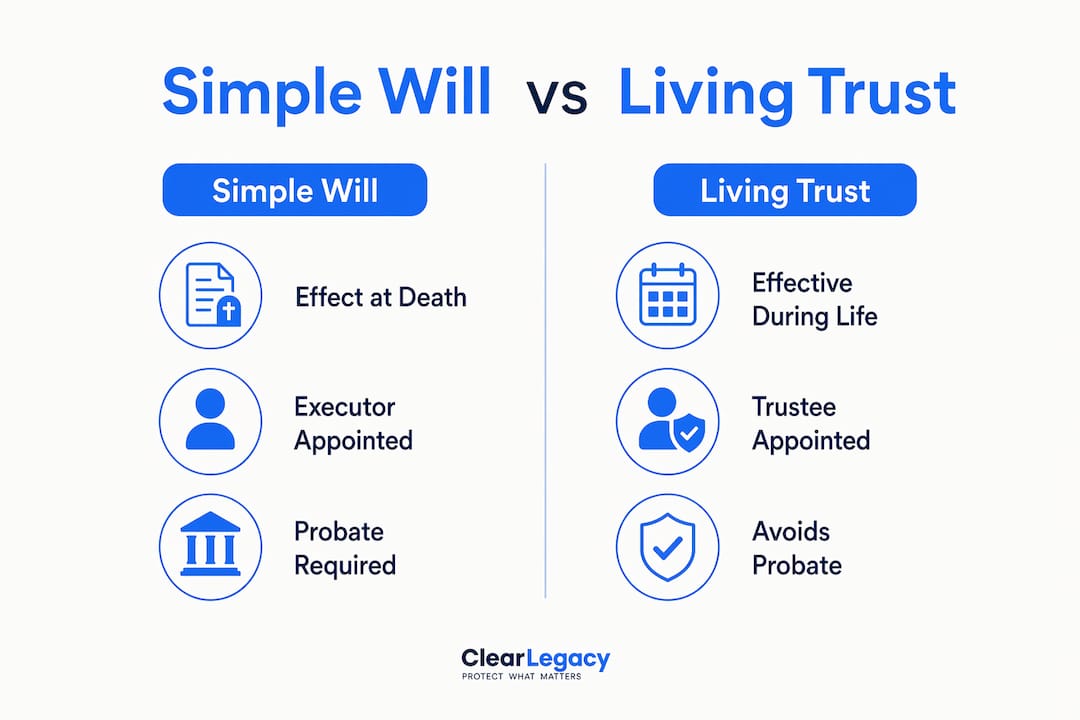
Simple wills suit modest estates with clear beneficiary instructions, families who prefer probate supervision, and anyone naming guardians for minor children. This means the majority of UK adults with a family home, savings, and straightforward family arrangements will find a simple will entirely adequate.
A living trust, or a will incorporating a discretionary trust, becomes relevant when:
- Your estate is likely to exceed the combined nil-rate bands and you want to plan for inheritance tax.
- You have a vulnerable or young beneficiary who should not receive assets outright.
- You want to maintain privacy and avoid the public probate process.
- You own property in multiple jurisdictions.
For most people reading this, a well-drafted simple will is the right tool. The key is to know its boundaries and complement it with an LPA and, if needed, a review of your UK trust law obligations as your estate grows.
How to create a simple will in the UK
Creating a valid simple will in England and Wales follows a clear process. The Wills Act 1837 formalities are non-negotiable, and any deviation can render the document invalid.
-
Confirm you meet the legal requirements. You must be aged 18 or over and of sound mind (known legally as having testamentary capacity). This means you understand the nature of making a will, the extent of your estate, and who your natural beneficiaries are.
-
List your assets and their approximate values. Include property, bank accounts, investments, pensions (noting these usually fall outside the will), vehicles, and personal possessions of value. This list informs your distribution decisions.
-
Choose your beneficiaries. Record their full legal names, current addresses, and your relationship to each. Decide whether gifts are specific (a named item or sum) or residuary (a share of whatever remains after debts and specific gifts are paid).
-
Appoint your executor and backup executor. Speak to them first. Confirm they understand the role involves applying for a grant of probate, collecting assets, paying debts, and distributing the estate. Executors who are unwilling or unable to act cause significant delays.
-
Name a guardian for any children under 18. This is one of the most important decisions in the document. Without a named guardian, the family courts decide.
-
Draft and execute the will correctly. The will must be typed or printed, not handwritten. You sign it in the presence of two witnesses, both present at the same time, who then sign in your presence. Witnesses must be adults and must not be beneficiaries or married to beneficiaries, as this invalidates their gift.
-
Store the will safely and tell your executor where it is. The original document should be kept in a secure location such as a solicitor's safe, a bank, or the Probate Registry's Certainty National Will Register. A will that cannot be found is treated as if it does not exist.
-
Review your will when circumstances change. Marriage automatically revokes a will in England and Wales. Divorce does not revoke a will but removes your former spouse as a beneficiary and executor. The birth of a child, a significant change in assets, or the death of a beneficiary or executor are all triggers for a review. Follow the step-by-step guidance to keep your will current.
Pro Tip: Online will writing services are a legitimate and affordable option for straightforward estates. They are valid under UK law provided the execution formalities are met correctly after you receive the document.
Key takeaways
A simple will is the most practical and accessible estate planning tool for the majority of UK adults, provided it is drafted precisely and complemented by a Lasting Power of Attorney.
| Point | Details |
|---|---|
| Simple will definition | A legal document directing asset distribution and naming executors, effective only on death. |
| Core legal requirement | Must comply with section 9 of the Wills Act 1837: signed by testator and two independent witnesses. |
| Key limitation | Offers no incapacity planning; a Lasting Power of Attorney is required for that purpose. |
| Executor selection | Confirm willingness before finalising the will to prevent probate delays. |
| When to consider more | Estates above HMRC nil-rate bands or with vulnerable beneficiaries benefit from trust planning. |
Why simplicity is a strength, not a shortcut
People often ask me whether a simple will is "enough." My honest answer is that for the vast majority of UK families, it is not just enough. It is the right tool entirely. The mistake I see most often is not people choosing a simple will when they need a trust. It is people doing nothing at all because they assume estate planning is complicated.
A simple will, drafted correctly and kept up to date, turns what could be the worst administrative experience a family faces into a manageable process. The executor knows what to do. The beneficiaries know what to expect. The courts are not left to decide who raises your children.
Where I do see problems is in two areas. The first is executor selection. People name a spouse or eldest child without having the conversation. That person then discovers, often while grieving, that they are legally responsible for a process they do not understand. The second is the assumption that a will covers incapacity. It does not. I have seen families in genuine difficulty because a parent lost capacity and had no LPA in place, leaving the family with no legal authority to manage their affairs.
My advice is straightforward. Write the will. Confirm your executor. Then book an appointment to sort the LPA. These two documents together cover the full arc of what your family might face.
— Sat
Create your simple will with Clearlegacy
If you are ready to put a valid simple will in place, Clearlegacy makes the process straightforward and affordable.

Clearlegacy's online will writing service starts at £69, with wills completed in around 15 minutes and delivered by email within 24 hours. Every document is prepared using AI-assisted automation and reviewed by qualified estate planners, guaranteeing compliance with the Wills Act 1837. There are no hidden fees and no solicitor appointments to arrange. Over 100 UK families have already used Clearlegacy to protect their estates. If you want a legally valid will fast, Clearlegacy is built precisely for that purpose.
FAQ
What is the simple will definition in UK law?
A simple will is a written legal document, executed under the Wills Act 1837, that directs how your estate is distributed after death and names an executor to carry out those instructions. It takes effect only on death and has no legal force during your lifetime.
What does a simple will include?
A simple will includes identification of the testator, named beneficiaries with full details, appointment of an executor and backup executor, guardianship directions for minor children, specific and residuary asset distribution instructions, and a properly witnessed signature. All components must be present for the document to function as intended.
Does a simple will avoid probate?
No. Assets passing under a simple will must go through the probate process in England and Wales, which is a matter of public record. Only assets held jointly or outside the estate, such as pension death benefits, bypass probate automatically.
How do I create a simple will in the UK?
You must be aged 18 or over and of sound mind, then draft the document in writing, sign it in the presence of two independent adult witnesses, and have both witnesses sign in your presence. UK will formalities under section 9 of the Wills Act 1837 are mandatory for the document to be legally valid.
How often should I update my simple will?
Review your will after any major life event: marriage (which automatically revokes a will in England and Wales), divorce, the birth of a child, a significant change in assets, or the death of a named executor or beneficiary. As a general rule, a review every three to five years keeps the document current with your circumstances.