TL;DR:
- Dying without a will results in the estate being distributed by law, not by personal wishes. Cohabiting partners have no automatic inheritance rights under UK law unless they make a formal claim or have specific arrangements.
Dying without a will means your estate is distributed by law, not by your wishes. This legal situation is called dying intestate, and the rules that follow are set out in the Administration of Estates Act 1925. If you are asking what happens if my partner dies without a will, the short answer depends entirely on whether you are married, in a civil partnership, or simply living together. The distinction matters enormously. Under English and Welsh law, your legal status at the time of death determines who inherits, not the length of your relationship or what your partner may have promised you.
How intestacy rules determine who inherits when a partner dies without a will
The Administration of Estates Act 1925 sets out a strict hierarchy of heirs. The law does not ask what your partner wanted. It applies a fixed formula based on legal relationships.
What a married or civil partner receives
A surviving spouse or civil partner inherits all personal chattels, a statutory legacy of £322,000, and half of any estate value above that threshold. Children divide the remaining half equally. If the estate is worth £322,000 or less, the spouse or civil partner inherits everything outright. That statutory legacy figure was updated in july 2023 and remains current. The practical effect is that a married partner is well protected on smaller estates but may receive less than expected on larger ones.

What a cohabiting partner receives
Cohabiting partners have no automatic inheritance rights under English and Welsh intestacy law, regardless of how long you lived together or whether you have children. This is one of the most widely misunderstood facts in UK estate planning. There is no such thing as a "common law marriage" in England and Wales. The law does not recognise it. If your partner dies intestate and you were not married or in a civil partnership, you inherit nothing by default.
The estate passes instead to the following, in order of priority:
- Children (including adopted children, but not stepchildren)
- Parents
- Siblings
- Half-siblings
- Grandparents
- Aunts and uncles
If none of these relatives exist, the estate passes to the Crown as bona vacantia. A long-term cohabiting partner still receives nothing.
Can a cohabiting partner make a claim?
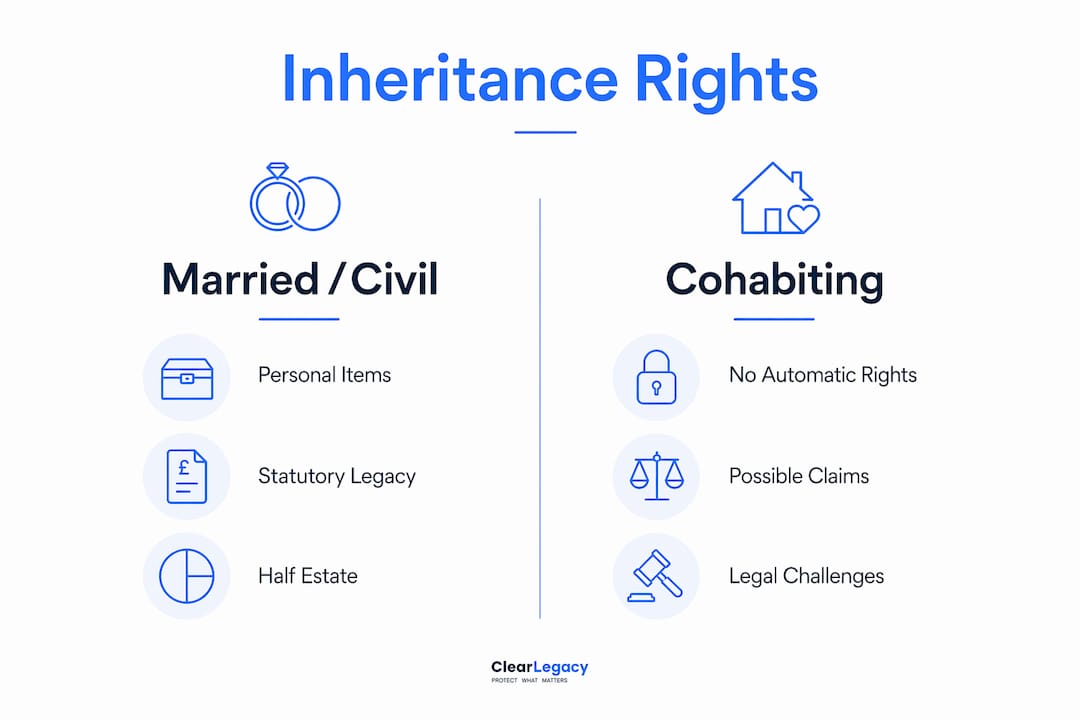
A cohabiting partner's only legal route is a claim under the Inheritance (Provision for Family and Dependants) Act 1975. This Act allows certain dependants to apply to court for reasonable financial provision from an estate. The application must be made within six months of the grant of administration. These claims are costly, uncertain, and emotionally draining. They are not a substitute for a will.
Pro Tip: If you are cohabiting and want to understand your specific rights, Clearlegacy's guide on cohabiting partner inheritance sets out the legal position clearly and without jargon.
What is the probate process when a partner dies intestate?
When someone dies without a will, the court does not automatically appoint the surviving partner to manage the estate. Instead, a family member or other eligible person must apply for a grant of letters of administration. This is the intestate equivalent of probate. Without a named executor in a will, control of estate administration defaults to court appointment, which may not reflect what the deceased would have wanted.
The process typically follows these steps:
- Register the death at the local register office within five days.
- Identify all assets and liabilities of the deceased, including property, bank accounts, and debts.
- Apply for letters of administration through HMRC and the Probate Registry, paying the relevant fee.
- Obtain a surety bond if required. Surety bonds protect against administrator misconduct but add cost and delay. They are routinely waived when a trusted executor is named in a will.
- Notify creditors and settle debts before distributing the estate.
- Distribute the estate according to the intestacy rules, not according to personal wishes.
Intestate probate takes 12 to 24 months and costs between 5% and 8% of the estate value. Those figures reflect the added burden of court oversight, genealogical research to trace heirs, and surety bond requirements. A straightforward testate estate (one with a valid will) typically resolves faster and at lower cost. You can estimate your own timeline using Clearlegacy's probate timeline tool.
Common misconceptions and challenges for surviving partners
The emotional weight of losing a partner is compounded when the legal process does not match what you believed would happen. Verbal promises and informal arrangements hold no legal weight in intestacy. A partner who was told "everything will be yours" has no legal recourse if those words were never written into a valid will.
"Intestacy laws prioritise rigid legal relationships over personal intentions, often causing emotional and financial hardship for surviving partners who thought they were provided for."
This is not a rare edge case. Many couples assume that living together for years, sharing finances, or raising children together creates some form of legal protection. It does not. The law treats a cohabiting partner of twenty years the same as a stranger when it comes to intestacy.
Common misconceptions include:
- "We've been together so long, I'm automatically entitled." Length of relationship creates no legal rights under intestacy.
- "Our children mean I inherit his share." Children may actually reduce what a married spouse receives, and a cohabiting partner still inherits nothing directly.
- "I'm listed as next of kin at the hospital." Next of kin status carries no inheritance rights. It is a medical and administrative designation only.
- "He told his family I should have everything." Without a will, those wishes cannot be enforced.
Disputes between blood relatives and surviving partners are common in intestate estates. Without a named executor, administration may fall to a relative who has conflicting interests, escalating both costs and family conflict.
Pro Tip: If you are already in this situation, Clearlegacy's dedicated page on partner death without a will sets out your immediate practical steps.
How to protect your partner's inheritance before it is too late
The most effective protection is a valid will under the Wills Act 1837. Section 9 of the Act sets out the formalities: the will must be in writing, signed by the testator, and witnessed by two independent adults present at the same time. A will that meets these requirements overrides intestacy rules entirely.
| Protection method | What it does | Limitation |
|---|---|---|
| Valid will | Directs assets to chosen beneficiaries | Must meet Wills Act 1837 formalities |
| Joint tenancy | Property passes automatically to survivor | Does not cover all asset types |
| Beneficiary nomination | Pensions and life insurance bypass probate | Does not apply to general estate assets |
| 1975 Act claim | Court may award provision to a dependant | Costly, uncertain, time-limited to six months |
| Letters of administration | Allows estate management without a will | Follows intestacy rules, not personal wishes |
Joint ownership of property as joint tenants (rather than tenants in common) means the property passes automatically to the survivor outside of probate. This is a useful tool but covers only that specific asset. Pension funds and life insurance policies with named beneficiaries also bypass probate entirely. Neither replaces a will for the broader estate.
For cohabiting partners already facing an intestate estate, the 1975 Act claim remains the only formal legal route. Act quickly: the six-month deadline from the grant of administration is strict. Citizens Advice and a specialist solicitor can help assess whether a claim is viable.
Writing a will does not need to be complicated or expensive. Clearlegacy's online will writing service produces a legally valid will in around 15 minutes, delivered by email within 24 hours, from £69. Every will is reviewed by a qualified estate planner before delivery.
Key takeaways
Without a valid will, English and Welsh intestacy rules distribute your estate by legal formula, not by your wishes, leaving cohabiting partners with no automatic inheritance rights whatsoever.
| Point | Details |
|---|---|
| Intestacy ignores personal wishes | The Administration of Estates Act 1925 applies a fixed hierarchy regardless of your intentions. |
| Cohabiting partners inherit nothing | No automatic rights exist for unmarried partners under English and Welsh law, regardless of relationship length. |
| Probate takes longer without a will | Intestate estates typically take 12 to 24 months and cost 5%–8% of the estate value. |
| Verbal promises are unenforceable | Only a signed, witnessed will under the Wills Act 1837 can direct assets to a chosen partner. |
| A 1975 Act claim is a last resort | Cohabiting partners can apply to court within six months of the grant of administration, but success is not guaranteed. |
Why I think most couples underestimate this risk
People tend to assume the law will reflect their relationship. After years of shared life, shared finances, and shared children, it feels inconceivable that the state would hand your estate to a sibling you barely speak to. But that is precisely what intestacy law does.
What strikes me most, having worked through these situations with families, is how often the problem is not ignorance but delay. Couples know they should write a will. They simply put it off. And then one day, the worst happens, and what should be a paperwork exercise becomes a legal dispute that can last years and cost tens of thousands of pounds.
The 1975 Act claim is frequently presented as a safety net for cohabiting partners. In practice, it is expensive, emotionally exhausting, and far from certain. I have seen claims fail because the surviving partner could not demonstrate financial dependency to the court's satisfaction. A will costs £69 and takes 15 minutes. A 1975 Act claim can cost thousands and take years. The comparison should be enough to prompt action today.
One more thing: married couples are not immune to this problem. If your estate is large enough, your spouse may receive less than you intended under the statutory legacy formula. A will lets you specify exactly what your partner receives, including the family home, personal possessions, and any specific gifts. Intestacy removes that precision entirely.
— Sat
Protect your partner with a Clearlegacy will today
If reading this has made you realise your partner could be left with nothing, the practical next step is straightforward.

Clearlegacy's online will writing service is built for exactly this situation. You complete your will in around 15 minutes, it is reviewed by a qualified estate planner, and you receive a legally valid document by email within 24 hours. Prices start at £69 with no hidden fees. Every will complies with the Wills Act 1837. Over 100 UK families have already used Clearlegacy to protect the people they love. If you want to see how the process works before you start, Clearlegacy's will writing guides cover every common question in plain English.
FAQ
What does dying intestate mean in the UK?
Dying intestate means dying without a valid will. The estate is then distributed according to the intestacy rules set out in the Administration of Estates Act 1925, not according to the deceased's personal wishes.
Does a cohabiting partner inherit if there is no will?
No. Cohabiting partners have no automatic inheritance rights under English and Welsh intestacy law, regardless of how long the relationship lasted. Only married or civil partners and blood relatives inherit by default.
How long does probate take when there is no will?
Intestate probate typically takes 12 to 24 months, compared to a shorter process for estates with a valid will. Added costs from court oversight, genealogical searches, and surety bonds push expenses to between 5% and 8% of the estate value.
Can I challenge an intestate estate as a surviving partner?
A cohabiting partner can apply for financial provision under the Inheritance (Provision for Family and Dependants) Act 1975. The application must be made within six months of the grant of administration, and the outcome is not guaranteed.
What is the statutory legacy for a surviving spouse in 2026?
A surviving spouse or civil partner receives all personal chattels plus a statutory legacy of £322,000. Half of any estate value above that threshold also passes to the spouse, with children sharing the remaining half.