TL;DR:
- Will writing costs include document drafting, legal consultations, storage, and registration fees, varying by complexity.
- Choosing the right service depends on your estate's details, with cheaper options like DIY kits limited to basic templates and higher fees applicable for trusts or complex arrangements.
Most people expect writing a will to be a straightforward, low-cost task. The reality is that what does will writing cost include is a question with several layers, and the answer varies considerably depending on the type of service you choose and the complexity of your estate. Will writing fees can cover everything from basic document drafting to legal consultations, storage, and trust arrangements. Understanding this cost breakdown for wills before you commit helps you avoid unexpected bills and choose a service that genuinely fits your needs.
Table of Contents
- Key takeaways
- What will writing fees typically include
- Comparing will writing costs across different services
- What affects will writing cost and charges to watch for
- Practical tips for choosing a will writing service
- Planning for what will writing costs really cover
- My honest take on will writing costs
- Write your will today with Clearlegacy
- FAQ
Key takeaways
| Point | Details |
|---|---|
| Fees cover more than drafting | Will writing costs typically include consultation, document preparation, and sometimes storage or registration. |
| Prices vary widely by method | DIY kits start at £10, online services from £50, and solicitors typically charge £150 to £300 for a simple will. |
| Complexity increases the cost | Trusts, blended families, and overseas assets can push fees beyond £500 to £1,000 or more. |
| Watch for hidden extras | VAT, disbursements, and storage fees are often charged separately and can raise your total bill noticeably. |
| Updating wills carries a cost | Life events such as marriage, divorce, or a new child require will reviews, which usually incur additional charges. |
What will writing fees typically include
The term "will writing" covers a professional legal service known more formally as testamentary document preparation. When you pay for this service, the fee is rarely just for the final printed document. Knowing what you are actually paying for helps you compare providers fairly.
Here is what will writing services pricing typically covers:
- Document drafting. The core of any service: preparing a legally valid will that reflects your wishes, names your executors, and distributes your estate correctly. For this to be valid under section 9 of the Wills Act 1837, it must be signed and witnessed properly.
- Legal consultation. Many solicitors and regulated services include at least one advisory session where they assess your circumstances, explain your options, and help you make decisions about guardianship, executors, and residuary clauses.
- Personalised advice. This is where professional services add genuine value. A qualified adviser can identify issues you may not have considered, such as potential inheritance tax (IHT) liability under the Inheritance Tax Act 1984 or the rights of dependants under the Inheritance (Provision for Family and Dependants) Act 1975.
- Document review and compliance check. A regulated service will review your completed will for errors or ambiguities before it is finalised.
- Registration and storage. Registration and storage are frequently charged as separate line items, though some services bundle them into the headline price.
- VAT and disbursements. Most solicitors charge VAT at 20% on top of their professional fee. Disbursements are third-party costs passed on to you, such as identity verification checks.
Pro Tip: Always ask any provider for a written quote that itemises every charge, including VAT, storage, and any follow-up fees. A headline price of £150 can quietly become £250 once everything is added.
The cost of will writing is genuinely an investment in legal clarity. The fee structures above are not uniform across every provider, which is why comparing your options carefully matters.
Comparing will writing costs across different services
The method you choose to write your will has the single biggest influence on how much you pay. Here is how the main options compare.
| Service type | Typical price range | What is usually included | Key limitation |
|---|---|---|---|
| DIY will kit | £10 to £50 | Template document only | No legal advice; high risk of errors |
| Online will service | £50 to £150 | Guided questionnaire, document generation | Limited personalisation |
| High street solicitor | £150 to £300 (simple will) | Full consultation, drafting, compliance check | Higher cost; appointments required |
| Complex solicitor will | £500 to £1,000+ | Trusts, tax planning, overseas assets | Significant time and expertise required |
DIY will-writing kits cost between £10 and £50 and are widely available. The fundamental problem is that they offer no personalised legal advice. If your circumstances involve children from a previous relationship, business assets, or property held as tenants in common, a template simply cannot address your situation with the precision required.
Online will services typically charge £50 to £150 and use guided questionnaires to help you build your document. The quality varies considerably. Some are little more than glorified templates; others are backed by qualified estate planners who review what you have submitted.
For a simple solicitor will, expect to pay between £150 and £300, with mirror wills for couples costing £200 to £500. Solicitors may charge flat fees for straightforward cases or hourly rates. Those hourly rates commonly range from £130 to £400 depending on the firm's location and the solicitor's experience, so an apparently simple will can become expensive if your situation requires extended discussion.

Pro Tip: If you are considering a solicitor but your estate is straightforward, ask explicitly for a fixed-fee quote. Many firms offer them for simple wills and it removes the risk of an open-ended hourly bill.
When asking how much for will writing you should budget, the honest answer is: it depends on what you need. A side-by-side comparison of online and solicitor services is worth reading before you decide.
What affects will writing cost and charges to watch for
Even within a single service type, prices can shift significantly. Several factors drive the average will writing cost higher than you might expect.
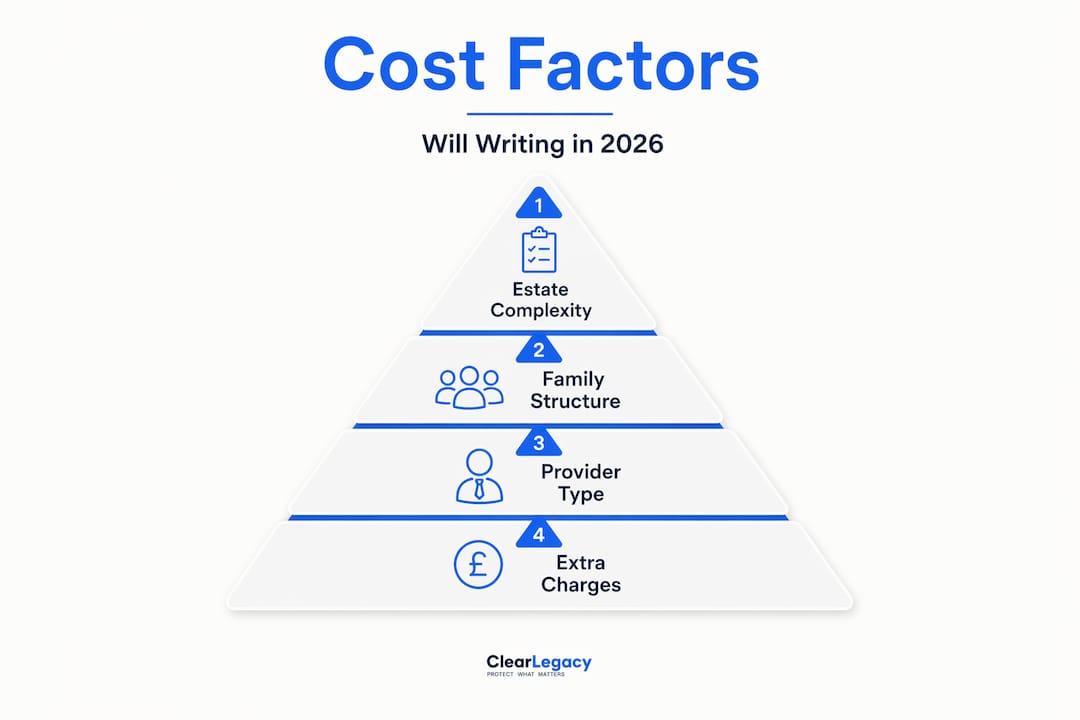
Estate complexity. Complex wills involving trusts, overseas assets, or blended family arrangements can exceed £500 to £1,000 due to the additional time and expertise involved. A discretionary trust, for instance, requires careful drafting to ensure it achieves its tax or protective purpose without creating ambiguities that could lead to dispute.
Family structure. Blended families, where one or both partners have children from previous relationships, introduce questions about who inherits what. Addressing these properly often requires a more detailed will and sometimes a trust arrangement.
Guardianship and executor appointments. Naming guardians for minor children and choosing appropriate executors sounds straightforward, but it often prompts discussion and revision that adds to overall fees with a solicitor.
Additional charges to watch for include:
- Inheritance tax planning. If your estate exceeds the nil-rate band of £325,000 (or £500,000 with the residence nil-rate band when leaving a home to direct descendants), your solicitor may recommend IHT-specific advice. This is almost always charged separately.
- Will updates. Failure to update your will after major life events such as marriage, divorce, or the birth of a child can create unintended inheritance outcomes and increase costs during estate settlement. Each update typically incurs a fresh drafting fee.
- Storage and safekeeping. Many people neglect to inform executors where their will is stored, causing delays and stress. If storage is not included in your package, it is worth paying for it separately.
- Unregulated will writers. Unlike solicitors, will writers do not have to be regulated. Using an unregulated provider may save money initially but professional advice from a licensed professional reduces the risk of costly disputes that unregulated documents can create.
Understanding what affects will writing cost ahead of time means you can ask the right questions before signing anything.
Practical tips for choosing a will writing service
Getting the balance right between cost and quality does not require guesswork. Follow these steps to make a well-informed decision.
- Check credentials. For solicitors, verify registration with the Solicitors Regulation Authority (SRA). For other will writers, look for membership of bodies such as the Society of Will Writers or the Institute of Professional Will Writers.
- Request an itemised quote. Ask for every charge in writing before you agree to anything. This includes VAT, disbursements, storage, and any fee for updating the will in future.
- Consider free or discounted schemes. The "Will Aid" scheme runs annually in November, when participating solicitors write basic wills in exchange for a suggested charitable donation. This is worth exploring if your estate is straightforward.
- Weigh convenience against complexity. For a simple estate with no trusts and a clear family structure, a reputable online will writing service offers excellent value. For anything involving trusts, tax planning, or disputed family circumstances, investing in a solicitor is usually justified.
- Confirm will storage is covered. Whether your service includes it or charges separately, make sure your will is stored securely and that your executor knows how to access it.
- Think about future updates. Some providers offer an annual update subscription; others charge per revision. If your circumstances are likely to change, a subscription model may save money over time.
When exploring cheap will writing options, the question is not just how much you pay today but whether the document will hold up when it matters most.
Planning for what will writing costs really cover
To bring this together clearly: the cost of will writing typically includes document drafting, some level of legal review or consultation, and potentially storage and registration. What you pay for each element depends on the service type, your estate's complexity, and the provider's fee structure.
Seeking advice from a qualified professional provides peace of mind that cheaper options cannot always match, particularly where family circumstances are not straightforward. That said, a reputable, reviewed online service is entirely appropriate for many people and represents genuine value.
Will writing cost should be viewed as an investment to prevent expensive legal disputes and to make sure your wishes are honoured. The right service for you is the one that matches your estate's complexity, not simply the lowest price on the page.
Your practical next steps are simple. Assess your estate, note any complexities, ask for itemised quotes from at least two providers, and confirm that legal review and storage are covered. Do not delay because of cost uncertainty. A clear, legally valid will, written today, is always better than a perfect one you never get around to making.
My honest take on will writing costs
I've seen people delay writing their wills for years because they assume the cost will be prohibitive. Then, when they finally investigate, they discover a basic online will costs less than a restaurant meal for two. The delay was never justified by the price.
What I've also seen is the other mistake: choosing the cheapest possible option without asking what it actually includes. A £15 DIY kit with no legal review, signed without a proper witness arrangement, is not a bargain. It is a document that may fail when it is needed most, turning an already difficult time into a protracted legal problem for the people you care about.
My view is that the sweet spot for most people sits between the two extremes. A reputable online service, backed by qualified estate planners and priced transparently, delivers genuine legal protection without the cost of a full solicitor appointment. The key is to check what is actually included rather than comparing headline prices alone.
If your estate involves a trust, significant IHT exposure, or a blended family with competing interests, spend the money on a solicitor. For everyone else, a well-structured online service is not a compromise. It is a sensible choice.
— Sat
Write your will today with Clearlegacy
If you are ready to act, Clearlegacy makes it straightforward.

Clearlegacy's online will writing service starts from just £69 and covers document drafting, AI-assisted preparation reviewed by qualified estate planners, and delivery to your inbox within 24 hours. There are no hidden fees and no solicitor appointments to book. Every will is legally valid under the Wills Act 1837. You can complete the entire process in around 15 minutes. For those who want to compare their options before committing, the online will comparison guide sets out what different providers include and how their pricing works. Over 100 UK families have already used Clearlegacy to protect what matters most.
FAQ
What does will writing cost typically include?
Will writing costs generally cover document drafting, a legal or compliance review, and sometimes a consultation. Storage and registration are often charged separately, so always ask for an itemised quote.
How much does a basic will cost with a solicitor in the UK?
A simple solicitor will costs between £150 and £300 for a single will, with mirror wills for couples ranging from £200 to £500. Complex wills involving trusts or overseas assets can exceed £1,000.
Are there cheap will writing options that are still legally valid?
Yes. Online will services typically charge £50 to £150 and can produce legally valid documents, provided they are backed by qualified reviewers and the will is correctly signed and witnessed under the Wills Act 1837.
Does will writing cost include VAT?
Most solicitors charge VAT at 20% on top of their professional fee, which is not always reflected in advertised prices. Fixed-fee online services frequently include all charges in a single transparent price with no VAT surprise.
How often should I update my will, and does it cost extra?
You should review your will after any significant life event such as marriage, divorce, the birth of a child, or a major change in assets. Updates almost always incur an additional fee, so check whether your provider offers a revision or subscription arrangement.