TL;DR:
- Online estate planning allows individuals to create legally valid wills and related documents through secure digital platforms without visiting a solicitor's office. It typically includes a will, lasting powers of attorney, healthcare directives, and digital legacy arrangements, ensuring comprehensive estate management. However, legal validation requires proper signing and witnessing, with online services guiding users through compliance under UK law.
Online estate planning is the process of creating and managing legally valid wills, trusts, powers of attorney, and healthcare directives through secure digital platforms that guide you with questionnaires, templates, and compliance checks. In the UK, this typically means using a service like Clearlegacy to produce documents that meet the formalities of the Wills Act 1837, all without setting foot in a solicitor's office. What does online estate planning include beyond a basic will? The honest answer is quite a lot. A complete plan covers asset distribution, guardianship, executor appointments, lasting powers of attorney, and increasingly, digital legacy provisions for your online accounts and cryptocurrency holdings.
What does online estate planning include as standard?
Online estate planning platforms deliver a suite of legal documents, not just a single will. Understanding each component helps you decide which documents your situation requires.

| Document | Purpose | Key function |
|---|---|---|
| Last will and testament | Distributes your estate after death | Names beneficiaries, executor, and guardians for minor children |
| Lasting power of attorney (financial) | Authorises someone to manage your finances if you lose capacity | Covers bank accounts, property, and investments |
| Lasting power of attorney (health and welfare) | Authorises someone to make medical decisions on your behalf | Covers treatment choices and care arrangements |
| Healthcare directive / advance decision | Records your wishes about specific medical treatments | Legally binding refusal of treatment under the Mental Capacity Act 2005 |
| Living trust | Holds assets during your lifetime and transfers them on death | Can help avoid probate for certain asset types |
The last will and testament is the foundation. It names your beneficiaries, appoints an executor to administer your estate, and, if you have children under 18, designates a guardian. A well-drafted will also includes a residuary clause, which catches any assets not specifically mentioned elsewhere.
Lasting powers of attorney (LPAs) are often overlooked but are arguably as important as the will itself. Without a financial LPA, your family may need to apply to the Court of Protection to manage your affairs if you lose mental capacity. That process is slow and expensive. A health and welfare LPA gives a trusted person the authority to make decisions about your medical care and living arrangements.
Healthcare directives, sometimes called advance decisions or living wills, record your wishes about specific treatments you would or would not want. These are legally binding in England and Wales under the Mental Capacity Act 2005, provided they are correctly signed and witnessed.
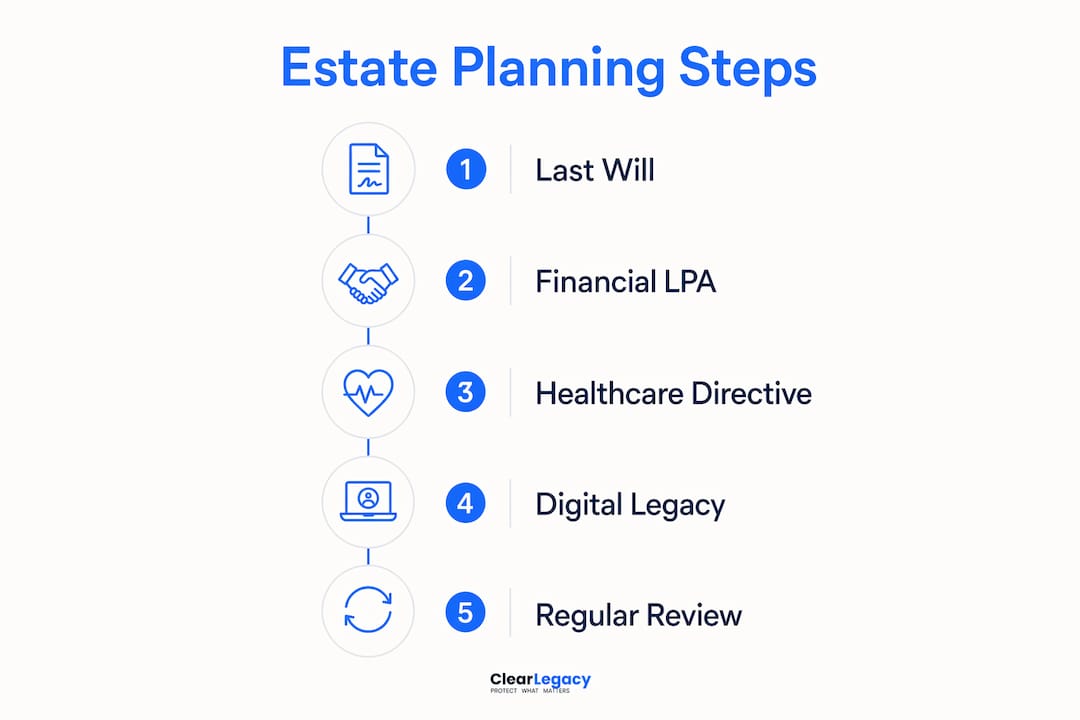
Estate planning platforms provide integrated workflows covering all of these documents, often with client portals for secure storage and future updates. That means you can revisit and revise your plan as your circumstances change, without starting from scratch.
Pro Tip: Do not treat your will as a one-off task. Review it after every major life event: marriage, divorce, the birth of a child, or a significant change in assets.
How do online platforms ensure legal validity in the UK?
Legal validity is the question most people ask first, and rightly so. In the UK, a will is only valid if it meets the formalities set out in section 9 of the Wills Act 1837. These require the will to be in writing, signed by the testator, and witnessed by two independent adults who are present at the same time.
This is where UK law differs significantly from some other jurisdictions. Electronic signatures are not yet fully supported for wills in England and Wales. Physical witnessing remains a legal requirement. Reputable online services account for this by producing a completed document that you then sign and have witnessed in the traditional way, rather than attempting a fully digital execution.
Here is how a quality online platform guides you through compliance:
- Guided questionnaire. You answer structured questions about your assets, beneficiaries, executor, and guardianship wishes. The platform uses your answers to populate a legally compliant document.
- Document review. Many services, including Clearlegacy, have qualified estate planners review the output before it is sent to you. This catches errors that a purely automated system might miss.
- Clear signing instructions. The platform provides step-by-step guidance on how to sign and witness the document correctly, reducing the risk of an invalid will.
- Secure storage. Your completed documents are stored digitally so you can access, review, and update them at any time.
- Optional solicitor involvement. For more complex estates, hybrid services offer access to a solicitor for a document review or a Q&A session, without the cost of full legal representation.
It is worth noting that remote online notarisation is not yet standard practice in England and Wales, unlike in some US states. Any platform claiming to offer a fully electronic will execution in the UK should be treated with caution.
Pro Tip: Always use two witnesses who are not beneficiaries under your will and are not married to a beneficiary. A gift to a witness or their spouse is void under the Wills Act 1837, even if the rest of the will stands.
Online estate planning vs a solicitor: benefits and limitations
The cost difference between online and traditional estate planning is substantial. Online estate planning bundles typically cost between £100 and £600, compared with solicitor-drafted plans that can run to several thousand pounds. That saving matters, but cost should not be the only consideration.
Where online estate planning works well
- Straightforward estates. If you own property in your sole name or jointly, have a clear list of beneficiaries, and have no complex business interests, an online service is likely sufficient.
- Speed and convenience. Clearlegacy delivers completed wills within 24 hours of submission. A solicitor appointment may take weeks to arrange.
- Accessibility. You can complete the process from home, at a time that suits you, without taking time off work.
- Transparency. Fixed pricing with no hidden fees means you know the total cost before you begin.
Where you should consider professional advice
Online estate planning services are effective for straightforward estates but less suitable for complex, high-net-worth, or blended-family situations that need tailored legal strategies. Specifically, consider a solicitor if:
- You have children from a previous relationship and want to protect their inheritance.
- You own a business or have significant pension assets requiring specialist structuring.
- Your estate is likely to exceed the HMRC nil-rate band of £325,000 or the residence nil-rate band of £175,000, and you want to plan for inheritance tax.
- You have assets in multiple countries.
A further risk with online tools is that they cannot identify conflicts between your will and other legal documents. A life insurance policy or pension, for example, passes outside your estate via a nomination form. If that nomination contradicts your will, the nomination wins. An online questionnaire will not flag this unless you know to raise it.
Hybrid services that combine automated drafting with access to a solicitor for review are growing in popularity. They offer reassurance for situations that are slightly more complex, without the full cost of bespoke legal advice.
Pro Tip: Before completing any online estate planning questionnaire, list all your assets and check whether each one passes under your will or outside it via a nomination or joint ownership arrangement.
How to complete a comprehensive estate plan entirely online
A complete estate plan entirely online is achievable for most UK individuals and couples. The process is more straightforward than many people expect.
Step-by-step process
- Choose your platform. Select a service that is specific to England and Wales, confirms compliance with the Wills Act 1837, and has qualified estate planners reviewing documents. Read the estate planning checklist before you begin so you have all the information to hand.
- Gather your information. You will need full names and addresses for your executor, beneficiaries, and guardians. Have a rough list of your assets and their approximate values.
- Complete the questionnaire. Answer each question carefully. Take your time on the sections covering residuary beneficiaries and guardianship, as these have the most significant long-term consequences.
- Review your documents. Read the completed documents thoroughly before signing. Check that names are spelled correctly and that the distribution of your estate reflects your intentions.
- Sign and witness correctly. Follow the platform's signing instructions precisely. Both witnesses must be present when you sign and must then sign themselves in your presence.
- Store your will safely. Keep the original in a secure location and tell your executor where it is. Many platforms offer digital storage as a backup, but the signed original is the legally operative document.
- Notify your executor and trustees. Tell them they have been appointed and where to find your documents. An executor who does not know they have been named cannot act promptly when needed.
Digital legacy planning
Digital legacy planning is a modern component that traditional wills rarely address. Failing to document your digital assets can cause permanent loss of accounts, photographs, and financial holdings. Your digital legacy plan should cover:
- Passwords and access credentials for email, social media, and financial accounts. Use a password manager such as 1Password or Bitwarden and share access instructions with a trusted person.
- Cryptocurrency wallets. Record your wallet addresses and private keys or seed phrases in a secure, offline format. Without these, the assets are irretrievable.
- Social media accounts. Platforms like Facebook and Google allow you to designate a legacy contact or inactive account manager. Set these up now.
- Subscription services. List recurring payments so your executor can cancel them promptly and avoid unnecessary charges to your estate.
If you hold a living trust, remember that assets must be retitled into the trust's name to be effective. A trust that has not been funded does not avoid probate and does not provide the control you intended. This step is often missed and is one of the most consequential errors in DIY estate planning.
Key takeaways
A complete online estate plan covers wills, lasting powers of attorney, healthcare directives, and digital legacy provisions, all produced through guided platforms that comply with the Wills Act 1837.
| Point | Details |
|---|---|
| Core documents | A complete plan includes a will, financial LPA, health and welfare LPA, and healthcare directive. |
| UK legal formalities | Wills must be physically signed and witnessed under the Wills Act 1837; electronic execution is not yet valid in England and Wales. |
| Cost advantage | Online plans cost significantly less than solicitor-drafted equivalents, making estate planning accessible to more families. |
| Know the limits | Online tools cannot identify conflicts between your will and nominations on pensions or life insurance policies. |
| Digital legacy | Document passwords, cryptocurrency credentials, and social media wishes as part of any complete estate plan. |
Why I think most people underestimate what online estate planning covers
People often assume that online estate planning means a basic will and nothing more. In my experience, that assumption leads to two problems. Either people do nothing because they think the process will be too limited, or they complete a will and consider the job done when it is only half finished.
The reality in 2026 is that a well-designed digital estate planning service covers the full range of documents a straightforward estate requires. The gap between online and solicitor-led planning has narrowed considerably. What remains is a genuine difference in the handling of complexity. For a couple with a family home, straightforward savings, and children from the same relationship, an online service is not a compromise. It is the sensible choice.
Where I would urge caution is in the area of digital assets and document conflicts. Most people have no idea that their pension and life insurance pass outside their will entirely. An online questionnaire will not prompt you to check your nomination forms unless you know to ask. That is not a flaw in the technology. It is a limitation of any self-directed process, online or otherwise.
My advice is to treat your estate plan as a set of connected documents, not a single form. Review everything together, including nominations, joint ownership arrangements, and your digital accounts. A will that is technically valid but internally inconsistent with your other documents can still cause real distress for the people you leave behind. The goal is not just a signed piece of paper. It is a plan that actually does what you intend.
— Sat
Start your estate plan with Clearlegacy today
If you have been putting off writing your will because you assumed it would be expensive or time-consuming, Clearlegacy removes both barriers.
Clearlegacy's 24-hour online will writing service lets you complete a legally valid will in around 15 minutes, with your documents delivered by email within 24 hours. Prices start from £69, with fixed fees and no hidden costs. Every document is reviewed by a qualified estate planner to confirm compliance with the Wills Act 1837. Over 100 UK families have already used Clearlegacy to protect their loved ones. If your estate is straightforward, there is no reason to wait. Start your will today and have it done by tomorrow.
FAQ
What documents are included in an online estate plan?
A complete online estate plan typically includes a last will and testament, a financial lasting power of attorney, a health and welfare lasting power of attorney, and a healthcare directive. Some platforms also support living trusts and digital legacy planning.
Is an online will legally valid in the UK?
Yes, provided it is signed by the testator and witnessed by two independent adults present at the same time, as required by section 9 of the Wills Act 1837. Electronic signatures alone are not sufficient for wills in England and Wales.
How much does online estate planning cost in the UK?
Clearlegacy's online will writing service starts from £69. This is significantly less than solicitor-drafted wills, which can cost several hundred to several thousand pounds depending on complexity.
When should I use a solicitor instead of an online service?
Use a solicitor if your estate involves a blended family, business interests, assets in multiple countries, or a potential inheritance tax liability above the HMRC nil-rate band of £325,000. For straightforward estates, a quality online service is sufficient.
What is digital legacy planning and should I include it?
Digital legacy planning involves documenting access to your online accounts, social media profiles, and cryptocurrency holdings so your executor can manage or close them after your death. Failing to record this information can result in permanent loss of digital assets and unnecessary complications for your family.