
Most people assume writing a will means booking a solicitor, taking time off work, and paying hundreds of pounds before a single word is committed to paper. The role of cloud-based estate planning is to dismantle that assumption entirely. Cloud tools now let you draft, store, update, and share legally relevant estate documents from your kitchen table, and 73% of law firms had adopted cloud-based legal tools by 2025. For UK individuals and couples who want control over their legacy without the friction of traditional processes, understanding what cloud estate planning can and cannot do is the most useful thing you can learn right now.
Table of Contents
- Key takeaways
- What cloud-based estate planning actually means
- Benefits and challenges of cloud estate planning tools
- Combining cloud tools with professional legal advice
- Choosing a cloud estate planning platform safely
- The impact of cloud technology on wills and digital estates
- My honest view on cloud estate planning
- Start your estate plan with Clearlegacy
- FAQ
Key takeaways
| Point | Details |
|---|---|
| Cloud tools are accessible and affordable | You can create and manage estate documents online without expensive solicitor appointments. |
| Legal validity still requires compliance | Electronic wills in the UK must meet strict procedural rules to be enforceable under the Wills Act 1837. |
| DIY carries real risk | Errors in AI or self-drafted wills frequently lead to costly probate disputes that outweigh initial savings. |
| Professional oversight matters | Cloud platforms work best when combined with qualified estate planner review, not as a standalone replacement. |
| Digital vaults outperform general cloud storage | Purpose-built estate vaults offer gated access and beneficiary controls that standard cloud folders cannot provide. |
What cloud-based estate planning actually means
Cloud-based estate planning refers to using internet-hosted software to create, store, organise, and update your estate documents. That includes wills, lasting powers of attorney, beneficiary designations, and digital asset inventories. Unlike traditional methods where paper documents sit in a solicitor's filing cabinet, cloud-based tools give you access to your plans from any device, at any time.
The contrast with traditional estate planning is stark. Historically, the process required multiple in-person appointments, weeks of waiting for drafts, and significant legal fees before you even signed anything. Cloud estate planning tools compress that timeline dramatically. You answer structured questions through a guided interface, the platform generates a draft, and a qualified reviewer checks it before delivery.
Key features you will typically find in reputable cloud estate planning software include:
- Guided document creation using structured questionnaires that reduce the chance of missing critical information
- Secure document storage with encryption and access controls
- Version history so you can track changes and revert if needed
- Collaboration features that allow your legal adviser to review or annotate documents remotely
- Notifications and reminders to prompt you when documents need updating after life events
Pro Tip: Set a calendar reminder to review your will every two years or after any major life change such as marriage, divorce, or the birth of a child. Cloud platforms make this update process far quicker than traditional methods.
The security dimension matters more than most people realise. Reputable platforms use bank-grade encryption, two-factor authentication, and strict data protection standards aligned with UK GDPR. That said, not all cloud services are built equally, and the difference between a purpose-built estate planning platform and a generic file-sharing service is significant.

Benefits and challenges of cloud estate planning tools
The advantages of virtual estate planning are real and well-documented, but so are the pitfalls. Understanding both sides helps you make a genuinely informed decision.
The benefits are compelling. Cost is the most obvious one. Probate expenses can consume up to 5% of an estate's value, and a poorly drafted or absent will makes that figure far more likely. Cloud-based services reduce upfront costs dramatically while still producing legally compliant documents when used correctly. Time savings are equally significant. What once took weeks can now take an afternoon.
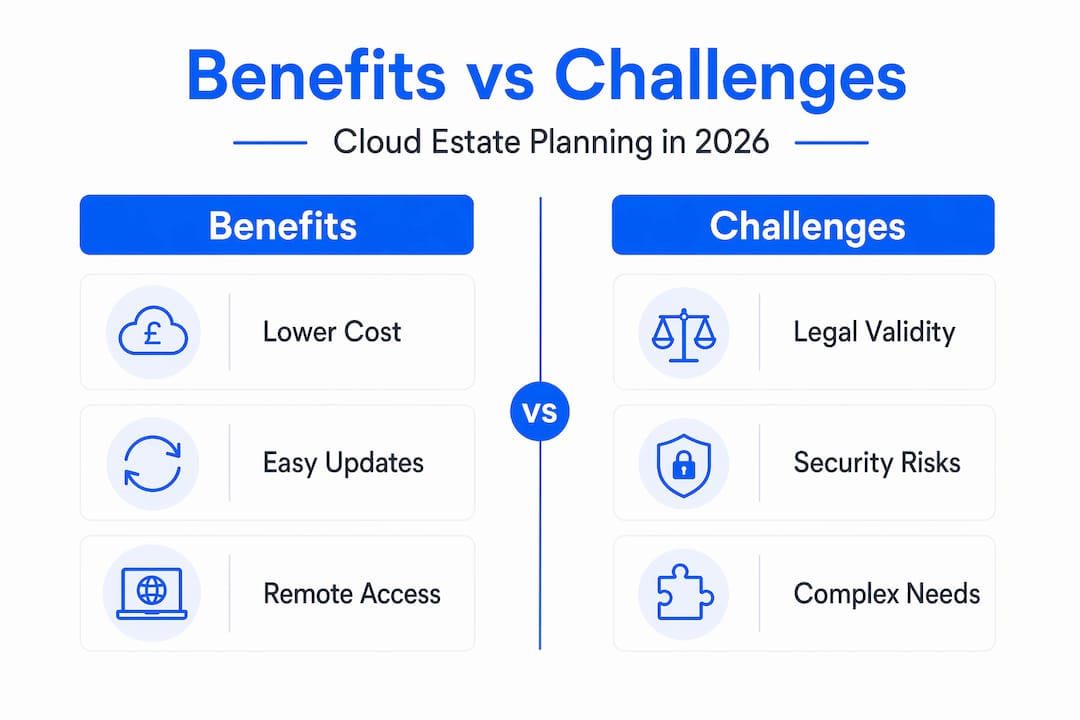
User-friendliness has also improved enormously. Modern estate planning solutions online guide you through complex decisions using plain language, removing the intimidation factor that stops many people from planning at all. For couples managing joint assets, cloud tools allow both partners to contribute to and review documents in the same session, from the same or different locations.
Digital estate management is another genuine benefit. Cloud platforms let you catalogue online accounts, cryptocurrency holdings, and subscription services alongside traditional assets. This is increasingly important as digital assets form a larger share of personal wealth.
"Consumers should use cloud tools for organisation but always involve professionals for legal drafting to ensure enforceability."
The challenges deserve equal attention. The legal validity of electronic wills in the UK requires strict compliance with the Wills Act 1837, which mandates physical or witnessed signatures in most circumstances. Compliance with electronic will rules is complex and frequently misapplied in generic DIY templates. A will that looks complete on screen may be unenforceable in a UK court if the execution process was not followed correctly.
DIY and AI-generated estate plans frequently lack legal scrutiny, causing expensive probate litigation that far exceeds the cost of getting professional help in the first place. This is not an argument against cloud tools. It is an argument for choosing platforms that include qualified human review as part of the service.
Combining cloud tools with professional legal advice
There is a distinction worth drawing clearly: estate preparation and estate planning are not the same thing. Estate preparation is the digital organisation of your assets, wishes, and documents. Estate planning is the legally enforceable formalisation of those wishes. Cloud tools excel at the former and support the latter, but they do not replace it.
Here is how a well-designed cloud estate planning process typically works when professional oversight is included:
- Information gathering. You complete a structured online questionnaire covering assets, beneficiaries, guardianship wishes, and any specific bequests.
- Automated document drafting. AI automates document intake and reconciliation, generating a draft will or LPA based on your responses.
- Professional review. A qualified estate planner or solicitor reviews the draft for legal accuracy, flags any issues, and confirms compliance with UK law.
- Delivery and execution. You receive the finalised document and follow the correct signing and witnessing procedure to make it legally valid.
- Secure storage and updates. The document is stored securely in the cloud, with access controls and reminders for future reviews.
The AI-assisted automation step is where many platforms now add genuine value. AI in cloud solutions reduces manual workloads, enabling estate planners to focus on personalised advice rather than administrative drafting. That means faster turnaround and more meaningful professional input where it counts.
One critical limitation to understand: creating a trust document online is not the same as having a functioning trust. Without proper funding and asset retitling, a trust created online may fail to avoid probate entirely. The document is only the beginning. The legal and administrative steps that follow, such as transferring property titles and updating beneficiary designations on financial accounts, must still happen offline.
Pro Tip: If you are creating a trust as part of your estate plan, ask your platform or adviser specifically about the asset retitling process. A trust document without funded assets is legally ineffective, regardless of how well-drafted it is.
Fully online approaches suit straightforward estates: a single property, standard beneficiaries, no complex business interests or family disputes. Hybrid approaches, where you use a cloud platform for drafting and a solicitor for review and execution, suit more complex situations. Knowing which category you fall into before you start saves time and money.
Choosing a cloud estate planning platform safely
Not all platforms are equal, and the wrong choice can create more problems than it solves. When evaluating cloud estate planning tools, apply the following criteria:
| Feature | What to look for | Why it matters |
|---|---|---|
| Encryption standard | AES-256 or equivalent | Protects sensitive personal and financial data |
| UK legal compliance | Wills Act 1837 adherence | Confirms documents will be enforceable in England and Wales |
| Professional review | Qualified estate planner included | Catches errors that automated systems miss |
| Digital asset support | Inventory tools for online accounts | Covers the full scope of modern estates |
| Access controls | Gated beneficiary access | Prevents premature or unauthorised document access |
| Pricing transparency | Fixed fees, no hidden costs | Avoids unexpected charges at a stressful time |
One area that catches people out is the difference between general cloud storage and specialist digital estate vaults. Storing your will in a shared folder on a standard cloud service offers no estate-specific privacy controls. Purpose-built digital vaults use gated access with pulse-check verification systems that automatically notify beneficiaries at the right time, without exposing documents prematurely.
When organising your digital assets, create a secure master document listing your online accounts, passwords (stored via a reputable password manager), and instructions for each. Store this separately from your will but within the same gated system. Your executor will need this information, and without it, digital assets can be lost permanently.
For UK legal compliance, check whether your online will is legally valid before committing to any platform. The signing and witnessing requirements under the Wills Act 1837 are non-negotiable, and platforms that do not address this explicitly are a red flag.
The impact of cloud technology on wills and digital estates
The impact of cloud technology on wills extends well beyond convenience. It is reshaping how legal professionals work, how families communicate about legacy, and how the law itself is evolving.
| Development | Status in UK (2026) | Practical implication |
|---|---|---|
| Electronic wills | Limited recognition; physical execution still required in most cases | Cloud drafting is valid; signing must follow Wills Act 1837 |
| Digital signatures | Accepted in some legal contexts but not for will execution | Cannot replace wet signatures on wills currently |
| Blockchain wills | Emerging technology; no formal UK legal framework yet | Useful for record-keeping, not yet legally binding |
| Remote witnessing | Permitted under specific temporary provisions; evolving | Check current rules before proceeding |
| Digital asset inventories | No legal requirement but strongly recommended | Prevents loss of significant digital wealth |
The benefits of online estate planning for families with geographic constraints are particularly clear. A couple where one partner lives abroad, or adult children spread across the country, can all contribute to and review estate documents without coordinating travel. Cloud platforms support this kind of distributed collaboration in a way that traditional solicitor offices simply cannot.
That said, the legal framework is still catching up with the technology. Digital estate planning complements but does not replace formal legal processes, and professional validation remains necessary. The technology is ahead of the legislation in several areas, which means relying solely on what a platform tells you without independent legal confirmation carries real risk.
My honest view on cloud estate planning
I have watched cloud technology transform how people approach their estates, and most of what I have seen is genuinely positive. Accessibility has improved beyond recognition. People who would never have walked into a solicitor's office are now creating legally valid wills in an evening. That matters enormously for the millions of UK adults who currently have no will at all.
But I have also seen the downside. The ease of cloud tools creates a false sense of completion. Someone fills in a questionnaire, receives a document by email, and assumes the job is done. In many cases it is. In others, a missed signing requirement or an unfunded trust means the document is legally worthless, and the family only discovers this during probate, at the worst possible time.
My concern is not with the technology. It is with platforms that prioritise speed over scrutiny. The risks of AI-generated estate plans are real and they fall on the family, not the platform. The best cloud estate planning services are the ones that use automation to improve efficiency but keep a qualified human in the loop before anything is finalised.
If you are comparing your online will options, the question to ask is not just "how fast can I get this done?" It is "who is checking this before it becomes my legal document?" That question separates genuinely useful platforms from ones that are simply convenient.
— Sat
Start your estate plan with Clearlegacy
If you are ready to move from researching to doing, Clearlegacy makes that step straightforward. For £69, you can write a legally valid will online in around 15 minutes, with your completed document delivered by email within 24 hours. Every will is reviewed by a qualified estate planner before delivery, so you get the speed of cloud technology with the legal assurance of professional oversight.
Clearlegacy also offers lasting power of attorney documents from £95, covering both property and financial affairs and health and welfare decisions. Fixed pricing, no hidden fees, and full compliance with the Wills Act 1837 mean you know exactly what you are getting. Over 100 UK families have already used Clearlegacy to protect their legacies. If you want to explore which online will writing service suits your situation, Clearlegacy's guidance tools make that comparison simple.
FAQ
What is cloud-based estate planning?
Cloud-based estate planning uses internet-hosted software to create, store, and manage estate documents such as wills and lasting powers of attorney. It allows you to access and update your plans from any device without visiting a solicitor's office.
Are online wills legally valid in the UK?
Yes, online wills can be legally valid in the UK provided they comply with the Wills Act 1837, which requires the document to be signed by the testator in the presence of two independent witnesses. The drafting method does not affect validity; the execution process does.
What are the main benefits of online estate planning?
The main benefits include lower costs compared to traditional solicitor fees, faster turnaround times, the ability to update documents easily, and access to digital asset management tools. Platforms that include professional review offer the strongest combination of convenience and legal reliability.
Can I use a general cloud folder to store my will?
General cloud folders lack the privacy controls and gated access needed for estate documents. Purpose-built digital vaults are recommended because they control when and how beneficiaries can access your documents.
Do I still need a solicitor if I use a cloud estate planning tool?
For straightforward estates, a reputable cloud platform with qualified reviewer oversight can replace the need for a full solicitor engagement. For complex estates involving trusts, business interests, or contested assets, professional legal advice remains advisable.