
TL;DR:
- Remote estate planning enables individuals to create legally valid wills using secure online platforms without visiting solicitors in person. Proper execution requires signing the will in the physical presence of two witnesses and periodically reviewing or updating it after life events to ensure validity. Using professional oversight alongside affordable digital tools significantly reduces risks of invalidity and helps protect your estate effectively from home.
Remote estate planning from home means using secure digital platforms to create, review, and finalise your will and other estate documents without ever visiting a solicitor's office. In the UK, this approach is increasingly practical and affordable, yet many people are unsure whether documents prepared this way carry the same legal weight as traditionally drafted ones. This guide walks you through everything you need to know: what virtual estate planning services actually involve, how to prepare, how to execute documents correctly under the Wills Act 1837, and how to keep your plan valid long after the ink is dry.
Table of Contents
- Key takeaways
- Remote estate planning from home: getting set up
- How to create a valid will remotely: a step-by-step process
- Mistakes that can invalidate your remote estate plan
- Verifying and maintaining your estate plan over time
- My perspective on planning your estate from home
- Start your will with Clearlegacy today
- FAQ
Key takeaways
| Point | Details |
|---|---|
| Legal validity still requires witnesses | Online wills in the UK must be signed in front of two witnesses to satisfy the Wills Act 1837, section 9. |
| Preparation saves time and errors | Gathering ID, financial details, and beneficiary information before you begin speeds up the process significantly. |
| Professional review adds protection | AI-drafted or DIY documents carry real risks; qualified estate planner review reduces the chance of a will being challenged. |
| Remote does not mean unprotected | Reputable platforms offer secure document storage, encrypted portals, and qualified oversight, all from your home. |
| Update your plan after life changes | Marriage, divorce, the birth of a child, or acquiring property all warrant a formal review of your existing documents. |
Remote estate planning from home: getting set up
Before you type a single word into an online will platform, a little preparation pays dividends. Remote estate planning, or what the legal profession calls virtual estate planning, refers to the process of instructing, drafting, reviewing, and finalising estate documents entirely through digital channels, whether that means a video call with a solicitor, an online questionnaire, or an AI-assisted drafting tool reviewed by a qualified professional.
The good news is that the technology requirements are modest. You need a device with a working camera and microphone, a stable broadband connection, a quiet private space, and a government-issued photo ID such as a passport or driving licence. You will also want digital copies of relevant documents: property deeds, pension details, insurance policies, and bank account summaries. Remote notarisation processes rely on ID verification via camera, knowledge-based questions, and real-time visual comparison, so having your documents to hand avoids delays.
It is worth understanding the three broad routes available to you before choosing one:
| Option | What it involves | Suitable for |
|---|---|---|
| DIY online will maker | Self-serve questionnaire, no legal review | Very straightforward estates with no complex assets |
| AI-assisted platform with professional review | Automated drafting plus qualified estate planner sign-off | Most individuals and couples; balances speed with legal rigour |
| Remote solicitor consultation | Video calls, collaborative drafting, full legal advice | Complex estates, business interests, or contested family situations |
The middle option suits the majority of people reading this. It combines the speed and affordability of online will preparation with the legal oversight that protects your family if your estate is ever challenged. For a detailed side-by-side breakdown, Clearlegacy's online will comparison sets out how the main UK providers differ on price, process, and legal rigour.
Pro Tip: Before you start any online session, write down the full names, dates of birth, and addresses of your intended beneficiaries and executors. This one step alone reduces the time you spend on a drafting questionnaire by a third.
How to create a valid will remotely: a step-by-step process
The process of home-based estate management through a digital platform follows a logical sequence. Understanding each stage prevents the most common reason documents fail: skipping a step because it felt like a formality.
-
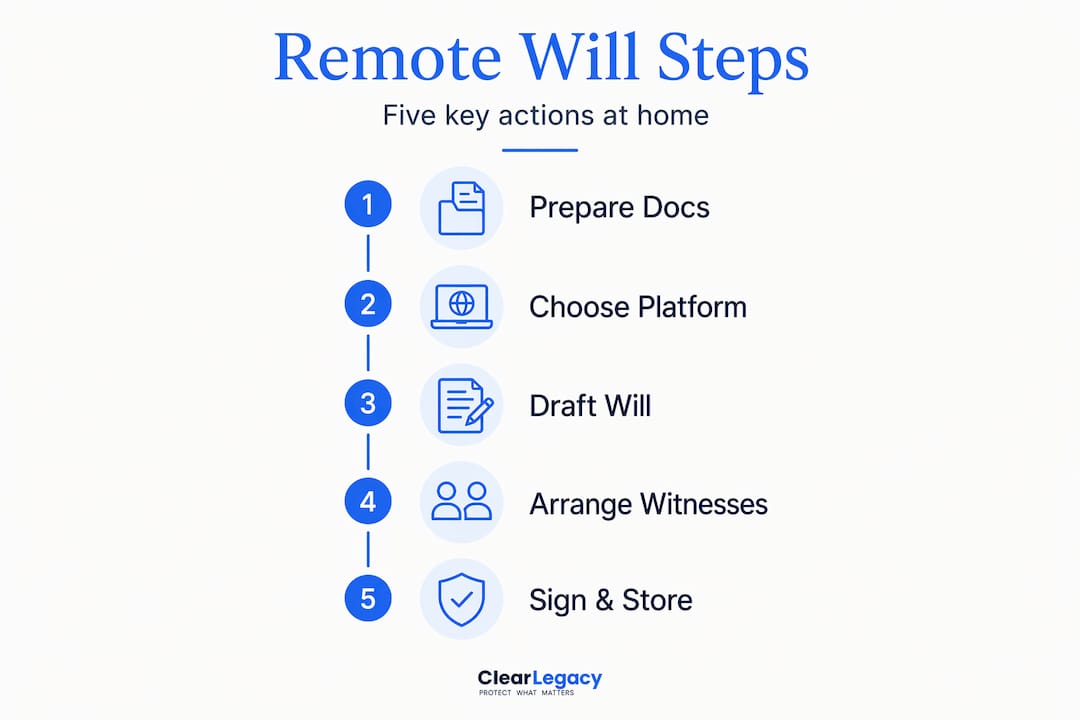
Choose your platform carefully. Look for a service that offers qualified estate planner review, transparent fixed pricing, and clear information about how your document will be stored and delivered. Clearlegacy, for example, charges from £69 and delivers your completed will by email within 24 hours.
-
Complete the online questionnaire. You will be asked about your assets, your chosen executors (the people who will carry out your wishes), your beneficiaries (who receives what), and any guardianship wishes if you have children under 18. Answer thoroughly. Vague answers produce vague clauses, and vague clauses invite disputes.
-
Review the draft document. Most reputable platforms send you a draft for review before finalisation. Read it carefully. Check that names are spelled correctly, that percentages add up to 100%, and that any residuary clause (the instruction covering assets not specifically named) reflects your intentions.
-
Arrange your witnesses. This is the step where many people misunderstand what "remote" actually permits in England and Wales. Online wills are legally valid only if signed and witnessed correctly under section 9 of the Wills Act 1837. That means you must sign the will in the physical presence of two witnesses, who must also sign in your presence. Email or electronic signatures alone are not sufficient for a will. Your witnesses cannot be beneficiaries or the spouses of beneficiaries.
-
Print, sign, and witness the document. Once satisfied, print the final version, sign it, and have both witnesses sign it in the same room on the same occasion. Do not pre-sign before the witnesses arrive.
-
Consider a Lasting Power of Attorney (LPA). A will only takes effect after death. An LPA allows a trusted person to manage your financial or health decisions if you lose mental capacity. Many remote estate planning services now help you prepare LPA paperwork alongside your will, though these also require specific witnessing and registration with the Office of the Public Guardian.
-
Store the original safely. A digital copy is useful for reference, but the original signed will is the legally operative document. Store it with a solicitor, a dedicated document storage service, or in a secure location known to your executor.
Pro Tip: Coordinate your witnesses in advance, ideally two people who live nearby and have no interest in your estate. Book a time with them before you finalise your document, so there is no delay between receiving your draft and executing it properly.
Mistakes that can invalidate your remote estate plan
Remote legal estate advice removes many of the logistical barriers to getting a will written, but it does not remove the legal rules that govern whether a will holds up. DIY or AI-generated documents frequently fail to meet formal legal requirements, creating the very probate complications they were meant to prevent.
The five most common errors are:
- Witnesses who are also beneficiaries. A beneficiary (or their spouse) who witnesses your will loses their entitlement under it. The will remains valid, but that person receives nothing.
- Signing before witnesses are present. If you sign first and your witnesses sign later, even minutes later, the will is not validly executed under section 9 of the Wills Act 1837.
- Outdated beneficiary information. If a named beneficiary predeceases you and your will has no substitute provision, that gift may fail and fall into the residuary estate or cause a partial intestacy.
- Ignoring assets outside the will. Pensions, life insurance policies, and jointly held property typically pass outside the will altogether. Coordinating beneficiary designations across all your assets requires care, and is where professional input makes the most difference.
- Failing to update after major life events. Marriage revokes a will automatically in England and Wales. Divorce does not revoke it but removes your former spouse as a beneficiary and executor, which may leave gaps you did not intend.
A will that has not been properly executed is not just incomplete. It is as if it never existed. Your estate would then pass under the rules of intestacy, which follow a fixed legal formula with no regard for your actual wishes.
Understanding the pros and cons of online wills before you start helps you choose a service that mitigates these risks rather than glossing over them.
Verifying and maintaining your estate plan over time
Creating your will is the beginning, not the end. A plan that sat in a drawer for fifteen years may no longer reflect your life. The table below sets out the key verification and upkeep steps, along with sensible timelines.

| Task | When to do it | Why it matters |
|---|---|---|
| Confirm executor and witnesses have copies | Immediately after signing | Prevents the will being untraceable when needed |
| Review beneficiary designations on pensions and life policies | Annually | These pass outside the will and override it |
| Full will review | Every 3 to 5 years | Life changes and asset values shift significantly over time |
| Update after marriage, divorce, or birth of a child | Within 3 months of the event | These events either revoke the will or create unintended gaps |
| Review after acquiring property | Within 6 months | Property ownership affects inheritance tax planning and intestacy outcomes |
Data protection deserves a mention here. Any platform storing your estate documents should comply with UK GDPR. Check their privacy policy before uploading personal financial information. Reputable services use encrypted portals and do not share your data with third parties without your consent.
Amendments to a will are made through a formal addition known as a codicil, or by making a new will entirely. Most online platforms allow you to return and update your document for a modest fee, which makes affordable ongoing estate management genuinely accessible for families who could never justify repeated solicitor appointments.
My perspective on planning your estate from home
I have watched remote estate planning go from a niche workaround to the preferred route for a significant proportion of UK families in a relatively short time. What strikes me is not the technology. It is the shift in who actually gets a will written.
Before accessible online platforms existed, estate planning was something a meaningful number of people perpetually postponed. The combination of cost, inconvenience, and mild dread about discussing death meant that roughly 60% of UK adults had no will. Remote estate planning has genuinely changed that calculation for the people who are willing to engage.
Where I urge caution is with purely DIY or AI-only tools where no qualified human reviews the output. The technology for drafting is impressive. But attorney guidance remains the most reliable safeguard when your estate plan needs to withstand a challenge from a disappointed relative or a complex blended family situation. The ideal model is a fast, affordable platform with professional oversight built in, not bolted on as an expensive optional extra.
My honest advice: do not let perfect be the enemy of good. A straightforward, properly executed will completed from your kitchen table today is worth more than a theoretically comprehensive plan that never gets started. Use technology to remove the friction. Use qualified oversight to remove the risk.
— Sat
Start your will with Clearlegacy today

If you are ready to take a practical step towards protecting your family, Clearlegacy makes the process straightforward. For as little as £69, you can complete your will in around 15 minutes using a guided online questionnaire. Every document is reviewed by a qualified estate planner before delivery, and you receive your finished will by email within 24 hours. There are no hidden fees and no hourly solicitor rates.
Clearlegacy's service is built specifically for the UK market, with full compliance under the Wills Act 1837 and clear guidance on how to execute your will correctly with witnesses. Over 100 UK families have already used the platform to secure their legacies without leaving home. Whether you want to write your will today or want to compare what is available before committing, Clearlegacy's will writing service gives you a transparent starting point.
FAQ
What does remote estate planning from home mean?
Remote estate planning from home means using secure online platforms to draft, review, and finalise your will and related documents without visiting a solicitor in person. The term covers everything from AI-assisted questionnaires to video consultations with qualified estate planners.
Is an online will legally valid in the UK?
Yes, provided it meets the formalities in section 9 of the Wills Act 1837. The document must be signed by the testator in the presence of two independent witnesses, who must also sign in the testator's presence. A digital or email signature alone is not sufficient for a will in England and Wales.
Can I update my will remotely after major life changes?
Yes. Most online will platforms allow you to return and amend your will through a new document or a formal codicil. Marriage automatically revokes a previous will in England and Wales, so updating promptly after major life events is particularly important.
What are the risks of using a DIY will template?
DIY templates carry the risk of failing to meet UK-specific legal formalities, omitting provisions for complex family situations, and leaving assets outside the will uncoordinated with your overall estate plan. Professional review, even through an affordable online service, significantly reduces these risks.
How long does it take to create a will online in the UK?
With a service like Clearlegacy, you can complete the questionnaire in approximately 15 minutes. The document is then reviewed by a qualified estate planner and delivered to you by email within 24 hours, at a fixed price from £69.