
TL;DR:
- Storing your will in a government-backed, solicitor’s secure vault, or accredited provider ensures documented custody and easier probate access.
- Complement this with registration in the National Will Register and clear written instructions to prevent loss or inaccessibility when it matters most.
The safest way to store your will after writing it is to choose a formally recognised location where the original document is protected from damage, accessible to your executors, and supported by a clear record of its whereabouts. Your options include lodging it with HM Courts & Tribunals Service, leaving it with a solicitor or professional will writer, using a secure home safe, or placing it in a bank safe-deposit box. Each method carries different implications for security, cost, and executor access. Getting this decision right is just as important as writing the will itself.
Where to store your will after writing: the most secure options
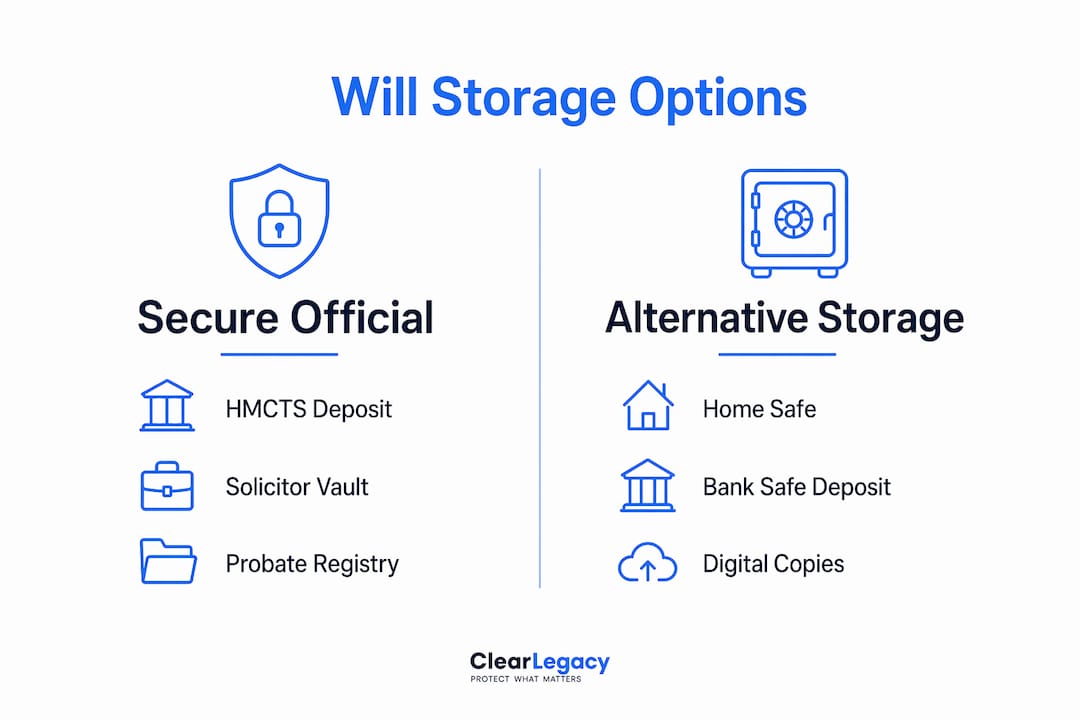
The three most legally credible locations for post-writing will storage in the UK are HM Courts & Tribunals Service (HMCTS), a solicitor's secure vault, and a professional independent storage provider. Each offers documented custody, which matters significantly during probate.

HM Courts & Tribunals Service operates an official will deposit scheme through the Newcastle District Probate Registry. You can lodge your will with HMCTS for a one-off fee of £23, payable by cheque or postal order. After a two-week processing period, you receive a lodgement certificate confirming the document is held securely. This means your will is stored in a government-controlled facility with no ongoing fees and no risk of it being misplaced by a third party. Fee assistance is available for those on low incomes.
Solicitor custody is the option most estate planning professionals recommend for straightforward peace of mind. Solicitor firms store wills in secure vaults with chain-of-custody records, and many offer free or low-cost storage as part of their will-writing service. When you pass away, the solicitor can notify your executors directly, which removes one layer of uncertainty from an already difficult process.
Professional independent storage providers offer a middle ground, typically providing fireproof, climate-controlled vaults with online registration of the document's location. These services often link to will registers, making it easier for executors to trace the original.
| Storage option | Key advantage | Key limitation |
|---|---|---|
| HMCTS deposit | Government-backed, low one-off cost | Two-week processing; requires postal submission |
| Solicitor custody | Chain-of-custody records; executor notification | Ongoing relationship with a firm required |
| Independent provider | Climate-controlled; often linked to registers | Variable quality; check accreditation |
| Home safe | Immediate access; no third-party involvement | Risk of damage, loss, or executor difficulty |
| Bank safe-deposit box | High physical security | Access restrictions after death; rental fees |
Pro Tip: Always keep your lodgement certificate or storage receipt in a separate, known location. If the certificate itself is lost, your executor will still need to know which institution holds the original.
Home safes and bank safe-deposit boxes: risks and recommendations
Home storage and bank safe-deposit boxes are popular choices, but both carry specific risks that are worth understanding before you commit to either.
A fireproof and waterproof home safe offers genuine protection against the most common causes of document loss. Home safes mitigate fire and flood risks effectively, provided your executors know the safe's location and have access to the combination or key. The problem arises when that information is not shared. A will locked inside a safe that no one can open is, in practical terms, as inaccessible as a will that does not exist.
Bank safe-deposit boxes offer high physical security, but they create a specific legal complication after death. Banks may restrict executor access to a safe-deposit box until a grant of probate is issued. The difficulty is circular: to obtain probate, the executor often needs the will, but the will is locked in the box that requires probate to open. Some banks will allow a limited inspection of the box in the presence of a bank official to retrieve a will specifically, but this varies by institution and is not guaranteed.
Key precautions to take with either home or bank storage:
- Tell at least two trusted people (ideally both executors) exactly where the will is stored and how to access it.
- Keep a written note of the storage location with your other important documents, such as your passport or property deeds.
- Never store the only copy of your will in a location that requires your death to be legally confirmed before it can be opened.
- Avoid attaching staples or paperclips to the original document, as marks suggesting tampering can complicate probate.
- Review access arrangements after any change of address, change of bank, or change of executor.
Pro Tip: If you use a home safe, consider leaving a sealed envelope with your solicitor or a trusted family member that contains the safe's access instructions. This avoids the document being accessible to anyone during your lifetime while still protecting your executors after your death.
What role do digital copies and will registers play?
Digital copies and will registration services are genuinely useful tools, but they serve a supporting role rather than a primary storage function.
Digital copies cannot replace the original signed document for probate purposes under current UK law. A scanned PDF of your will, however clearly legible, will not be accepted as the basis for a grant of probate. Its value lies in allowing your executors to read and understand your wishes quickly, and in helping them confirm what the original should contain if any dispute arises. If you do store a digital copy, use encrypted cloud storage with strong password protection and share access details with your executors securely.
The National Will Register does not hold your will. It records the fact that a will exists and where the original is stored. Executors and solicitors can search the register after your death to locate the document, which is particularly valuable if you have moved house, changed solicitors, or stored the will somewhere unexpected. Registration costs a modest fee and takes only a few minutes.
The most effective approach combines physical storage with registration and clear communication:
- Store the original in a formally recognised location (HMCTS, solicitor, or accredited provider).
- Register the will's location with the National Will Register.
- Keep an encrypted digital copy for reference, shared securely with your executors.
- Leave written instructions with your other important documents confirming all of the above.
This layered approach means that even if one element fails, your executors have multiple routes to locating and verifying your original will.
How to make sure your executors can find your will
Writing a will that no one can find when it matters is one of the most common and avoidable failures in estate planning. Verbal instructions alone are insufficient; written and multiple notifications are what actually protect your executors and your beneficiaries.
Follow these steps to make your will genuinely accessible:
- Tell your executors in writing where the original will is stored, including the name of the institution, any reference number, and the contact details for retrieving it.
- Provide a letter of instruction kept with your other important documents at home. This letter should list the storage location, the names and contact details of your executors, and any other relevant documents such as your lodgement certificate or storage receipt.
- Confirm access procedures for each storage type. If the will is with a solicitor, your executors should know the firm's name and address. If it is in a home safe, they need the combination or key location.
- Register the will's location with the National Will Register so that a professional search will locate it even if your personal records are lost.
- Review executor knowledge after major life events. After marriage, divorce, or the birth of a child, revisit both the will itself and your storage arrangements to confirm everything remains current and your executors are still the right people for the role.
Storing the will alongside its original execution paperwork, including witness signatures and any supporting affidavits, strengthens its admissibility during probate without requiring further evidence. This is a detail many people overlook, but it can save your estate considerable time and cost if the will's validity is ever questioned.
When an original will is lost or destroyed, reconstruction is often contentious and can lead to family disputes that undermine the very intentions the will was meant to protect. Secure, documented storage is the single most effective way to prevent this outcome.
Key takeaways
Secure will storage requires combining a formally recognised physical location with clear written communication to your executors and registration of the will's whereabouts.
| Point | Details |
|---|---|
| HMCTS deposit is the most official option | Lodge your original will for £23 with the Newcastle District Probate Registry for government-backed storage. |
| Solicitor custody offers the clearest executor pathway | Firms maintain chain-of-custody records and can notify executors directly, reducing probate delays. |
| Home and bank storage require extra communication steps | Executors must know access details in advance; bank boxes can create a circular access problem after death. |
| Digital copies support but cannot replace originals | Encrypted digital copies aid reference only; the signed original remains legally required for probate. |
| Registration and written instructions are non-negotiable | The National Will Register and a written letter of instruction together protect against the will being untraceable. |
Why I think most people get will storage backwards
Most people treat will storage as an afterthought. They spend time and care writing the document, then fold it into an envelope and put it in a drawer. I have seen this cause real distress for families who are already dealing with grief, and it is entirely preventable.
The insight that changed how I think about this is simple: a will is only as useful as its accessibility at the moment it is needed. A perfectly drafted document that cannot be located, or that is locked behind a legal access problem, turns the estate administration process from a paperwork exercise into a dispute. That is the opposite of what any testator intends.
My honest recommendation is to use HMCTS deposit or solicitor custody as your primary storage method, then layer on the National Will Register and a clear written letter of instruction. This is not overcautious. It is the minimum that gives your executors a realistic chance of acting on your wishes without delay or contest. If you have a legally valid will under the Wills Act 1837, protecting it with equally careful storage is the logical next step.
Review your storage arrangements every time something significant changes in your life. A will written before a second marriage, a house move, or the arrival of grandchildren may need updating, and your storage plan should be reviewed at the same time.
— Sat
Start with a will that is built to last

If you have already written your will, the next step is making sure it is stored correctly and that your executors know exactly where to find it. If you are still in the process of writing, Clearlegacy makes it straightforward. Starting from £69, you can complete your will in around 15 minutes through Clearlegacy's online platform, with the document reviewed by qualified estate planners and delivered to you within 24 hours. The service is fully compliant with the Wills Act 1837 and comes with fixed pricing and no hidden fees. Over 100 UK families have already used Clearlegacy to protect their estates. You can explore the full online will writing service and get started today at clearlegacy.co.uk.
FAQ
Where is the safest place to keep your will in the UK?
The safest place to store your will in the UK is with HM Courts & Tribunals Service or a solicitor's secure vault, as both provide documented custody and clear executor access. HMCTS charges a one-off fee of £23 and issues a lodgement certificate confirming the deposit.
Can I store my will at home?
You can store your will at home in a fireproof and waterproof safe, but you must ensure your executors know the location and have access to the safe's combination or key. Home storage carries a higher risk of loss or damage compared to professional or government storage.
Do I need to register my will?
Registering your will with the National Will Register is not a legal requirement, but it is strongly recommended. The register records where your original will is stored, helping executors locate it quickly without the risk of it being overlooked or lost.
Can a digital copy of my will be used for probate?
A digital copy cannot be used to obtain a grant of probate under current UK law. The original signed document is legally required, so digital copies should be treated as reference tools only, stored securely with access shared with your executors.
How often should I review my will storage arrangements?
You should review your will storage arrangements after any significant life event, including marriage, divorce, the birth of a child, a house move, or a change of executor. Keeping storage details current prevents delays and disputes during estate administration.