
TL;DR:
- Appointing a guardian in a will ensures your children are cared for by someone you trust if both parents pass away. The guardian gains parental responsibility automatically through a valid, witnessed will, providing immediate stability without court interference. Regularly review and update your guardianship choice to reflect changes in circumstances and avoid legal disputes.
Guardianship in a will UK is the legal appointment of a trusted person to care for your children or dependents if you die before they reach adulthood. Known formally as testamentary guardianship, this provision sits within the framework of the Children Act 1989 and gives you direct control over who raises your children. Without it, the Family Court decides. That decision may not reflect your wishes, your values, or your children's existing relationships. Appointing a guardian in your will is one of the most protective steps any parent can take.
What does guardianship in a will UK actually mean?
A testamentary guardian is someone named in a parent's will who gains parental responsibility on the parent's death, provided no surviving parent already holds that responsibility. The term "testamentary" simply means the appointment is made through a will, as opposed to a court order. This distinction matters because a will-based appointment takes effect automatically, without requiring a court hearing.

Parental responsibility covers all the rights, duties, and authority a parent holds over a child's upbringing. A testamentary guardian steps into that role. They make decisions about education, healthcare, religion, and where the child lives. The appointment does not transfer ownership of assets. Financial matters require separate planning, which is covered later in this guide.
The Children Act 1989 governs how testamentary guardianship operates in England and Wales. Northern Ireland follows similar principles under its own legislation. Scotland operates under a distinct legal framework through the Children (Scotland) Act 1995, so parents in Scotland should seek advice specific to Scottish law.
Who can be a guardian in a UK will?
Choosing the right person is a deeply personal decision, but UK law sets clear boundaries on who qualifies.
Eligibility requirements include:
- The person must be aged 18 or over at the time they take on the role.
- They must have the mental capacity to fulfil the responsibilities of guardianship.
- They do not need to be a blood relative. A close friend, godparent, or trusted family member outside the immediate family can all be valid choices.
- Step-parents can be appointed, but only if they already hold parental responsibility through a parental responsibility agreement or court order.
Guardian appointments do not automatically confer parental responsibility in every scenario. The appointment activates only when no surviving parent with parental responsibility remains. If one parent survives, the appointed guardian does not step in automatically. This is a point many parents misunderstand.
Pro Tip: Appoint a substitute guardian alongside your primary choice. If your first nominee dies before you, or declines the role, a substitute prevents the appointment falling to the Family Court by default.
The guardian role is entirely separate from the executor role. Your executor administers your estate, deals with probate, and distributes assets. Your guardian cares for your children. These can be the same person, but they carry distinct legal responsibilities. Keeping them separate often works better in practice, particularly where large estates are involved.
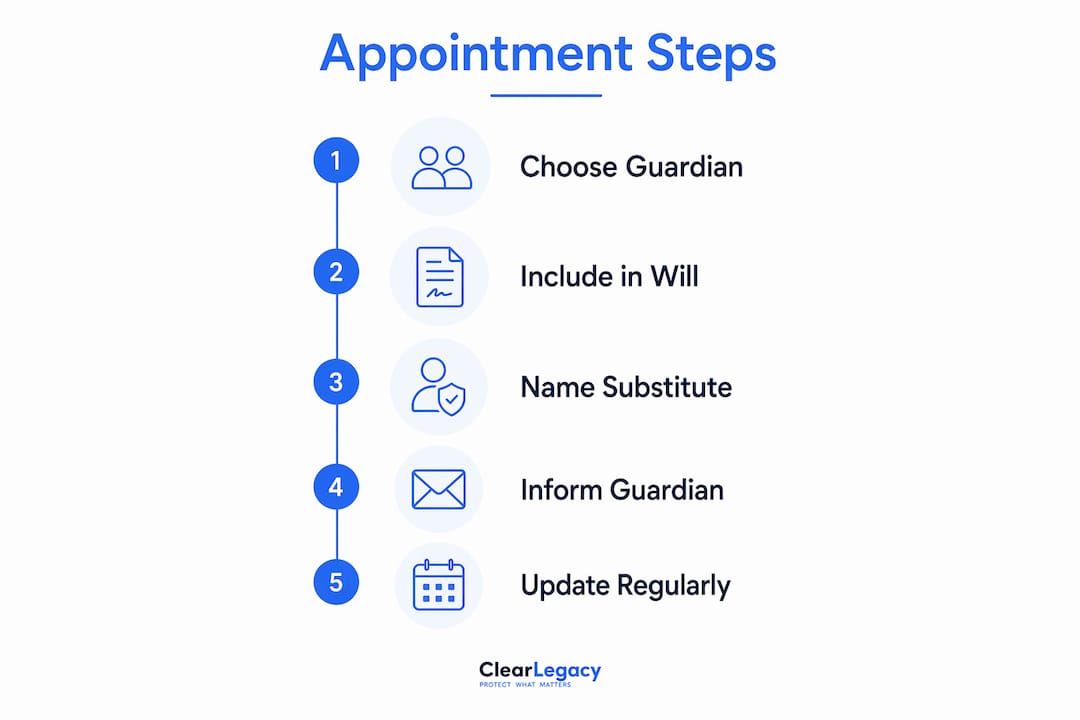
How to appoint a guardian in your UK will: step by step
Appointing a guardian correctly requires following the legal formalities that govern all valid wills in England and Wales.
-
Draft a guardianship clause. Your will must include a clear, specific clause naming your chosen guardian by their full legal name. Vague references such as "my sister" are not sufficient. Include their address for clarity.
-
Meet the Wills Act 1837 requirements. Under section 9 of the Wills Act 1837, your will must be in writing, signed by you in the presence of two independent witnesses, and signed by both witnesses in your presence. Neither witness should be a beneficiary of the will or married to one.
-
Sign and witness the will correctly. Both witnesses must be present at the same time when you sign. A will signed without proper witnessing is invalid. An invalid will means your guardianship appointment has no legal force.
-
Inform your nominated guardian. Communicating your choice to the person you have named reduces delays and legal complications. A guardian who is unaware of their appointment may decline or be slow to act at a critical moment.
-
Store your will safely. Your executor needs to locate the will quickly after your death. A will stored in an inaccessible location defeats its own purpose.
-
Review the appointment regularly. Circumstances change. Your chosen guardian may move abroad, become unwell, or your relationship may change. Review your will every three to five years, or after any major life event.
"A properly stored and witnessed will ensures executors can act swiftly." Executors play a key role in ensuring guardianship instructions are found and followed after death.
The legal weight of a valid guardianship appointment is significant. When a valid appointment exists, no court approval is required, allowing for immediate stability for your children. That speed matters enormously in the days following a parent's death.
What happens if you do not name a guardian in your will?
Failing to appoint a guardian means the Family Court has full discretion to decide a child's future after both parents die. That process takes time, and time is the last thing a grieving child has in abundance.
The consequences of leaving this decision to the court include:
- Delays in placement. Social services may become involved while the court considers applications from relatives or other interested parties.
- Competing applications. Different family members may apply to become the child's guardian, leading to disputes that play out in court proceedings.
- Outcomes that do not reflect your wishes. Courts prioritise the child's welfare and will consider various applicants if no guardian is named, which may not align with parents' wishes.
- Emotional disruption for the child. Uncertainty about where a child will live adds distress to an already traumatic period.
Relatives can apply to the Family Court to become a child's guardian under the Children Act 1989. The court will assess each applicant's suitability based on the child's welfare. This process can take months. During that time, the child's living arrangements may be temporary and unsettled.
The position differs slightly across jurisdictions. In Northern Ireland, the court process follows similar principles but operates under separate legislation. Parents in Wales follow the same rules as England under the Children Act 1989.
Guardianship and trusts: separating care from money
Guardianship determines who cares for your children. It does not determine who manages their money. These are two separate legal functions, and conflating them is one of the most common mistakes parents make in estate planning.
Guardianship focuses on care and upbringing responsibilities. Trusts must be set up separately to manage inheritance funds. A trust written into your will allows you to ring-fence assets for your children's benefit until they reach a specified age, typically 18 or 21, though you can set any age you choose.
| Role | Responsibility | Who holds it |
|---|---|---|
| Guardian | Day-to-day care, education, healthcare decisions | Named in your will as guardian |
| Trustee | Managing and distributing inherited assets | Named in your will as trustee |
| Executor | Administering the estate and obtaining probate | Named in your will as executor |
Trustees and guardians can be the same person, but separating them provides a useful check. A trustee who is independent of the guardian can act as a financial safeguard, releasing funds for the child's benefit without any single person holding unchecked control over both care and money.
Pro Tip: Set a letter of wishes alongside your will. This non-binding document guides your trustee on how you would like funds used, covering things like school fees, holidays, or university costs. It does not form part of the will itself but gives your trustee meaningful direction.
A trust written into your will also protects assets from being accessed before your child is mature enough to manage them. Without a trust, a child inherits outright at 18 under the rules of the Administration of Estates Act 1925. Many parents prefer to delay that access to 21 or 25.
Key takeaways
Appointing a guardian in your will under the Children Act 1989 is the only legally reliable way to control who cares for your children if both parents die.
| Point | Details |
|---|---|
| Testamentary guardianship | A guardian named in your will gains parental responsibility automatically, with no court hearing required. |
| Wills Act 1837 formalities | Your will must be signed by you and two independent witnesses to be legally valid. |
| Inform your guardian | Tell your nominated guardian in advance so they can accept and act without delay. |
| Separate guardian from trustee | Appoint a trustee to manage your children's inheritance independently of the guardian. |
| Review regularly | Revisit your guardianship appointment every three to five years or after major life changes. |
Why I think most parents leave this too late
Parents often treat guardianship as a decision they will make "when the time is right." The uncomfortable reality is that the time is right the moment you have a child. I have seen families where both parents died without a will, leaving grandparents, aunts, and uncles in a painful dispute before the Family Court. The children spent months in temporary arrangements while the court worked through competing applications. None of that was inevitable.
The other mistake I see regularly is verbal assurances. A parent tells their sister, "We want you to have the children if anything happens." The sister agrees. Nothing is written down. When the worst happens, that conversation has no legal standing whatsoever. The Family Court is not bound by it. Only a properly witnessed will carries legal weight.
Reviewing your guardianship choice matters too. The person you trusted at 28 may not be the right choice at 42. Circumstances change. People move, relationships shift, health declines. A will you wrote when your children were toddlers may name someone who is no longer in a position to take on the role. Reviewing your basic will contents every few years is not excessive. It is responsible.
The emotional side of this decision is real. Choosing between a sibling and a close friend, or deciding whether to split guardianship from financial control, requires honest conversations. Have them. An awkward conversation now is far better than a legal dispute later.
— Sat
Clearlegacy: appoint a guardian in your will today
Naming a guardian is one of the most protective decisions you can make for your children. Clearlegacy makes it straightforward.

With prices starting at £69 and wills delivered within 24 hours, Clearlegacy's online will writing service guides you through every clause, including your guardianship appointment, in around 15 minutes. Each will is reviewed by a qualified estate planner and complies fully with the Wills Act 1837. Over 100 UK families have already used Clearlegacy to protect their children's futures. You can complete yours today, without a solicitor appointment and without hidden fees. If you are ready to write a will that includes a legally valid guardianship clause, get started here.
FAQ
What is testamentary guardianship in the UK?
Testamentary guardianship is the formal appointment of a guardian through a will. The named person gains parental responsibility for your children automatically on your death, provided no surviving parent with parental responsibility remains.
Does a guardian need parental responsibility to be appointed?
No. You can appoint any eligible adult as guardian in your will. However, the guardian only gains parental responsibility when the appointment activates, which is on the death of the last surviving parent with parental responsibility.
What happens if both parents die without naming a guardian?
The Family Court takes full discretion over the child's future. Relatives can apply to become guardians, but the process can take months and the outcome may not reflect the parents' wishes.
Can a guardian and a trustee be the same person?
Yes, but separating the roles is often advisable. An independent trustee manages your children's inherited assets without the same person holding unchecked control over both care and finances.
How often should I update my guardianship appointment?
Review your will every three to five years, or after any significant life change such as a move, a change in your relationship with the nominee, or a change in their health or circumstances.