
TL;DR:
- Planning your estate without a solicitor is legally valid in England and Wales if formalities are properly followed, including correct witnessing.
- Using guided online tools or templates can be affordable and effective for straightforward estates, but complex situations may still require professional advice.
Most people assume that planning your estate requires a solicitor's appointment, several hundred pounds in fees, and weeks of waiting. That assumption is wrong. Estate planning without a solicitor is not only possible in England and Wales, it is legally valid when you follow the correct formalities. Whether you want to write a will, set up a Lasting Power of Attorney (LPA), or simply organise your wishes on paper, there are affordable, accessible routes that do not require you to sit across a desk from a lawyer. This guide explains exactly how to do it safely, clearly, and without unnecessary expense.
Table of Contents
- Key takeaways
- Estate planning without a solicitor: what the law says
- DIY estate planning: your accessible options
- Risks and how to mitigate them
- Practical steps to plan your estate without a solicitor
- Online services vs solicitors: a clear comparison
- My honest view on the DIY estate planning trend
- Start your estate plan today with Clearlegacy
- FAQ
Key takeaways
| Point | Details |
|---|---|
| DIY wills are legally valid | A will made at home carries the same legal weight as one drafted by a solicitor, provided statutory formalities are met. |
| Correct witnessing is non-negotiable | Two independent, non-beneficiary witnesses must be present when you sign your will for it to be valid under the Wills Act 1837. |
| Online services reduce error risk | Guided online platforms check your document against legal requirements, significantly lowering the chance of rejection. |
| LPAs can be registered without a solicitor | The Office of Public Guardian provides free tools to create LPAs, with only a £92 registration fee required. |
| Know when to seek professional advice | Complex estates involving overseas assets, business interests, or blended families benefit from professional input. |
Estate planning without a solicitor: what the law says
The foundational rule is straightforward. Under section 9 of the Wills Act 1837, a will is legally valid in England and Wales if it meets these conditions:
- The person making the will (the testator) must be aged 18 or over and of sound mind.
- The will must be in writing.
- The testator must sign the will, or direct someone to sign it in their presence.
- The signature must be made or acknowledged in the presence of two witnesses, both present at the same time.
- Both witnesses must then sign the will in the testator's presence.
- Witnesses must not be beneficiaries of the will, nor married to a beneficiary. If they are, the gift to that person becomes void.
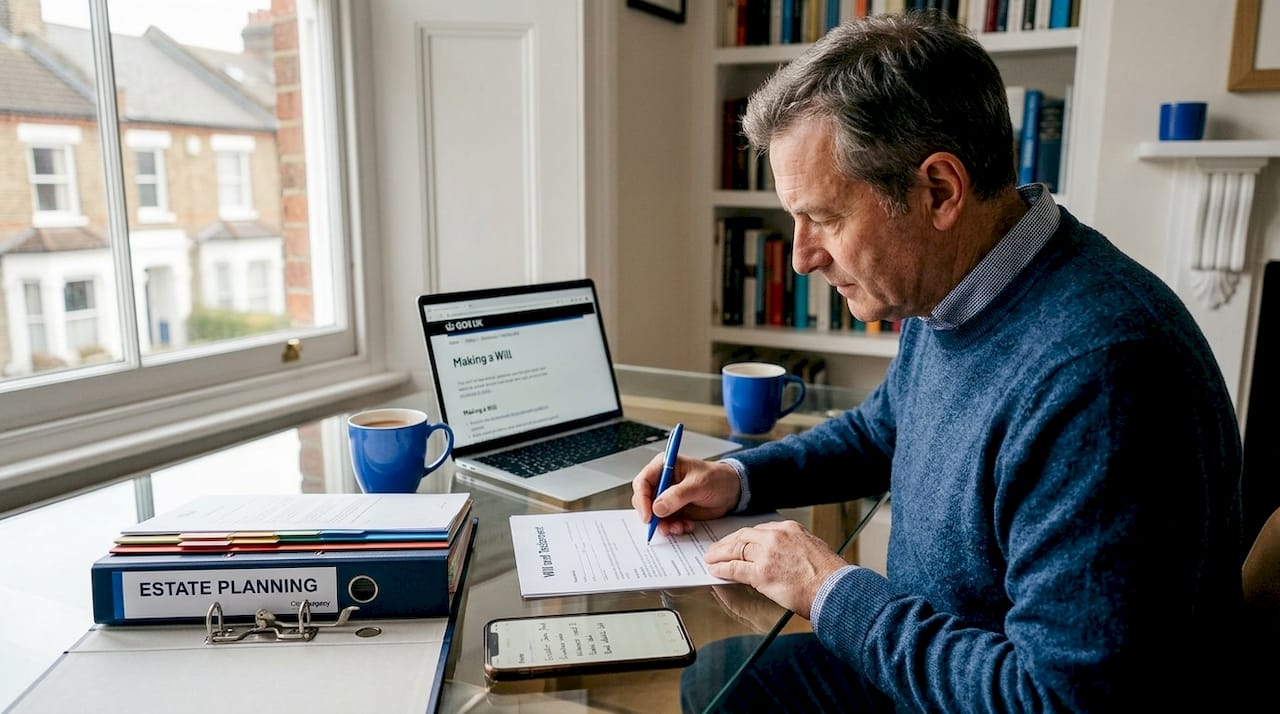
A DIY will created at home with these formalities observed has exactly the same legal weight as one prepared by a solicitor. The law does not require professional involvement. What it does require is precision.
For Lasting Powers of Attorney, the legal framework is similarly accessible. The Office of Public Guardian (OPG) oversees LPA registration in England and Wales, and its online service allows you to complete the forms yourself. The only mandatory cost is the £92 registration fee per LPA, and no legal qualifications are required. You will need a certificate provider, a person who confirms you understand the document and are not under pressure, but this role can be filled by a professional you already know, such as a GP or a social worker.
Pro Tip: Always date your will clearly. An undated will is not automatically invalid, but it can create confusion if multiple versions exist. A clear date helps establish which document reflects your most recent wishes.
DIY estate planning: your accessible options
You do not need to choose between doing everything yourself with no guidance and paying a solicitor. There is a spectrum of options, and understanding them helps you pick the approach that suits your circumstances.
-
Fully DIY, using template documents. You can find will templates online and complete them manually. This is the lowest-cost option, but it carries the highest risk of error. A missed clause, an improperly witnessed signature, or ambiguous wording can render your will invalid or lead to a contested probate.
-
OPG's online LPA tool. The OPG's online service lets you create Property and Financial Affairs LPAs and Health and Welfare LPAs without solicitor involvement. Thousands of people in England and Wales use this route each year. The forms guide you through each step, flag common errors, and submit directly to the OPG for registration.
-
Guided online will-writing services. These platforms sit between a blank template and a solicitor. You answer a structured set of questions about your assets, wishes, beneficiaries, and executors. The service then generates a legally compliant will, often reviewed by a qualified professional before it is issued to you. Online will services typically cost £150 to £300, compared with several hundred pounds or more for a solicitor.
-
Hybrid approach. You draft your will using an online service, then pay for a one-off professional review. This combines the cost savings of self-directed estate planning with a safety net for anything you may have overlooked.
The right option depends on your estate's complexity. For a straightforward estate, a single property, a spouse or partner as primary beneficiary, and perhaps children named as secondary beneficiaries, a good online service provides everything you need. Where your situation involves trusts, multiple properties, overseas assets, or particular tax considerations, professional input becomes genuinely worthwhile.
Risks and how to mitigate them
Estate planning without a solicitor carries real risks when approached carelessly. Understanding the most common failure points helps you avoid them entirely.
- Witnessing errors. Signing order mistakes and invalid certificate providers are among the most frequent reasons for LPA rejection by the OPG. The same applies to wills: if your witnesses did not all sign in each other's presence, the document may be challenged.
- Rejected LPA applications. The £92 registration fee is non-refundable if your application is rejected due to errors. Repeat applications mean paying again, which can quickly exceed the cost of using a guided service from the start.
- AI-generated documents. Relying on a general AI chatbot to draft your will is a significant risk. AI-generated wills can contain errors that lead to invalid or contested estate plans, because these tools lack understanding of your personal circumstances and the specific requirements of UK law.
- Incomplete coordination. DIY approaches frequently overlook alignment between your will, any trusts you hold, beneficiary designations on pensions and life insurance policies, and your LPAs. Your will cannot override a nominated beneficiary on a pension pot, for example. Each element needs to work alongside the others.
- Missing nuance in complex families. Blended families, trusts, and tax implications are often missed by generic DIY documents. If you have stepchildren, children from a previous relationship, or a cohabiting partner without the automatic rights that marriage confers, a standard template may not adequately reflect your intentions.
Pro Tip: Before signing your will, read it aloud from beginning to end. It sounds slow, but it forces you to notice ambiguous phrasing that your eye might skip over when reading silently.
Practical steps to plan your estate without a solicitor
Follow these steps in order to build an estate plan that is legally sound and genuinely useful to those you leave behind.
-
List your assets and liabilities. Write down everything you own: property, savings accounts, investments, pensions, life insurance policies, and valuable personal possessions. Note any debts, mortgages, or financial obligations. This inventory forms the foundation of your plan.
-
Choose your executors. An executor administers your estate after you die. You can appoint up to four, but two is a practical number. Choose people who are organised, trustworthy, and willing to take on the responsibility. You must ask them before naming them.
-
Decide on your beneficiaries. Be specific. Rather than "my children equally," name them. Where you leave percentage shares of the residuary estate (everything left after specific gifts and debts), state those percentages explicitly.
-
Select and complete the appropriate forms. Use a reputable online will-writing service for your will, and the OPG's online tool for your LPAs. Follow the guided questions carefully.
-
Execute your documents correctly. Sign your will in the presence of two independent witnesses. Both must sign immediately after you. Do not let one witness leave the room before the other has signed. For LPAs, follow the signing order specified in the form precisely.
-
Register your LPAs. Submit your completed LPA forms to the OPG for registration. An LPA cannot be used until it is registered, so do this while you are well and have capacity.
-
Store and share your documents. Keep the originals in a safe, known location. Tell your executors and attorneys where to find them. You may also register your will with the National Will Register for a small fee, so it can be located after your death.
| Document | Who needs it | Key action |
|---|---|---|
| Will | Everyone over 18 with assets or dependants | Draft, sign, and witness correctly |
| Property and Financial Affairs LPA | Anyone who wants to protect finances if incapacitated | Complete OPG form and register |
| Health and Welfare LPA | Anyone who wants to control medical decisions | Complete OPG form and register |
| Letter of wishes | Optional but recommended | Write informally, store with your will |
Online services vs solicitors: a clear comparison
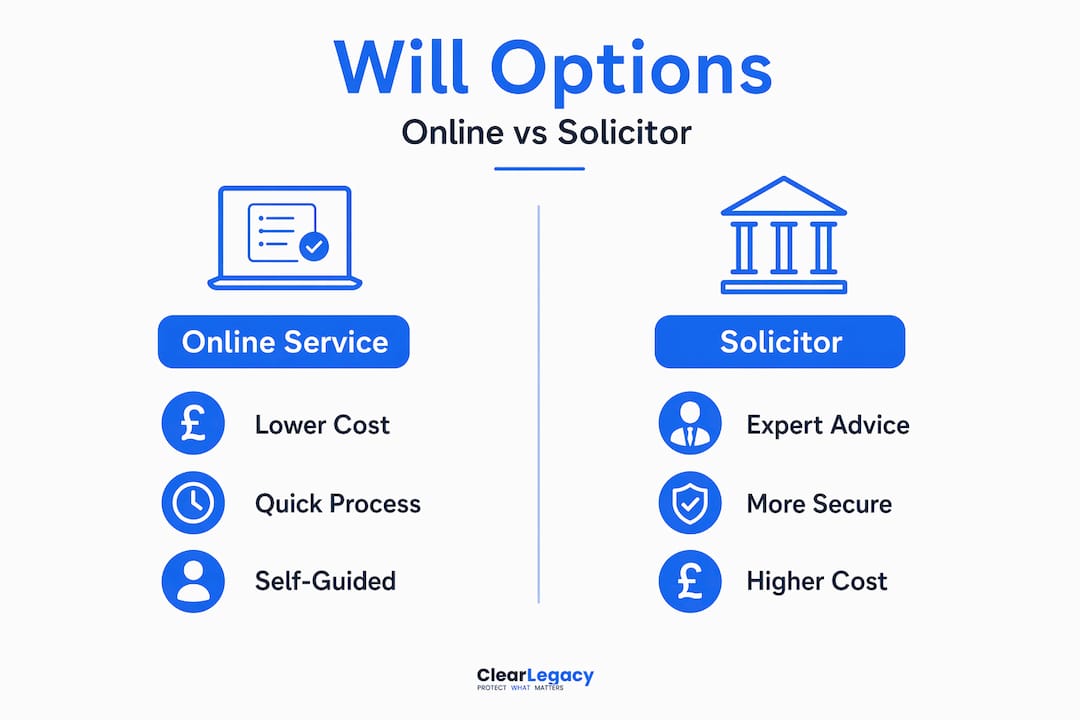
Choosing between an online will service and a solicitor comes down to cost, complexity, and the level of reassurance you need.
| Factor | Online will service | Solicitor |
|---|---|---|
| Cost | From £69 to £300 | £300 to £1,000 or more |
| Turnaround time | Hours to 24 hours | Days to weeks |
| Legal validity | Fully valid if correctly executed | Fully valid |
| Suitability | Straightforward estates | Complex or contentious estates |
| Error risk | Lower with guided platforms | Lowest with experienced solicitor |
| Accessibility | Any time, from home | Appointment required |
The distinction between online will services and solicitors is not about legal validity, it is about the level of guidance and expertise built into the process. For a straightforward estate, a guided online platform matches a solicitor's output at a fraction of the cost. Where professional legal advice genuinely adds value is in situations involving overseas assets, business succession, contested family dynamics, or inheritance tax planning above the £325,000 nil-rate band (or £500,000 when the residence nil-rate band applies to a direct descendant).
My honest view on the DIY estate planning trend
I have seen a clear shift over the past few years. People are no longer intimidated by the idea of writing their own will or setting up an LPA without a solicitor. That confidence is largely earned. The legal framework in England and Wales is accessible, the OPG's tools are genuinely good, and online will-writing services have matured considerably.
But I will be honest about where I think people still go wrong. The temptation to use a free AI chatbot to generate a will is real, and the results can be genuinely dangerous. AI tools produce text that sounds authoritative but misses the legal specifics that matter. A clause that looks reasonable on screen can fail entirely in probate.
What I advise, and what I think works well in practice, is this: use a guided online service that has a qualified professional reviewing your document before you receive it. You get the affordability and speed of a DIY approach without carrying all the risk yourself. Save a solicitor for the moments your estate actually needs one. A blended family with stepchildren, a business interest, a property abroad. Those situations deserve professional input.
For everyone else? A well-structured online service is not a compromise. It is the right tool for the job.
— Sat
Start your estate plan today with Clearlegacy
If you want to plan your estate without a solicitor appointment, without waiting weeks, and without paying hundreds of pounds, Clearlegacy makes it straightforward.
Clearlegacy's online will-writing service starts at just £69. You complete a guided questionnaire in around 15 minutes, and a qualified estate planner reviews your document before it is sent to you by email within 24 hours. The process meets the requirements of the Wills Act 1837 and carries no hidden fees. Over 100 UK families have already used Clearlegacy to protect their loved ones and their assets. If you would like to understand the step-by-step process before you begin, Clearlegacy's guides walk you through exactly what to expect.
FAQ
Is estate planning without a solicitor legally valid in the UK?
Yes. A will created without a solicitor is fully legally valid in England and Wales under the Wills Act 1837, provided it is signed by the testator and witnessed by two independent adults who are present at the same time and are not beneficiaries.
What are the most common mistakes in DIY estate planning?
The most frequent errors are witnessing mistakes, such as witnesses signing at different times, and incomplete coordination between a will, LPA, and pension or life insurance nominations. Signing order errors are also the leading cause of LPA rejection by the OPG.
Can I make an LPA without a solicitor?
Yes. The Office of Public Guardian provides an online tool to create both types of LPA without legal representation. You pay only the £92 registration fee per LPA, and no solicitor is required at any stage.
When should I use a solicitor for estate planning?
Use a solicitor when your estate involves overseas assets, business succession, a blended family with competing interests, or significant inheritance tax planning. For straightforward estates, a guided online service provides legally equivalent results at considerably lower cost.
Are online will-writing services reliable?
Reputable online will-writing services that include professional review of your completed document are reliable and legally sound. Avoid platforms that simply generate a document with no human oversight, and never rely on a general AI tool to draft your will, as AI-generated documents carry significant risk of containing errors that invalidate your estate plan.