
TL;DR:
- Blended families in the UK face unique estate planning challenges because default laws do not recognize stepchildren or non-married partners as inheritors.
- Legal tools like tailored wills and trust structures are essential to protect family members and prevent conflicts, especially after remarriage or asset ownership changes.
Estate planning for blended families in the UK is the process of deliberately structuring wills, trusts, and beneficiary arrangements to protect children and partners from multiple relationships. Without a clear plan, UK intestacy rules under the Administration of Estates Act 1925 exclude stepchildren and unmarried partners entirely. Marriage automatically revokes existing wills, and jointly owned property passes by survivorship, bypassing your wishes altogether. The good news is that legal tools such as life interest trusts, discretionary trusts, and carefully drafted wills give you full control. This guide explains the challenges, the solutions, and the steps to take right now.
What unique inheritance challenges do blended families in the UK face?
Blended families face a set of legal risks that standard estate planning rarely addresses. The UK's default intestacy rules treat stepchildren as legal strangers. Stepchildren have no automatic inheritance rights unless they are legally adopted or explicitly named in a will or trust. That single fact catches many families off guard.
The risks compound quickly when you look at how assets are owned and how life events interact with existing documents:
- Remarriage revokes your will. Marriage automatically revokes any previously made will unless it was drafted "in contemplation of marriage." Failing to write a new will after remarriage is one of the most frequent causes of unintended disinheritance in blended families.
- Joint ownership bypasses your will. Assets held in joint names pass automatically to the surviving owner by right of survivorship. A surviving step-parent then controls the full asset and can distribute it however they choose, potentially cutting out your biological children entirely.
- Cohabitants have no legal protection. There is no such thing as common law marriage in England and Wales. An unmarried partner receives nothing under intestacy, regardless of how long you have lived together.
- Inheritance Tax thresholds create complexity. The current nil-rate band is £325,000 and the residence nil-rate band is £175,000. When assets pass across multiple family lines, reliefs can be lost or duplicated without careful planning.
"Four out of ten professionals report a rise in disputes within blended families over the past year, with 70% of conflicts linked to tensions between a surviving spouse and children from previous relationships."
The pattern is consistent. Complexity drives conflict. Seven out of ten professionals highlight complexity as the main driver of disputes in blended estates. That statistic underlines why a deliberate, documented plan is not optional for blended families. It is the only reliable protection.
Which legal tools help blended families protect children and partners?

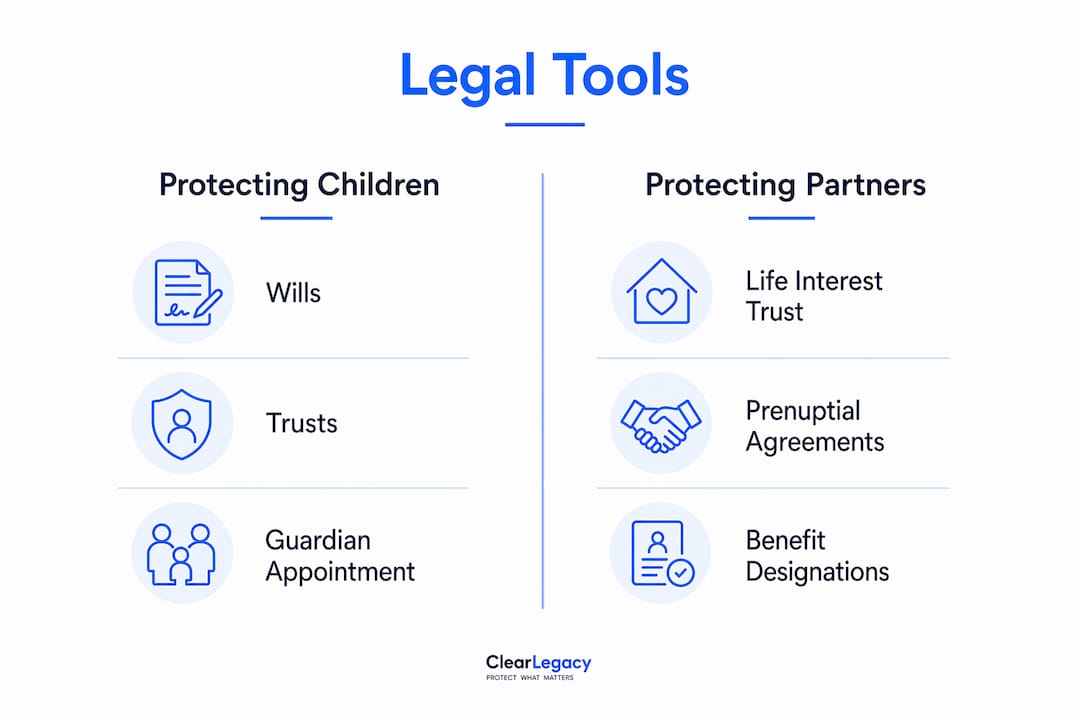
Several legal instruments work together to give blended families fair and enforceable outcomes. No single document does everything. The most effective plans combine at least two or three of the following tools.
Wills tailored for blended families
A will is the foundation. For blended families, a generic will is rarely sufficient. You need to name stepchildren explicitly if you want them to inherit, and you need to specify what each beneficiary receives. Wills for blended families in the UK should also include a residuary clause that clearly handles any assets not mentioned elsewhere. Review your will after every major life event, particularly remarriage.
Trust structures: life interest and discretionary trusts
Trusts allow a surviving partner to benefit during their lifetime while preserving the capital for children from a previous relationship. This is the most practical solution to the classic blended family dilemma: you want to provide for your spouse, but you also want your children to inherit eventually.
The two most common structures are:
- Life interest trust (interest in possession trust). The surviving spouse receives income or the right to occupy a property for life. On their death, the capital passes to named beneficiaries, typically your biological children.
- Discretionary trust. Trustees hold assets and distribute them at their discretion among a defined class of beneficiaries. This offers flexibility when family circumstances are likely to change.
| Trust type | Surviving partner's benefit | Children's inheritance |
|---|---|---|
| Life interest trust | Income or right to occupy property for life | Capital passes on partner's death |
| Discretionary trust | Distributions at trustees' discretion | Included in beneficiary class |
Pro Tip: Name a professional trustee alongside a family member. A solicitor or trust corporation brings impartiality; a family member brings context. The combination reduces the risk of disputes without removing personal knowledge from the decision.
Executors, trustees, and prenuptial agreements
Appointing an independent professional as executor or trustee significantly reduces the risk of family disputes in blended estates. Neutral fiduciaries have no competing loyalties. They apply the terms of the will or trust without the emotional weight that family members carry. You can find guidance on executor responsibilities at Clearlegacy's executor decision tree.
Prenuptial and postnuptial agreements clarify inheritance expectations before disputes arise. Formal documentation prevents misunderstanding, which is the leading cause of litigation in blended family estates. These agreements do not override a will automatically, but they provide strong evidence of intention if a claim is made under the Inheritance (Provision for Family and Dependants) Act 1975.
Finally, beneficiary designations on pensions, life insurance, and jointly owned assets override wills entirely. Review them every time your family structure changes. A pension nomination form completed before a second marriage will pay out to your ex-partner, not your current spouse, regardless of what your will says.
How to create an estate plan for blended families step by step
A structured process prevents the most common oversights. Work through these steps in order.
- Map your full asset picture. List every asset: property, savings, pensions, life insurance, business interests, and jointly owned accounts. Note how each is owned, whether solely, jointly as joint tenants, or jointly as tenants in common.
- Define who you want to provide for. Write down every person you wish to benefit: biological children, stepchildren, your current partner, and any dependants. Be explicit. Vague intentions are not legally enforceable.
- Choose executors and trustees carefully. Select people who can act impartially. For blended families, a professional executor or trustee is often the right choice. Read Clearlegacy's guide on executor responsibilities before making this decision.
- Draft or update your will with specialist input. A solicitor experienced in blended family matters will identify risks you may not have considered. If you have children from two relationships, your will needs to address both sets of interests explicitly.
- Consider trust structures. Decide whether a life interest trust or discretionary trust fits your circumstances. Trusts add a layer of protection that a simple will cannot provide.
- Review all beneficiary designations. Update pension nominations, life insurance policies, and any jointly owned accounts to reflect your current intentions.
- Communicate your intentions. Tell your family what you have planned and why. Disputes often arise not from the plan itself but from surprise. A conversation now prevents a legal battle later.
- Review regularly. Revisit your plan after every significant life event: a new child, a divorce, a property purchase, or a change in financial circumstances.
Pro Tip: Hold your estate planning documents in one secure location and tell your executor exactly where they are. A perfectly drafted will that nobody can find is legally useless.
Common mistakes to avoid in blended family estate planning
Most problems in blended family estates are preventable. They stem from inaction, assumption, or outdated documents.
- Not updating your will after remarriage. Marriage revokes your existing will. Many people do not realise this until it is too late.
- Relying on verbal agreements. "My spouse knows what I want" is not a viable estate strategy. All intentions must be formalised and documented.
- Leaving stepchildren out by default. Stepchildren receive nothing under intestacy. If you want them to inherit, name them explicitly in your will or trust.
- Holding all property as joint tenants. Joint tenancy means the survivor inherits automatically. Changing to tenants in common gives each owner a defined share that can be left by will.
- Appointing a family member as sole executor. In blended families, a sole family executor faces competing loyalties. A neutral professional co-executor removes that pressure.
- Ignoring powers of attorney. Powers of attorney in blended families should be chosen carefully. Naming an agent with clear, uncontested authority prevents disputes over incapacity decisions before death.
- Failing to align your will with a prenuptial agreement. If the two documents contradict each other, litigation becomes far more likely.
"Formal documentation prevents the misunderstanding that is the leading cause of litigation in blended family estates."
The pattern across all these mistakes is the same. Assumptions replace documents. When you assume your family understands your wishes, you leave the outcome to chance and to the courts.
Key takeaways
Effective estate planning for blended families in the UK requires explicit wills, trust structures, and regularly reviewed beneficiary designations to protect every member of the family.
| Point | Details |
|---|---|
| Stepchildren need explicit inclusion | Stepchildren inherit nothing under intestacy; name them directly in your will or trust. |
| Remarriage revokes existing wills | Write a new will immediately after marriage or remarriage to avoid unintended intestacy. |
| Trusts balance competing interests | A life interest trust lets your partner benefit for life while preserving capital for your children. |
| Beneficiary designations override wills | Review pension nominations and life insurance policies after every change in family structure. |
| Neutral executors reduce conflict | A professional executor or trustee removes competing loyalties from the administration process. |
Why blended family estate planning deserves more honesty
The advice I see most often in this area is technically correct but emotionally incomplete. Solicitors explain the tools. Fewer explain the conversation you need to have with your family before you sign anything.
In my experience, the families who avoid disputes are not necessarily the ones with the most sophisticated trust structures. They are the ones who sat down together, explained their reasoning, and made sure nobody was blindsided. A life interest trust is a powerful instrument. But if your adult children from a first marriage do not understand why their inheritance is deferred, they will challenge it the moment you are gone.
The other thing I would say plainly: do not wait for the "right time." Blended families are often formed after a period of upheaval, divorce, or bereavement. The instinct is to let things settle before dealing with paperwork. That instinct is understandable and genuinely dangerous. Remarriage revokes your will on the day it happens. You can be unintentionally intestate before the wedding cake is finished.
Get the documents in place first. Then have the conversation. The order matters more than most people realise.
— Sat
Clearlegacy: wills designed for blended families
Blended families have specific needs that a standard will template cannot meet. Clearlegacy's online will writing service is built for exactly this situation: legally valid wills completed in around 15 minutes, reviewed by qualified estate planners, and delivered within 24 hours.

Prices start at £69 with no hidden fees. Every will is checked for compliance with the Wills Act 1837 before it reaches you. Over 100 UK families have already used Clearlegacy to protect their loved ones. If your family includes stepchildren, a new partner, or assets from a previous relationship, the right time to act is now. You can also explore Clearlegacy's estate planning scenarios to find guidance matched to your specific circumstances.
FAQ
Do stepchildren inherit automatically in the UK?
No. Stepchildren have no automatic inheritance rights under UK intestacy rules unless they have been legally adopted. They must be named explicitly in a will or trust to inherit.
Does getting married cancel my existing will?
Yes. Marriage or remarriage automatically revokes any existing will in England and Wales unless the will was made "in contemplation of marriage." You must write a new will after remarrying to avoid dying intestate.
What is a life interest trust in blended family planning?
A life interest trust lets your surviving partner benefit from an asset, such as the family home, during their lifetime. On their death, the capital passes to your chosen beneficiaries, typically your biological children, rather than to your partner's estate.
Can an unmarried partner inherit under UK intestacy rules?
No. Cohabiting partners receive nothing under the Administration of Estates Act 1925, regardless of the length of the relationship. The only protection is a valid will that names them as a beneficiary.
How often should blended families review their estate plan?
Review your estate plan after every significant life event: remarriage, the birth of a child, a divorce, a property purchase, or a substantial change in assets. Beneficiary designations on pensions and life insurance should be checked at the same time as your will.