TL;DR:
- Writing a will in the UK does not require a solicitor if the document meets the legal formalities.
- A professional solicitor adds value for complex estates, trusts, and inheritance tax planning, but simple situations often only need a DIY or online will.
There is no legal requirement to use a solicitor to write a will in the UK. You can write your own will provided it meets the formalities set out in the Wills Act 1837, including correct signing and witnessing. That said, whether you should use a solicitor depends on how complex your estate is. For straightforward situations, a well-made DIY will or a reviewed online will is perfectly valid. For blended families, business owners, or anyone with inheritance tax concerns, professional legal advice can prevent costly mistakes. This guide helps you decide which route is right for you.
Do I need a solicitor for a will in the UK?
The short answer is no. No legal requirement exists to involve a solicitor when writing a will in England or Wales. What the law does require is that your will complies with section 9 of the Wills Act 1837. That means it must be in writing, signed by you in the presence of two independent witnesses, and those witnesses must sign in your presence.
A solicitor regulated by the Solicitors Regulation Authority brings legal expertise to that process. They can spot problems before they become disputes, advise on guardianship, and flag assets you may have overlooked. For many people with modest, straightforward estates, though, that level of input is not strictly necessary.
The question is not really whether you can write a will without a solicitor. The question is whether your circumstances make professional guidance worthwhile.
What does a solicitor do when writing your will?
A solicitor's core role is to make sure your will is legally valid and clearly expresses your wishes. Solicitors ensure wills meet legal formalities under the Wills Act 1837 and can guide you through complex decisions about trusts, executors, and tax planning.
Here is where their expertise adds genuine value:
- Legal validity. A solicitor checks that your will satisfies every requirement under section 9 of the Wills Act 1837, reducing the risk of it being challenged or declared invalid after your death.
- Inheritance tax planning. Solicitors assist with inheritance tax planning and the inclusion of trusts to protect vulnerable beneficiaries. The current HMRC nil-rate band is £325,000, with a residence nil-rate band of £175,000 for property passed to direct descendants. A solicitor can help you use both allowances effectively.
- Trusts and complex assets. If you own a business, hold property abroad, or want to protect assets for a child with additional needs, a solicitor can draft the appropriate trust structures.
- Executor and guardian appointments. Choosing the right executor matters. A solicitor can explain the legal duties involved and help you make an informed choice.
- Future updates. Life changes. A solicitor can advise on when to update your will and how to add a codicil, which is a formal amendment, without invalidating the original document.
Solicitor fees for wills vary. A straightforward single will typically costs between £150 and £300. Mirror wills for couples often cost more. Fees rise significantly for complex estates involving trusts or tax planning.
Pro Tip: Ask your solicitor for a fixed-fee quote before any work begins. Hourly billing can make even a simple will unexpectedly expensive.
When can you write a will without a solicitor?
Many UK adults can write their own will if their estates are simple and they understand the legal rules. A simple estate typically means leaving all assets to one or two people, with no trusts, no overseas property, and no significant inheritance tax liability.
The following situations generally suit a DIY will or an online will writing service:
- Leaving everything to a spouse or civil partner. This is the most common and straightforward scenario.
- Leaving assets to one or two named individuals. No complex distribution, no conditions attached.
- Appointing a trusted family member as executor. No need for professional executor services.
- No business interests or foreign assets. Your estate consists of a UK home, savings, and personal possessions.
- No minor children requiring trust arrangements. Your children are adults and financially independent.
The risks of writing a will yourself are real, however. Mistakes in DIY wills can cause them to be invalid or lead to expensive legal disputes. Common errors include improper witnessing, ambiguous language around specific gifts, and failing to include a residuary clause, which is the catch-all provision for anything not specifically mentioned.
Pro Tip: Even if you write your own will, paying a solicitor for a one-off review is far cheaper than the cost of a disputed estate. Many solicitors offer a fixed-fee review for under £100.
Solicitor vs online will service vs will writer: which is right for you?
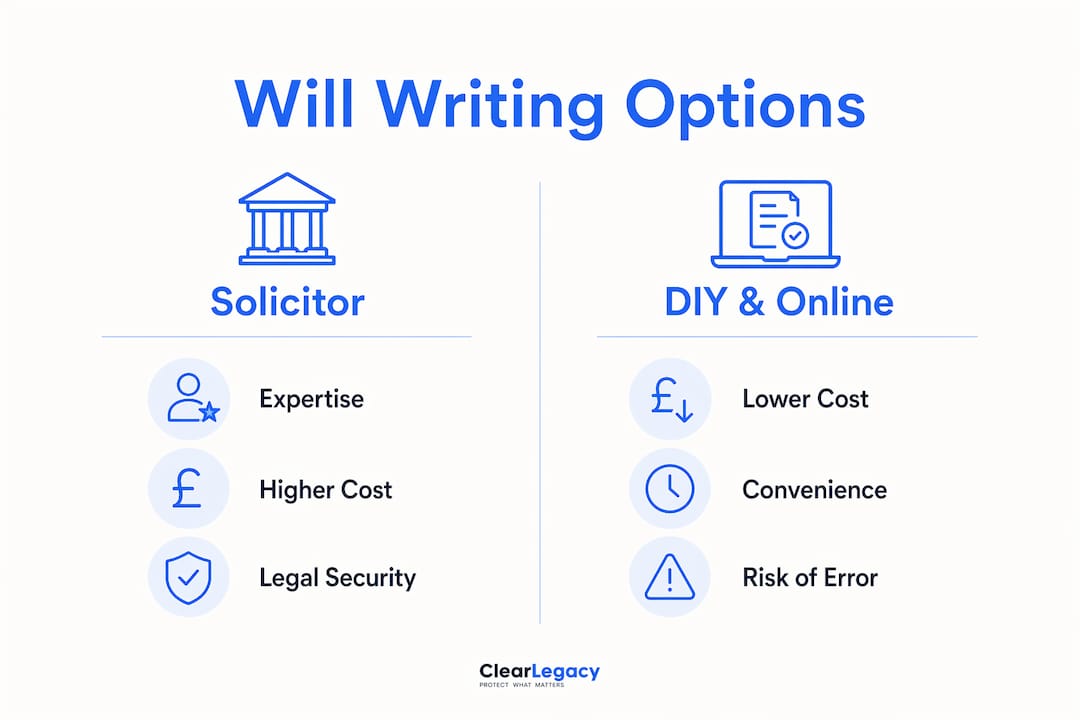
Online will writing services vary in quality and regulation. Some are regulated by the Institute of Professional Will Writers or the Society of Will Writers, but this is not universal. Solicitors are regulated by the Solicitors Regulation Authority, which provides a formal complaints process and professional indemnity insurance. Understanding the differences helps you choose the right option for your circumstances.
| Option | Regulation | Typical cost | Best suited for | Turnaround |
|---|---|---|---|---|
| Solicitor | Solicitors Regulation Authority | £150–£300+ | Complex estates, trusts, tax planning | Days to weeks |
| Online will service | Varies (some Institute of Professional Will Writers accredited) | £69–£150 | Straightforward estates | Hours to 24 hours |
| Professional will writer | Institute of Professional Will Writers or Society of Will Writers | £100–£200 | Moderate complexity | Days |
Key points to weigh up when comparing your options:
- Regulation matters. A solicitor carries professional indemnity insurance and is accountable to the Solicitors Regulation Authority. Not all will writers carry equivalent protection.
- Cost reflects complexity. Online services are cost-effective for simple wills. Solicitors justify their fees when estate complexity demands it.
- Review and revision. Some online services include a review by a qualified estate planner. This bridges the gap between pure DIY and full solicitor involvement.
- Speed. If you need a will quickly, online services typically deliver within 24 hours. Solicitor appointments can take weeks to arrange.
For a detailed comparison of these routes, the Clearlegacy guide on will writing service vs solicitor covers the key differences in plain terms.
How to decide whether you need a solicitor for your will in 2026
Your decision comes down to the complexity of your estate and the level of certainty you need. Work through the following checklist. If you answer yes to any of these, professional legal advice is strongly advisable:
- You own a business or have a share in one.
- You own property abroad or have assets in multiple countries.
- Your estate is likely to exceed the HMRC inheritance tax threshold of £325,000 (or £500,000 with the residence nil-rate band applied).
- You have children from a previous relationship and a current partner.
- You want to set up a trust, for example to protect a vulnerable beneficiary.
- You are estranged from a close family member who might challenge your will under the Inheritance (Provision for Family and Dependants) Act 1975.
- You have recently divorced or separated, as divorce revokes a will in England and Wales.
If none of those apply, a well-constructed online will or a DIY will kit reviewed by a professional is likely sufficient. The hybrid approach of creating a will with an online service and then paying a solicitor for a review is increasingly popular. It gives you the speed and affordability of an online service with the reassurance of professional sign-off.
To verify a solicitor's credentials before engaging them, use the Solicitors Regulation Authority's online register at sra.org.uk. For will writers, check membership of the Institute of Professional Will Writers or the Society of Will Writers.
Storing your will securely is just as important as writing it correctly. Keep the original in a fireproof location, tell your executor where it is, and consider registering it with the National Will Register. Review your will every three to five years, or after any major life event such as marriage, divorce, or the birth of a child.
Pro Tip: Tell your executor where your will is stored before you need to. Families lose weeks searching for documents at the worst possible time.
Solicitors are not legally required as executors, and many people appoint a trusted family member or friend instead. Executors can always hire a solicitor at the probate stage if the estate turns out to be more complex than expected. That flexibility means you do not need to commit to solicitor involvement at the will-writing stage simply to protect your executor later.
Key takeaways
A valid will in the UK does not require a solicitor, but complex estates involving trusts, tax planning, or blended families benefit significantly from professional legal advice.
| Point | Details |
|---|---|
| No legal requirement | You can write a valid will in the UK without a solicitor if you meet the Wills Act 1837 formalities. |
| Solicitors add value for complexity | Business ownership, trusts, overseas assets, and inheritance tax planning all warrant professional legal input. |
| DIY suits simple estates | Leaving assets to one or two people with no trusts or foreign property is well suited to a DIY or online will. |
| Hybrid approach is cost-effective | Using an online service then paying for a solicitor review gives legal reassurance at a lower overall cost. |
| Store and review your will | Keep the original safe, inform your executor of its location, and review it after every major life change. |
My view on DIY wills versus solicitor involvement
The debate around whether to use a solicitor for a will is often framed as a binary choice. In practice, it rarely is. Most people I speak to fall somewhere in the middle: their estates are not complex enough to justify full solicitor fees, but they are not confident enough to go entirely alone.
What I have found is that the hybrid approach resolves this tension well. Writing your will through a quality online service, then paying a solicitor for a one-off review, gives you the best of both worlds. You control the process and the cost, but you have professional eyes on the document before it is signed. That combination is genuinely underused.
The bigger mistake I see is people doing nothing at all. Dying without a will, which is called dying intestate, means the Administration of Estates Act 1925 dictates who inherits your estate. For unmarried partners in particular, the consequences are severe. There is no such thing as common law marriage in England and Wales, and an unmarried partner has no automatic right to inherit anything. A will, however it is made, is always better than no will.
My honest advice: if your estate is straightforward, use a reputable online service with a qualified review process. If your estate is complex, pay a solicitor. Either way, do it this year.
— Sat
Write your will online with Clearlegacy
Clearlegacy offers an online will writing service with a 24-hour turnaround, starting from £69. You complete your will in around 15 minutes through a guided digital process. Every will is then reviewed by a qualified estate planner before delivery, so you get both speed and legal assurance.

Clearlegacy uses fixed pricing with no hidden fees, making it straightforward to budget for your estate planning. The service is well suited to straightforward and moderately complex estates, and over 100 UK families have already used it to protect their legacies. If you want a legally valid will without the cost or delay of a traditional solicitor appointment, Clearlegacy is a practical and trusted option. Visit clearlegacy.co.uk to get started.
FAQ
Is a solicitor legally required to write a will in the UK?
No. There is no legal requirement to use a solicitor to write a will in the UK. Your will is valid provided it meets the formalities in section 9 of the Wills Act 1837.
What makes a DIY will invalid?
Common errors include improper witnessing, unclear language, and overlooked assets. A will must be signed by the testator in the presence of two independent witnesses, who must also sign in the testator's presence.
How much does a solicitor charge to write a will in the UK?
Solicitor fees for a straightforward single will typically range from £150 to £300. Fees increase for mirror wills, trusts, or complex tax planning. Online will writing services start from significantly less, with Clearlegacy pricing from £69.
Can I use an online will writing service instead of a solicitor?
Yes. Online will writing services are a legitimate and cost-effective option for straightforward estates. Choose a service whose wills are reviewed by a qualified estate planner and that complies with the Wills Act 1837.
What is the hybrid approach to will writing?
The hybrid approach means creating your will through an online service and then paying a solicitor for a one-off review. This method balances affordability with legal reassurance and is increasingly popular among UK adults.