TL;DR:
- Digital estate planning involves organizing your online accounts and assets to ensure proper management or transfer after death, reducing family frustration. It requires creating a thorough inventory, setting up platform legacy tools, and including explicit authority in your will, with regular updates. Proper planning safeguards access to digital assets like cryptocurrency, social media, and online businesses, which are not automatically covered by standard wills.
Digital estate planning is the process of organising your online accounts, digital assets, and electronic records so they are managed, transferred, or closed according to your wishes after your death or incapacitation. It covers everything from your Gmail account and iCloud photo library to cryptocurrency wallets and digital businesses. Without a clear plan, your family may face locked accounts, lost assets, and months of frustration. This guide explains the key components of digital estate planning, the UK legal framework that governs it, and the practical steps you can take today to protect your online legacy.
What is digital estate planning and why does it matter?
Digital estate planning is defined as the structured process of inventorying digital accounts and assets, securing access for trusted individuals, designating a digital executor, and leaving explicit instructions in your legal documents. It sits alongside your traditional will and powers of attorney as a core part of any complete estate plan.

The scale of what most people own digitally is easy to underestimate. A typical UK adult holds dozens of online accounts, cloud storage subscriptions, streaming services, and potentially financial assets in digital form. Each of these has its own access rules, terms of service, and inheritance implications. Without specific instructions, even a well-drafted will may leave your executor powerless to access the accounts that matter most.
Understanding digital estate planning also means recognising that it extends beyond passwords. It covers visibility, prioritisation, and trusted legal pathways that prevent families from facing confusion or unnecessary delays at an already difficult time. Getting this right is one of the most practical acts of care you can offer the people you leave behind.
How do you build a digital asset inventory?
The foundation of any digital estate plan is a thorough inventory of everything you own or control online. Common digital assets include online accounts, cloud storage, digital photographs, and other electronic records, but the full picture is usually broader than that.
Your inventory should cover:
- Email accounts (Gmail, Outlook, Apple Mail) including their associated recovery options
- Social media profiles (Facebook, Instagram, LinkedIn, X) and any monetised creator accounts
- Cloud storage (Google Drive, iCloud, Dropbox, OneDrive) and the files held within them
- Financial accounts accessed online, including bank portals, investment platforms, and PayPal
- Cryptocurrency wallets and the exchanges where holdings are registered
- Subscription services (Netflix, Spotify, Adobe Creative Cloud) that may carry automatic billing
- Digital businesses, online shops, or domain names with commercial value
- Intellectual property, including self-published books, music, NFTs, and licensed content
For each entry, record the platform name, the account username or email address, the approximate value or sentimental significance, and clear disposition instructions. State whether you want the account memorialised, closed, or transferred.
A digital asset inventory should be maintained separately from your legal will and updated regularly as accounts and passwords change. Storing it inside your will is a mistake, because wills enter the public domain through probate. Keep the inventory in a secure location and tell your executor where to find it.
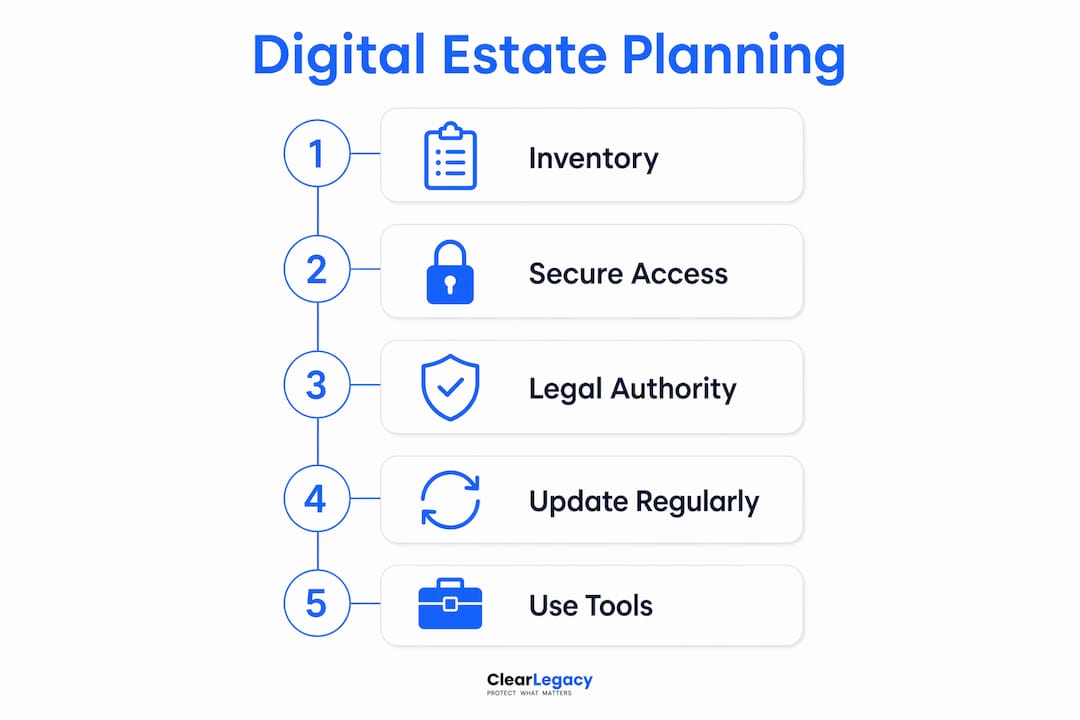
Pro Tip: Review your inventory every January and after any major life event such as opening a new financial account, launching a business, or acquiring cryptocurrency.
How do you manage access securely for your executor?
Granting your executor access to digital accounts without exposing sensitive credentials publicly requires a layered approach. The right combination of platform tools, password managers, and secure offline storage gives your executor a clear path without creating a security risk.
Raw usernames and passwords should never appear in wills because wills become public documents during probate. Anyone who searches the probate register could, in theory, access that information. The solution is to separate the legal authority from the technical access details.
Platform legacy tools
The major technology companies now offer structured legacy access features. Google's Inactive Account Manager and Apple's Legacy Contact take priority over wills for digital asset access and allow designated trusted contacts to retrieve data after death. Google permits up to 10 trusted contacts and allows you to specify which data they can download. Apple issues a digital access key to your named Legacy Contact, who must present it alongside a death certificate to gain access.
Facebook's Legacy Contact can manage your memorialised profile, pin posts, and respond to friend requests, though they cannot read your private messages. These platform tools are worth setting up regardless of what your will says, because they offer a smoother, faster route for your family.
Password managers and secure vaults
| Method | How it works | Best for |
|---|---|---|
| 1Password | Stores credentials in an encrypted vault; emergency access can be granted to a trusted contact | Everyday accounts and subscriptions |
| Bitwarden | Open-source password manager with emergency access feature allowing a nominated person to request entry after a waiting period | Tech-confident executors |
| Secure offline document | Printed or handwritten credentials stored in a fireproof safe or with a solicitor | Critical accounts with no legacy tool |
Your access plan should also address two-factor authentication. If your executor cannot receive the verification code sent to your phone, they may be locked out even with the correct password. Consider registering a trusted device or providing recovery codes alongside your secure credentials document.
Pro Tip: Use a combination of platform legacy tools for major accounts and a password manager with emergency access for everything else. Store recovery codes for critical accounts in a sealed envelope with your solicitor.
What is the UK legal framework for digital estate planning?
UK estate law recognises digital assets as part of your estate, but the legal framework for managing them is less developed than for physical property. The Wills Act 1837 governs the formal requirements for a valid will, and the Administration of Estates Act 1925 sets out how an estate is administered. Neither statute specifically addresses digital assets, which means the instructions you leave in your will and supporting documents carry significant practical weight.
Without explicit digital asset authority in wills, fiduciaries may only receive account catalogues rather than content access, due to privacy laws and provider policies. This is a critical distinction. Your executor may be able to confirm that an account exists but be unable to retrieve the emails, photographs, or financial records held within it.
To give your executor full authority, your will should include:
- A digital assets clause that explicitly grants your executor authority to access, manage, transfer, and close digital accounts
- A reference to where your digital asset inventory is stored, without disclosing the inventory itself in the will
- The appointment of a digital executor, who may be the same person as your traditional executor or a separate individual with the technical knowledge to manage online accounts
The digital executor role can be separate from the traditional executor and requires access to secure information as well as an understanding of platform terms of service. Choosing someone who is both trustworthy and technically capable matters more than most people realise.
Clear and explicit authorisation in estate documents saves executors from delays and legal obstacles when accessing digital assets. Vague language such as "my online accounts" without specifying authority to access content is unlikely to satisfy platform providers or satisfy the requirements of the Administration of Estates Act 1925.
Your executor's duties under UK law already include gathering and protecting assets. A digital assets clause extends that duty explicitly to the online world, removing ambiguity and protecting your executor from potential liability.
How should you handle cryptocurrency and high-value digital assets?
Cryptocurrency, digital businesses, and intellectual property each require additional planning beyond a standard digital assets clause. The risks of getting this wrong are significant: assets can be permanently lost, transferred to the wrong person, or tied up in legal disputes for years.
Cryptocurrency seed phrases and private keys must never be stored in wills due to the public availability of probate documents. Your executor instructions should reference where keys are kept without disclosing the sensitive details themselves.
Practical options for securing cryptocurrency access include:
- Hardware wallets (such as Ledger or Trezor) stored in a fireproof safe, with the location recorded in your secure access plan
- Multisignature wallets, which require multiple keys to authorise a transaction, reducing the risk of a single point of failure
- A sealed letter held by your solicitor that references the location of seed phrases without containing them directly
Cryptocurrency transfer involves separating legal ownership instructions from private key storage, often using hardware wallets and multisig arrangements for security and continuity. Your will should state your intention to leave the cryptocurrency to a named beneficiary, while your secure access plan provides the technical route to retrieve it.
Digital businesses present a different challenge. A sole trader's online shop or content platform may have significant commercial value, but it cannot simply be transferred like a bank account. You may need a trust structure or a specific business succession clause to ensure continuity. Intellectual property rights in NFTs, self-published content, and licensed music require separate consideration, as ownership and licensing terms vary widely between platforms.
Pro Tip: If you hold cryptocurrency worth more than a few hundred pounds, consult a solicitor with digital asset experience before finalising your estate plan. The cost of specialist advice is small compared to the risk of permanent asset loss.
How do you keep your digital estate plan up to date?
A digital estate plan is not a document you create once and file away. Technology changes, accounts accumulate, and personal circumstances shift. Neglecting updates risks locked accounts, lost assets, and family conflict at the worst possible time.
Follow these steps to keep your plan current:
- Review annually. Set a fixed date each year to check your digital asset inventory, update passwords in your secure vault, and confirm that platform legacy settings are still active.
- Update after major life events. Marriage, divorce, the birth of a child, or a significant financial change should each trigger a review of both your will and your digital estate plan.
- Check platform legacy tools. Google, Apple, and Facebook update their legacy features periodically. Confirm that your nominated contacts are still correct and that the access permissions reflect your current wishes.
- Coordinate with your estate documents. Any change to your will or powers of attorney should be accompanied by a review of your digital assets clause and executor instructions.
- Seek specialist advice for complex estates. If you acquire a digital business, significant cryptocurrency holdings, or intellectual property with commercial value, work with a solicitor who understands digital asset law.
Digital asset planning requires regular reviews, particularly after major life changes or account updates. The families who avoid the most difficulty are those whose plans reflect their current digital lives, not the accounts they held five years ago.
Key takeaways
A complete digital estate plan combines a detailed asset inventory, explicit legal authority in your will, platform legacy tools, and secure access arrangements to give your executor everything they need.
| Point | Details |
|---|---|
| Define your digital assets | List every account, wallet, and platform with its value and disposition instructions. |
| Separate inventory from will | Store your digital asset inventory securely away from your will to protect privacy during probate. |
| Use platform legacy tools | Set up Google Inactive Account Manager and Apple Legacy Contact as a priority, not an afterthought. |
| Grant explicit legal authority | Include a digital assets clause in your will that covers access, management, transfer, and closure. |
| Review regularly | Update your plan annually and after every major life event to prevent locked accounts and lost assets. |
Why digital estate planning deserves more attention than it gets
Most people I speak with have thought carefully about who inherits their house and their savings. Very few have thought about what happens to the 47 online accounts they use every week. That gap is where families run into real trouble.
The misconception I encounter most often is that a will covers everything. It does not. A will grants your executor legal authority, but platform providers are not obliged to honour that authority for content access unless you have set up the right tools and used the right legal language. I have seen families wait months to access a loved one's email account, not because the law was against them, but because no one had set up Google's Inactive Account Manager or included a digital assets clause in the will.
The other thing worth saying plainly is that digital estate planning is not just for people with cryptocurrency or tech businesses. If you have a Gmail account, an iCloud photo library, or a PayPal balance, you have a digital estate. The estate planning decisions you make today about those accounts will determine whether your family can access them or not.
The good news is that getting this right is genuinely straightforward once you know the framework. A clear inventory, the right platform settings, and a will that explicitly addresses digital assets will put you well ahead of most people. Start with the inventory. Everything else follows from that.
— Sat
Protect your digital legacy with Clearlegacy
Clearlegacy makes it straightforward for UK families to write a legally valid will that explicitly covers digital assets, without the cost or delay of a traditional solicitor appointment. Starting from £69, you can complete your will in around 15 minutes from home, and receive it by email within 24 hours. Every document is reviewed by qualified estate planners and complies with the Wills Act 1837. Whether you need to appoint a digital executor, include a digital assets clause, or simply get a will in place for the first time, Clearlegacy gives you a clear, affordable route to protecting everything you own, online and offline. Visit the Clearlegacy will writing service to get started today.
FAQ
What does digital estate planning cover?
Digital estate planning covers the organisation, access, and legal transfer of all your online accounts and digital assets, including email, social media, cloud storage, cryptocurrency, and digital businesses. It involves creating an inventory, appointing a digital executor, and including explicit instructions in your will.
Should I put passwords in my will?
No. Passwords should never appear in a will because wills become public documents through probate. Use a password manager such as 1Password or Bitwarden, or store credentials in a secure offline document held separately from your will.
What is a digital executor?
A digital executor is a person appointed to manage your online accounts and digital assets after your death. They may be the same person as your traditional executor or a separate individual with the technical knowledge to handle platform access and digital transfers.
Do UK wills automatically cover digital assets?
Not automatically. Under the Administration of Estates Act 1925, your executor has authority over your estate, but platform providers may restrict content access without an explicit digital assets clause in your will. You need specific legal language granting authority to access, manage, and close digital accounts.
How often should I update my digital estate plan?
Review your digital estate plan at least annually and after any major life event such as marriage, divorce, or acquiring new financial accounts. Platform legacy settings and your secure access plan should be checked at the same time as your will.