
Estate planning should protect your family's future, not quietly drain it. Yet for many UK families, the real cost of a poorly structured plan only becomes clear after death, when unexpected legal fees start eating into the inheritance. Knowing how to avoid hidden legal fees in estate planning is one of the most financially consequential things you can do right now. This guide walks you through exactly where these charges lurk, how to spot transparent fee structures, and the practical steps that keep legal costs in estate planning firmly under your control.
Table of Contents
- Key takeaways
- How to avoid hidden legal fees in estate planning
- Identifying a transparent fee structure
- Steps to prepare an estate plan that minimises legal fees
- Mistakes that cause unexpected legal fees
- Verifying your estate plan over time
- Why transparency in estate planning fees matters
- Plan your estate with complete fee clarity
- FAQ
Key takeaways
| Point | Details |
|---|---|
| Hidden fees are common | Probate disputes, subscription traps, and poorly drafted wills all create costs families rarely anticipate. |
| Fixed fees beat hourly billing | Choosing a fixed-fee service removes the risk of open-ended charges accumulating over time. |
| Ask before you sign | Requesting a full written fee breakdown upfront is the single most effective way to avoid surprise legal charges. |
| Update your will regularly | Outdated wills trigger disputes and corrections that generate significant additional legal costs. |
| Transparent services exist | Fixed-fee online platforms with qualified review offer legally sound documents without hidden add-ons. |
How to avoid hidden legal fees in estate planning
The phrase "hidden fees" covers a wide range of charges that never appear in the original quote. Some are buried in contract small print. Others only materialise when something goes wrong. Understanding each type is the first step toward avoiding them.
Probate disputes and caveat filings
When a will is contested, the costs multiply fast. Caveat applications rose 12% in the twelve months to July 2025, reaching 11,589 total filings. A caveat costs just £3 to lodge, but the litigation it triggers can cost thousands. Ambiguous wording, missing beneficiary details, or a failure to document the testator's wishes clearly are the usual culprits.

DIY and AI-generated wills
Free online templates and AI-generated documents are tempting precisely because they appear to cost nothing. The reality is different. Errors in AI-generated wills frequently lead to probate delays and thousands of pounds in legal fees to correct. A document that looks complete on screen may omit critical provisions that only a qualified reviewer would catch.
Subscription traps in online will services
Not all online providers charge a single flat fee. Some lock you into annual subscriptions that quietly renew. A £49 will can become a £500 expense over five years once recurring charges accumulate. Always check whether the fee you pay today is genuinely a one-off payment or the start of a billing relationship.
Trust-related fees that compound over time
Trusts can be valuable, but they carry ongoing administration costs. If a trust is drafted without proper legal scrutiny, it may not hold up, generating litigation fees that far exceed what a properly structured arrangement would have cost at the outset. Probate fees and legal costs can consume 3% to 8% of an estate's total value. On a £500,000 estate, that is up to £40,000 gone before a single beneficiary receives a penny.
Identifying a transparent fee structure
Knowing what to look for before you commit to any estate planning service is how you minimise estate planning costs before they become a problem. The right questions, asked early, reveal everything.
Questions to ask any estate planning provider:
- What is included in the quoted fee, and what is not?
- Are amendments charged separately, and if so, at what rate?
- Is document storage included, or billed as an add-on?
- Will the provider take on an executor role, and what are the associated fees?
- Is the fee fixed, or does it convert to hourly billing if the matter becomes complex?
The difference between fixed-fee and hourly billing matters enormously. Fixed fees give you certainty. Hourly billing means a single phone call to clarify a clause can appear on your invoice. When comparing services, look at the online will vs solicitor cost breakdown carefully, because the headline price rarely tells the full story.
Pro Tip: Ask for the full fee schedule in writing before signing anything. A reputable provider will send it without hesitation. Reluctance to disclose fees in writing is itself a warning sign.
The Competition and Markets Authority has raised concerns over hidden fees in unregulated will writing, which means the burden of scrutiny falls on you. Read every clause about amendments, storage, and executor appointments before agreeing to proceed.
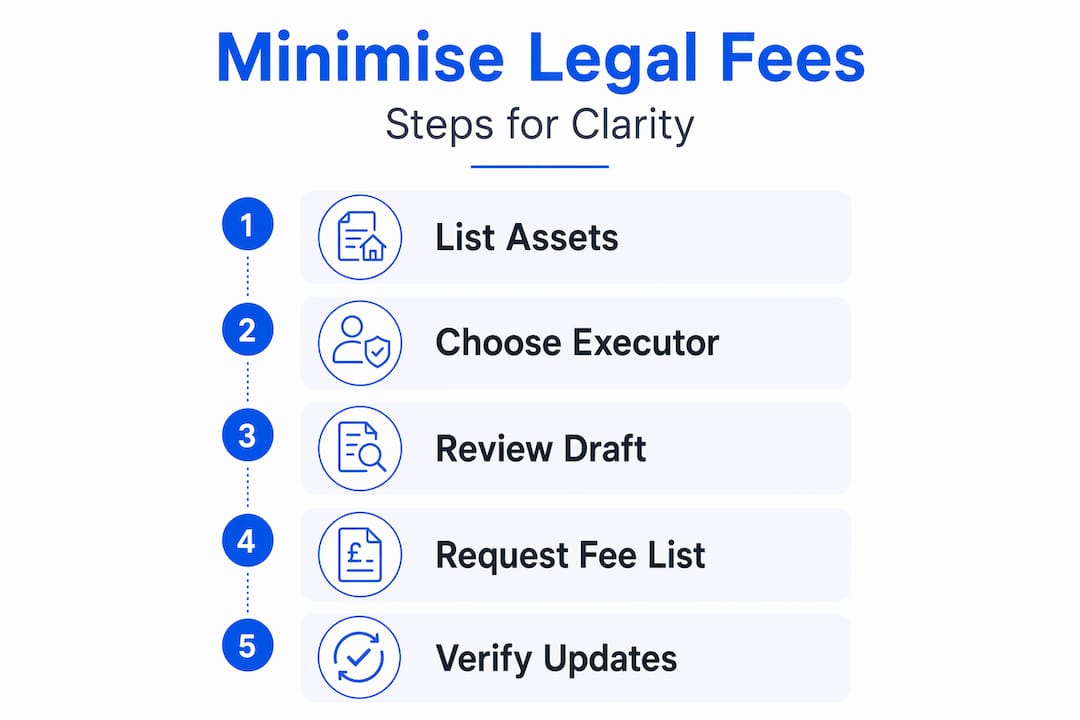
Steps to prepare an estate plan that minimises legal fees
A well-prepared estate plan does not just protect your assets. It actively reduces the chance of expensive disputes and corrections down the line. Follow these steps to build a plan that holds up.
-
Compile a complete asset inventory. List every asset, account, and policy you own, along with current beneficiary designations. Discrepancies between your will and non-probate assets (such as pension nominations) are a leading cause of costly disputes.
-
Decide between a simple will and a trust. Most straightforward estates need a well-drafted will, not a trust. Trusts add complexity and ongoing administration costs. Use a trust only when your estate genuinely requires one, and always get qualified legal review.
-
Choose a service with transparent pricing. Flat-fee platforms that provide legally sound documents without subscription charges are consistently the most cost-effective option for families. Check that the service includes review by a qualified estate planner, not just automated document generation.
-
Document your decision-making capacity. Attorney interviews and contemporaneous notes strengthen a will against challenges based on testamentary capacity or undue influence. DIY methods cannot replicate this protection.
-
Tell your heirs what you have planned. Open family conversations are consistently cited by legal professionals as the most effective strategy for preventing contested estates. Surprises after death breed disputes. Clarity now prevents them.
| Step | Action | Cost risk if skipped |
|---|---|---|
| Asset inventory | List all assets and beneficiary designations | Disputes between will and non-probate assets |
| Will vs trust decision | Match structure to estate complexity | Unnecessary trust administration fees |
| Transparent provider | Verify fixed fees and qualified review | Subscription charges and correction costs |
| Capacity documentation | Record testamentary capacity formally | Undue influence challenges and litigation |
| Heir communication | Discuss intentions openly with family | Caveat filings and contested probate |
Mistakes that cause unexpected legal fees
Most hidden fees in wills are not the result of bad luck. They follow predictable patterns. Recognising these mistakes before you make them is how you stay ahead of the costs.
-
Using a free or generic template without professional review. Incorrect wills can be among the most expensive things a person leaves behind. A document that looks valid may fail at probate, triggering correction costs that dwarf what a proper will would have cost.
-
Failing to update after major life changes. Marriage, divorce, the birth of children, and significant asset acquisitions all affect how your estate should be distributed. An outdated will creates ambiguity that lawyers bill to resolve.
-
Ignoring non-probate assets. Pensions, joint accounts, and life insurance policies pass outside your will. If the beneficiary designations on these assets conflict with your will, the resulting disputes generate real legal costs.
-
Delayed communication with executors. When executors are not briefed on the location of documents or the intentions behind the will, they make decisions that can be challenged. That challenge costs money.
-
Signing up with providers who charge for amendments. Life changes, and your will needs to change with it. If every update triggers a billable event, you will either pay repeatedly or let the document become outdated. Look for platforms that allow low-cost or free amendments as a matter of policy.
Pro Tip: Before choosing any online will service, search the provider's name alongside "subscription fees" and "amendment charges". What existing customers say publicly is often more revealing than the pricing page.
Verifying your estate plan over time
Creating a will is not a one-off task. The legal and tax environment changes, your personal circumstances evolve, and a plan that was sound three years ago may have gaps today. Regular verification is how you prevent future hidden fees from accumulating.
| Review trigger | What to check | Why it matters |
|---|---|---|
| Marriage or divorce | Beneficiary designations and executor appointments | Marriage revokes a previous will under English law |
| Birth of a child or grandchild | Guardianship provisions and inheritance shares | Omitted beneficiaries can contest the estate |
| Significant asset change | Asset inventory and trust provisions | Outdated valuations create tax and distribution issues |
| Change in tax law | Inheritance tax thresholds and exemptions | Missed planning opportunities increase the tax burden |
| Death of an executor or beneficiary | Replacement appointments | Gaps in executor succession cause probate delays |
Beyond scheduled reviews, confirm with your provider how your documents are stored and how your executor will access them. A will that cannot be located at the point of death is as problematic as one that was never written. Fixed-fee services with clear update policies make ongoing compliance straightforward and affordable. You can use a probate cost calculator to estimate what your estate might face if documentation is not kept current.
Why transparency in estate planning fees matters
I have seen the same scenario play out more times than I care to count. A family discovers, weeks after a loved one's death, that the estate they expected to inherit is being consumed by legal fees nobody anticipated. The will was drafted years ago by a provider who charged a low headline fee. What nobody read carefully was the clause appointing that same provider as executor, at a percentage of the estate's value.
In my experience, the families who avoid this outcome are not the ones who spent the most on legal advice. They are the ones who asked the right questions early and chose services that had nothing to hide. Transparent upfront planning is not just financially smarter. It removes an enormous source of stress from what is already one of the most difficult periods any family goes through.
The uncomfortable truth about estate planning is that estate planning is far more than document creation. The cost of getting it wrong is almost never apparent at the point of signing. It surfaces later, when the people you wanted to protect are the ones paying for the mistake. What I have learned is that the best protection is not complexity. It is clarity: clear fees, clear documents, and clear communication with the people who matter most.
— Sat
Plan your estate with complete fee clarity
If you have read this far, you already understand that the real risk in estate planning is not the fee you can see. It is the one you cannot. Clearlegacy was built specifically to remove that uncertainty.

With fixed-fee will writing starting from just £69, Clearlegacy gives you a legally valid will, reviewed by qualified estate planners, delivered within 24 hours. There are no subscriptions, no amendment traps, and no executor fee clauses buried in the small print. Every price is stated clearly before you begin. The process takes around 15 minutes online, and your documents are stored securely with straightforward executor access. For couples, mirror wills from £99 offer the same transparency and legal rigour at a price that reflects what the work actually costs. Over 100 UK families have already chosen Clearlegacy to protect what they have built.
FAQ
What are the most common hidden fees in estate planning?
The most common hidden fees include probate litigation costs from disputed wills, recurring subscription charges from online providers, amendment fees for updating documents, and executor fees where the will-writing provider has appointed itself as executor at a percentage of the estate's value.
How do I know if an estate planning service has transparent fees?
Ask for a full written fee schedule before committing, and check specifically whether amendments, storage, and executor services carry additional charges. A reputable provider will disclose all costs upfront without hesitation.
Can a free will really cost my family more in the long run?
Yes. Free or very low-cost wills often omit critical provisions or lack professional review, which can lead to costly probate disputes. Incorrect wills are among the most expensive documents a person can leave behind.
How often should I update my will to avoid unexpected legal costs?
Review your will after any major life event, including marriage, divorce, the birth of a child, or a significant change in assets. An outdated will creates ambiguity that generates legal costs at exactly the wrong moment.
What questions should I ask an estate attorney about fees?
Ask what the quoted fee includes, whether amendments are charged separately, how documents are stored, whether the provider takes an executor role and at what cost, and whether billing is fixed or hourly. Getting the answers in writing protects you from surprise legal charges later.